Supplemental Resources: The Three
Theory of Mind Tools for Neurodiverse Therapy and Coaching
When the Work Calls for Something More: ToM-RS, ToM-DT, ToM-DT VIA
The R.E.A.L. Neurodiverse™ Framework is designed to carry your clients through a full developmental arc, and for most, the core programs provide exactly what's needed. But sometimes a moment in the work asks for more precision. A couple sitting with a misattunement they can't quite name. An autistic adult who would benefit from anchoring Theory of Mind development in their own real-life experiences rather than in hypothetical scenarios. A relationship where even the most careful reflection is limited by what memory can hold.
The supplemental theory of mind resources within the R.E.A.L. Framework were built for those moments. They are optional, structured, and always grounded in the same neurologically respectful values as the core programs. They don't redirect the work; they deepen it, at exactly the point where depth is called for.
These tools are available selectively, based on your credential level, and are never required for program completion. They grow with your practice, offered not as an add-on, but as a natural extension of the care you're already providing.
They are not required. They are not replacements. They are structured extensions.
Used thoughtfully, they deepen insight and expand what becomes possible inside the work.
Step in. The structure and the support are already here.
Three Theory of Mind Tools For Going Deeper
➡️
Theory of Mind Reflection Session (ToM-RS)
Included with Entry-Level NFS-E Credential Access
The Theory of Mind Reflection Session (ToM-RS) is a semi-structured, provider-guided interview designed to strengthen emotional recognition and relational insight.
➡️
Theory of Mind
Dyadic Tool
(ToM-DT)
Available with Advanced
NFS-S or NFS-P Credentials
The Theory of Mind Dyadic Tool (ToM-DT) expands reflection into structured relational dialogue.
➡️
Theory of Mind Dyadic Tool Video Interaction Analysis (ToM-DT VIA)
Available with Advanced
NFS-S or NFS-P Credentials
The ToM-DT VIA integrates consensually recorded video of real relational interactions into the reflection process.
More precision. More clarity. More of what your clients need.
Want a Structured Introduction to the Practice Tools?
The Theory of Mind tools are one part of a broader set of practice tools in the R.E.A.L. framework. If you'd like to understand how they connect to the five empathy spectrum assessments and the Individual Empathy Spectrum Plot™, you can receive a short series of three emails that walks through each tool in turn.
You'll receive three emails about:
The five empathy spectrum assessments and the model of empathy that makes them possible
The Individual Empathy Spectrum Plot™ and how it turns assessment results into something clients can see and work with directly in session
The Theory of Mind tools: when to use them, how they work, and how they grow with your credential
Each email focuses on one layer of the practice tools suite, with enough detail to understand how the tools fit together and how to begin using them with clients.
➡️ Theory of Mind Reflection Session (ToM-RS): Real-Life Reflection for Autistic Adults
Included with NFS-E Credential Access
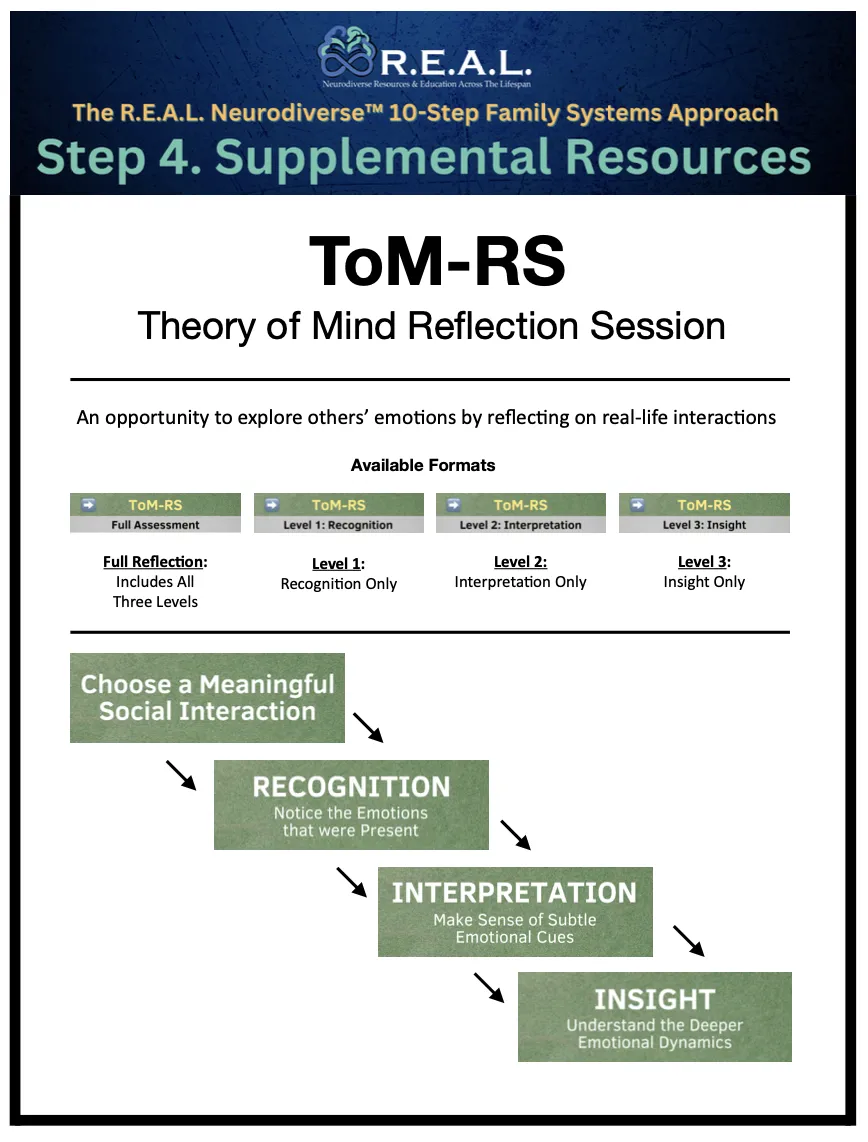
The Theory of Mind Reflection Session (ToM-RS) is a semi-structured provider-guided interview that guides clients through emotional reflection using their own real-world relational experiences as the foundation. Rather than presenting fictional vignettes or hypothetical scenarios, it asks clients to draw from moments that already carry weight and meaning for them, making the reflection more grounded, more honest, and more useful than the standard quantitative Theory of Mind assessments included in the R.E.A.L.™ programming.
Moving through basic recognition, nuanced interpretation, and complex insight, the ToM-RS offers a way into Theory of Mind development that respects how clients actually process emotional experience. For providers supporting autistic adults, it bridges the gap between theoretical understanding and lived relational reality. Something often shifts in these sessions, not because the tool pushes for change, but because the structure creates space for clients to see themselves more clearly.
The ToM-RS structure allows clients to explore emotional moments safely and systematically, particularly valuable for neurodivergent individuals who benefit from concrete, personalized reflection.
The ToM-RS is included and ready to integrate when your clients need it.
➡️ Theory of Mind Dyadic Tool (ToM-DT): Structured Shared Reflection for Neurodiverse Couples and Families
Available with Advanced NFS-S or NFS-P Credentials
When a neurodiverse couple is navigating a relationship shaped by neurological difference, even their most sincere attempts to understand each other can fail. The ToM-DT was designed for exactly that challenge.
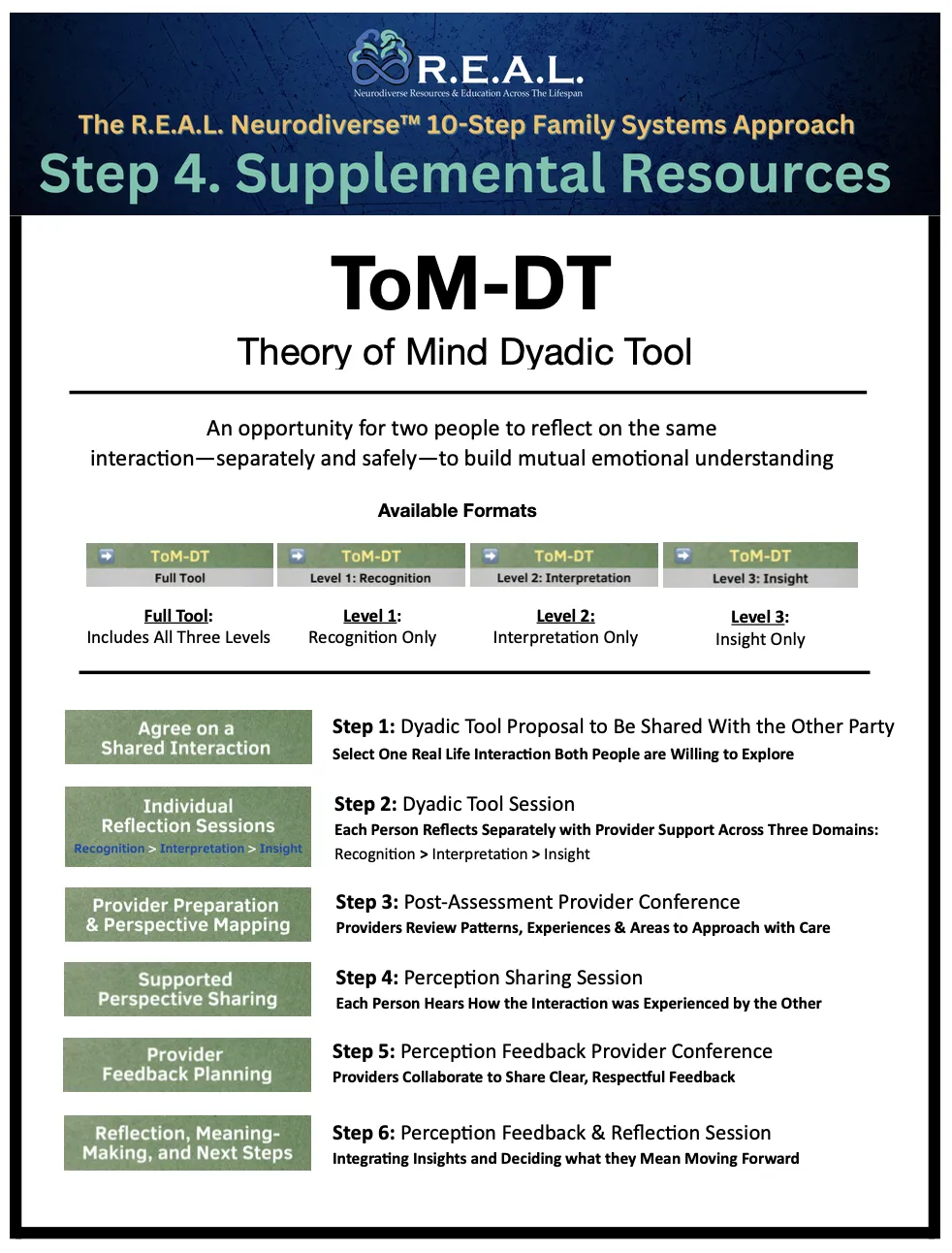
This six-step, provider-guided tool brings both parties through the same relational moment, separately, with their respective providers, before perspectives are shared. That sequence matters. It allows each person to arrive at their own reflection without the emotional noise of real-time response, making the eventual exchange safer and more accurate for both.
Walking through Recognition, Interpretation, and Insight, the ToM-DT supports clearer understanding of misattunements and their emotional impact. The goal isn't agreement, it's mutual comprehension. When two people can finally see what the other was experiencing in a shared moment, something often becomes possible that wasn't before. Client-led, provider-facilitated, the ToM-DT holds that process with structure and care.
Available to providers holding advanced NFS-S (Specialist) or NFS-P (Practitioner) credentials.
➡️ Theory of Mind Dyadic Tool
Video Interaction Analysis (ToM-DT VIA): Video-Based Relational Insight
Included with NFS-S or NFS-P Credentials
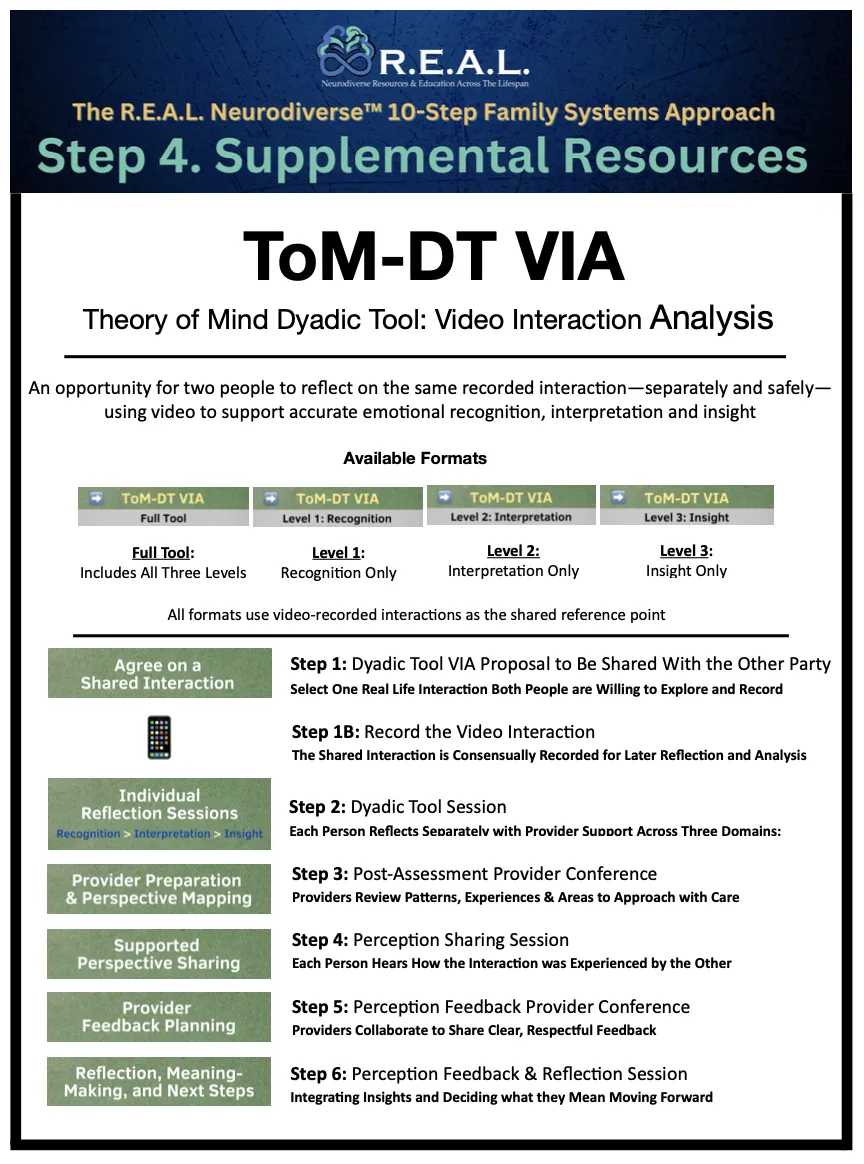
Memory shapes everything we think we experienced. In neurodiverse relationships, where emotional processing differences can make real-time interaction difficult to read and even harder to recall accurately, that limitation can quietly undermine the most careful relational work.
The ToM-DT VIA extends the dyadic tool by adding a consensually recorded visual record of an actual relational interaction. Both partners still reflect separately, still move through the same three levels of emotional understanding, but now with a shared reference point that neither partner has to reconstruct from memory alone. Providers collaborate to compare and clarify emotional perceptions before clients exchange perspectives, building a more accurate and more compassionate picture of what actually happened between them.
This is neurologically respectful design at its most precise, giving clients access to the details they may have genuinely missed, without judgment, and with the full support of the framework they've been building throughout their work together. Insight reduces blame. Mapping reduces confusion. Structured awareness supports relational repair.
The ToM-DT VIA is especially powerful for neurodiverse relationships where subtle nonverbal cues and emotional timing are easy to misread in real time.
Available to providers holding advanced NFS-S (Specialist) or NFS-P (Practitioner) credentials.
The Three-Stage Insight Pathway
Supplemental resources aren't introduced in isolation. They're woven into the R.E.A.L. process at the points where they can do the most good.
📹
1. Neurodiversity-Affirming Education
The foundational psychoeducational work comes first. Supplemental tools are only introduced after shared language is established because that shared language is what makes structured reflection meaningful.
🌀
2. Individual Integration
The ToM-RS lives here. It extends the individual work of this phase by creating a structured space for clients to explore their own emotional recognition and relational insight through real, lived experience.
🌿
3. Relational Discussion
For providers with advanced credentials, the ToM-DT and ToM-DT VIA become available in this phase, bringing two people into carefully structured shared reflection when the individual groundwork has been laid and both are ready.
Optional. Structured. Thoughtfully-Sequenced. Integrated.
➡️ Tools That Grow With You
When a client's process calls for something more focused, the supplemental tools give you a structured path forward, one that supports relational accuracy and neurologically respectful insight-building while keeping your approach clearly within your scope of practice.
They are optional, but powerful.
And they grow with your credential.

Ready To Bring These Tools Into Your Practice?
When the right tool meets the right moment, something shifts for your client, and for the work itself. The ToM-RS is already included and waiting. The advanced tools are there when your practice is ready for them.
Optional. Structured. Right-sized for the moment.
Step in. The structure and the support are already here.


