The R.E.A.L. Neurodiverse™ Assessment Suite: Five Empathy Spectrum Tools For Neurodiverse Therapy and Coaching
Where Empathy Becomes Something You Can Actually See
In neurodiverse couples and families, confusion often arises when empathy is discussed as if it were a single trait, something a person either “has” or “doesn’t have.”
The R.E.A.L. Neurodiverse™ framework approaches empathy differently. Rather than treating empathy as a single ability, the model identifies five distinct empathy-related spectrums that influence how individuals experience, process, and respond to others.
Step in. The structure — and the support — are already here.
Understanding Empathy Differently
The Five Empathy Spectrums: Structured Self-Insight Tools to Support Individual Client Integration
The R.E.A.L. Neurodiverse™ model identifies five distinct empathy-related spectrums that influence how individuals experience, process, and respond to others. Both autistic and non-autistic individuals fall somewhere on each of these spectrums. Falling on an empathy spectrum does not mean being “a little autistic.” It means that human capacities vary across multiple dimensions, and those variations shape communication, regulation, and relational dynamics.
⚖️
Emotion-Origin Awareness (EOA)
Distinguishing Your Emotions From Others'
Assesses how easily someone can distinguish between emotions that began in another person and emotions that began within themselves, a key factor in reducing confusion and improving communication in neurodiverse relationships.
⚖️
Empathic-Emotion Intensity (EEI)
Empathic Sensitivity
Measures the intensity with which a person feels the emotions of others in their environment, helping explain differences in sensitivity, overwhelm, and emotional responsiveness within relationships.
⚖️
Embodied
Simulation (ES)
Nonverbal Attunement and Internal Mirroring
Assesses how strongly a person internally mirrors and anticipates the actions of others, a key factor in nonverbal attunement, timing, and the sense of immediate social connection within neurodiverse relationships.
⚖️
Interoception
Reading Emotional Signals From Within the Body
Measures how accurately someone detects and interprets emotional signals from within their body, helping explain differences in emotional clarity, self-regulation, and vulnerability to overwhelm in neurodiverse relationships.
⚖️
Theory of Mind (ToM)
Cognitive Perspective-Taking
Measures a person’s ability to cognitively understand others’ thoughts, perspectives, and intentions, helping explain differences in misunderstanding, conflict, and perspective-taking within neurodiverse relationships.
When clients can see where they fall across these five spectrums, something shifts. Confusion gives way to clarity, and self-understanding becomes the foundation for real relational change.
Interested A Structured Look At The R.E.A.L.™ Practice Tools?
The five empathy spectrum assessments are one part of a broader set of practice tools in the R.E.A.L. framework. If you'd like to understand how they work alongside the visual mapping tool and the supplemental Theory of Mind resources, you can receive a short series of three emails that walks through each tool in turn.
You'll receive three emails about:
The five empathy spectrum assessments and the model of empathy that makes them possible
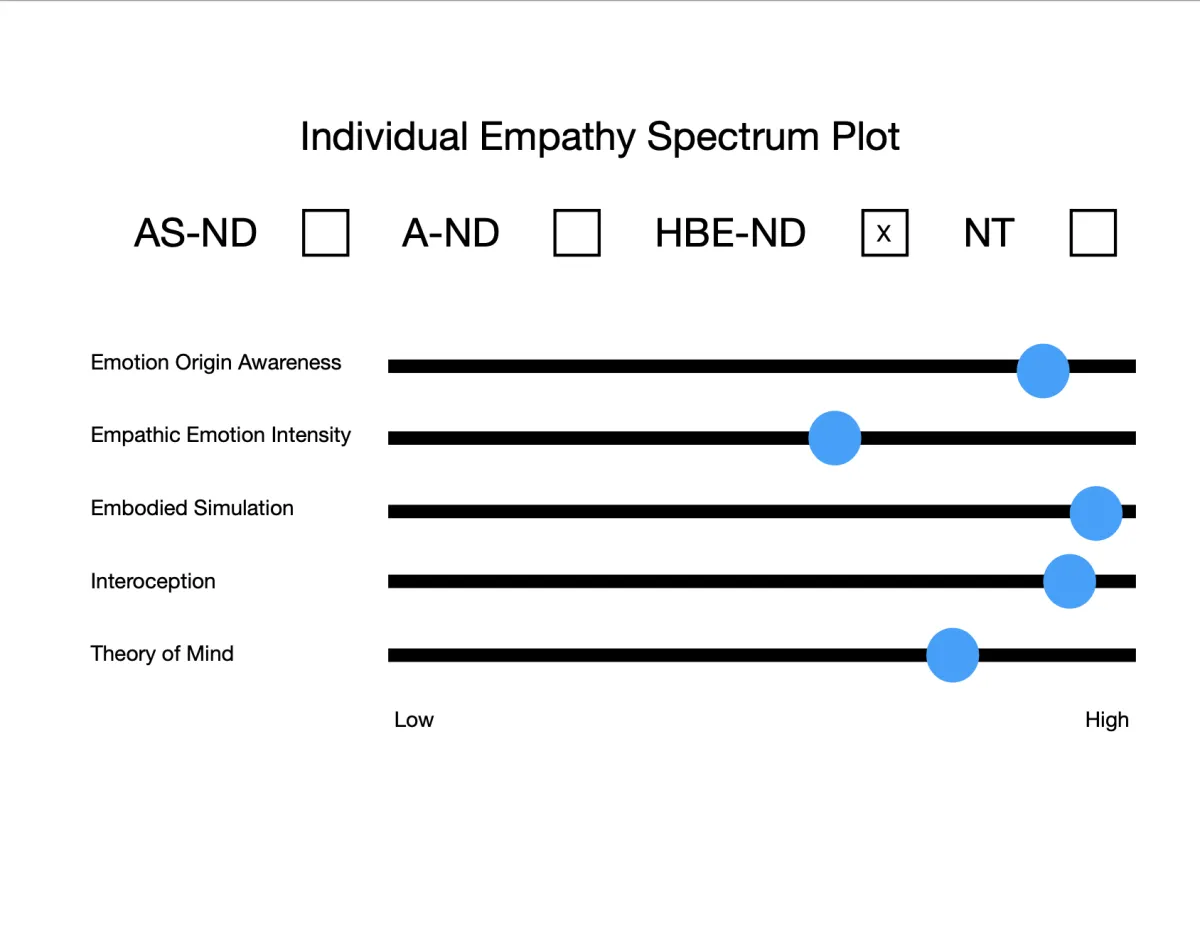
The Individual Empathy Spectrum Plot™ and how it turns assessment results into something clients can see and work with directly in session
The Theory of Mind tools: when to use them, how they work, and how they grow with your credential
Each email focuses on one layer of the practice tools suite, with enough detail to understand how the tools fit together and how to begin using them with clients.
Designed for Self and Relational Insight, Not Diagnosis
The Five Empathy Spectrum Assessments are structured, quantitative self-insight tools used during Stage 2: Individual Integration of the R.E.A.L. Neurodiverse™ 10-Step Framework.
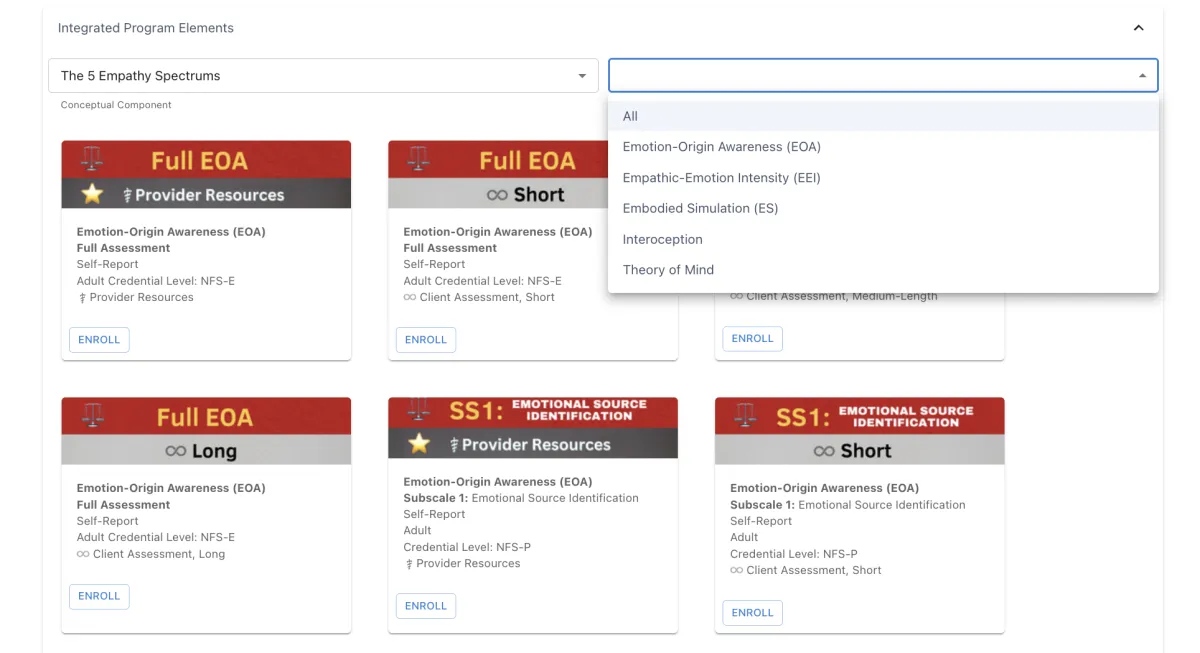
These assessments are:
Designed to support guided reflection
Clinically grounded in developmental and neuropsychological theory
Used within a structured integration process
Tools for self-insight and guided reflection, not diagnostic instruments
Clinically informed, theoretically grounded, and still evolving as research measures
Their purpose is clarity: structured insight that supports understanding without labeling.
Five Spectrums. One Clearer Picture.
The Five Empathy Spectrum Assessments are structured self-insight tools used during Stage 2 — Individual Integration. They help clients understand how empathy moves through their own nervous system and shapes their relationships.
📹
1. Neurodiversity-Affirming Education
Clients begin with structured psychoeducational modules that establish shared language and neurodiversity-affirming context, offering autistic and non-autistic tracks and family and life partnership focuses.
🌀
2. Individual Integration
Clients engage in structured individual sessions using multimodal integration tools, including guided discussions or modules, reflective exercises, somatic practices, and more. Each is designed to honor individual neurological processing styles.
🌿
3. Relational Discussion
At the completion of each step or substep, individual track work culminates in optional structured shared discussions—bringing autistic and non-autistic participants together for insight-based, neurologically respectful exploration.
Mapping the empathy spectrums increases self-understanding, reduces blame, and opens the door to more grounded relational discussion and personal decision-making.
From Confusion to Clarity: What Clients Gain from Empathy Spectrum Mapping
When clients can finally see where they fall across these five spectrums, something shifts. They gain a shared language for understanding:
Why misunderstandings occur
Why emotional intensity differs
Why one partner or family member feels overwhelmed while another feels confused
Why communication patterns repeat
Insight reduces blame. Mapping reduces confusion. Structured awareness supports relational repair.
There's More Waiting for You Down the Road

Advanced tools are available to providers who pursue higher credential levels within the R.E.A.L. Neurodiverse™ Family Systems pathway:
Expanded Step 4 Empathy Assessments (IESP™ and advanced subscales)
Step 6 Neurodiverse Relationship Dynamics™ Scales
Step 7 Trauma and Empathic Trauma Assessment Suite
Composite trauma scoring and advanced clinical mapping tools
Advanced credentials unlock expanded quantitative tools for deeper relational, trauma, and systems-level insight.
Bring Structured Insight Into Your Practice
If you’re ready to use quantitative empathy mapping to reduce confusion and deepen relational understanding, enroll as a Solo Practitioner or explore multi-provider options.
Give clients language for what they’ve struggled to explain.
Start transforming relational work with confidence.


