Seven Integration Modalities:
One Coherent System, Built for Every Neurological Processing Style
The R.E.A.L. Neurodiverse™ framework gives you structured, trauma-informed tools that support meaningful client integration, not just reflection.
The R.E.A.L. Neurodiverse™ framework includes a structured ecosystem of seven integration modalities that help clients move beyond understanding toward lasting change. Each modality engages a different dimension of human processing: discussion, imagery, symbolic expression, creative response, body awareness, retrospective reflection or pattern sequencing, and future vision.
All clients have access to every modality. What differs is how each tool is guided, adapted to honor neurological processing style, sensory profile, pacing needs, and relational readiness. The framework is unified, not fragmented, with one coherent system that respects real neurodiverse experience.
Step in. The structure and the support are already here.
What You Get: Seven Structured Tools for Neurodiverse Therapy and Coaching Integration
Seven Ways to Meet Your Clients Where They Are
The R.E.A.L. Neurodiverse™ framework includes a structured ecosystem of seven integration modalities that help autistic and non-autistic clients move beyond understanding toward lasting change.
Some tools invite narrative, some invite structure, some invite body-based awareness, and some invite optional self-expression. None require emotional performance, and none assume a single style of integration. Through the client portal, clients have the opportunity to explore and select the modalities that speak to them, bringing their own sense of what feels right into the room.
🌱
Integration Discussions or Modules
Guided integration tools that help clients translate core concepts into personal clarity and real-life change.
Non-autistic clients use structured, open-ended discussions that support meaning-making, emotional integration, and role awareness over time.
Autistic clients use step-based modules designed for clarity, predictability, and paced cognitive integration, with space for emotion to emerge later, if and when it does.
💠
Integration
Poems
Structured poetic reflections that support step-based integration without pressure to analyze or perform.
For non-autistic clients, poems use metaphor and emotional resonance to support validation, identity clarity, and meaning-making.
For autistic clients, poems prioritize direct, neurologically attuned language that supports clarity, pacing, and pattern recognition.
🌄
Integration Artwork
Structured visual reflections that support step-based integration through symbolic imagery rather than verbal processing.
For non-autistic clients, artwork offers metaphorical mirrors that support emotional recognition, boundary clarity, and validation without requiring explanation.
For autistic clients, artwork functions as a structured visual anchor, supporting pattern recognition, cognitive containment, and paced internal reflection.
✍️
Integration Invitations
Flexible reflection prompts that support step-based integration through optional, self-directed expression.
For non-autistic clients, invitations support emotional processing and identity clarity through writing, movement, art, symbolism, or quiet noticing.
For autistic clients, invitations function as structured cognitive entry points, supporting pattern exploration, mapping, movement, creative expression, or silent reflection without emotional demand.
🧘🏾
Somatic Integration Practices
Structured body-based practices that support step-aligned nervous system regulation and integration without requiring narrative processing.
For non-autistic clients, somatic practices focus on emotional pain release, embodied boundary repair, and nervous system settling through breath, visualization, and micro-movement.
For autistic clients, somatic integration prioritizes sensory-based regulation, external anchors, movement, rhythm, and nonverbal stabilization that align with interoceptive differences.
🕰️
Retrospective Reflections
Structured reflection tools that support identity clarity and step-based integration through guided review of relational history.
For non-autistic clients, Narrative Reflections support self-authorship, emotional truth-telling, and identity repair through trauma-informed storytelling and flexible expression formats.
For autistic clients, Pattern & Sequence Reflections emphasize structure over story, using mapping, timelines, and recurring-pattern analysis to support insight without emotional demand.
🚀
Future
Narratives/Mapping
Future-oriented tools that help clients move from insight to direction — in neurologically aligned ways.
For non-autistic clients, the Narrative of the Future supports authorship and emotional sovereignty. Clients envision a life grounded in clarity and chosen direction expressed through writing, voice, imagery, movement, or symbolic form.
For autistic clients, Structured Futures Mapping (SFM) supports forward planning through visual logic and modular tools. Clients explore small, structured shifts using maps and grids — without pressure to commit or perform.
You guide the process and hold the clinical container, but the direction is genuinely shared.
Every Modality Is Trauma-Informed
Neurodiverse family systems carry relational trauma: often accumulated over years, often unnamed. Every integration modality in the R.E.A.L. framework is designed with that reality in mind.
None of the seven modalities require clients to narrate pain before they are ready. None assume emotional accessibility on any given day. Each one is structured to allow insight to arrive at the client's own pace with the depth, the format, and the level of emotional demand shaped by neurology and readiness, not by what the moment seems to call for.
Trauma-informed integration isn't a separate layer added onto the framework. It is built into the design of every tool, every track, and every step of the way.
Why Seven Modalities Matter: Because Integration Isn't One-Size-Fits-All

Clients integrate insight in different ways. Some engage most readily through conversation, others through imagery, writing, body-based practice, narrative mapping, or future-oriented planning. The R.E.A.L.™ framework makes these pathways explicit so you always have a meaningful option, no matter where your client is on a given day.
Multiple pathways mean clients can find their way in, even when one door feels closed
Integration that honors neurological differences builds trust and reduces the friction that so often stalls progress
Different modalities help clients move gently through different stuck points, in their own way
Seven options let you meet the moment rather than work around it
Different clients. Different processing styles. Different days. When the tool fits the person, something shifts.
One Framework, Adapted Delivery
All seven modalities are part of a unified system. What changes is not the tool, but its structure and delivery: shaped to honor individual neurological needs, pacing preferences, and sensory profiles. This allows clients to engage in ways that feel accessible and natural to them, while you deliver consistent, developmentally sound support.
Parallel autistic and non-autistic versions are built into each modality, not improvised in session.
You know how to adjust structure, pacing, and depth for the person in front of you
Emotional intensity and abstraction are calibrated thoughtfully, so clients aren't pushed beyond their readiness
The R.E.A.L.™ Framework anticipates neurological difference instead of reacting to it.
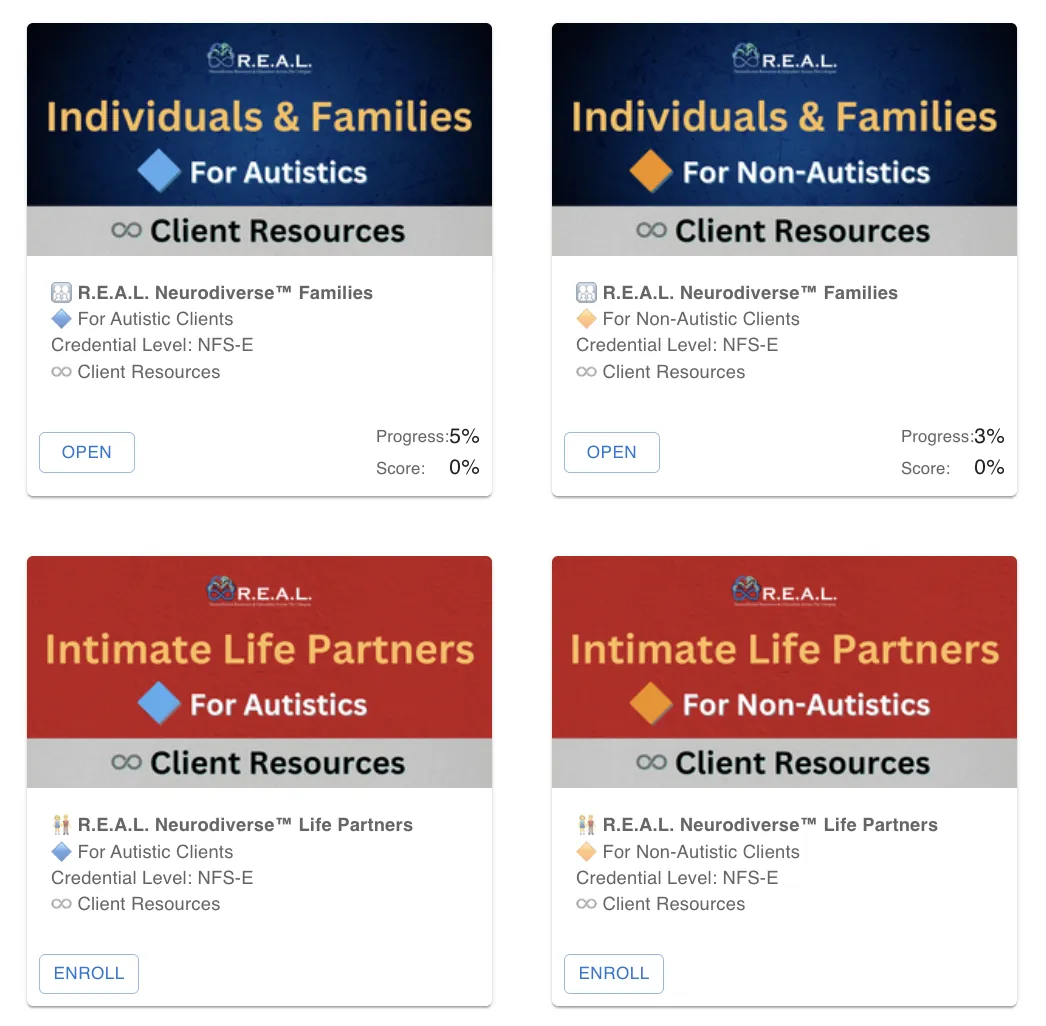
This is neurologically respectful design: built to honor the way every nervous system works, not reshape it.
Your Clients Lead. You Hold the Space.
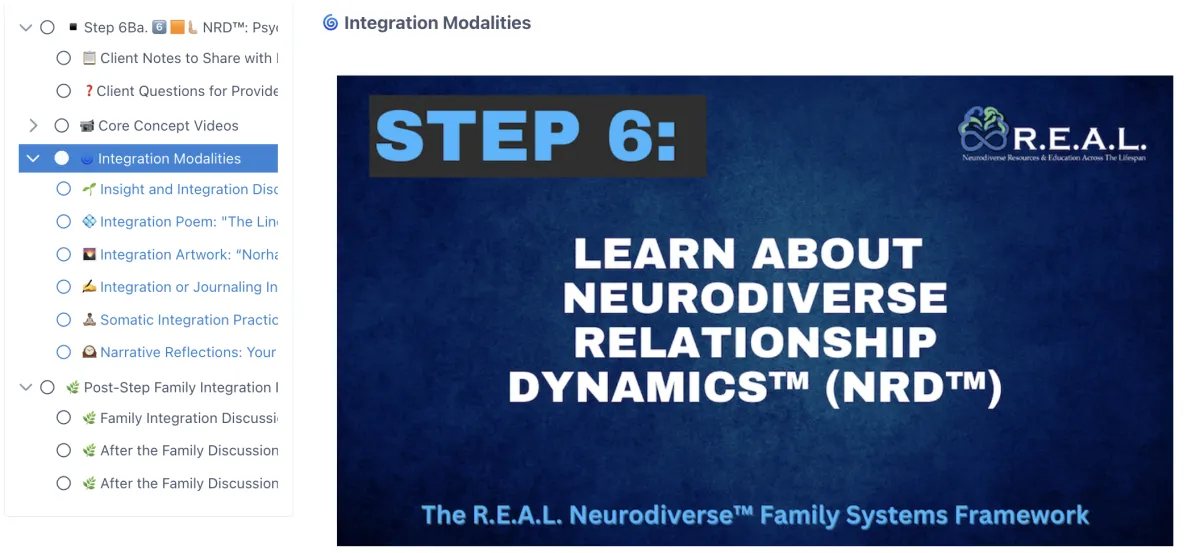
Inside the client portal: at each step and substep, clients choose from a full menu of integration modalities: poems, artwork, journaling, somatic practice, narrative reflections, and more. Access is offered before or during their session, depending on their needs and readiness. You guide the work. They lead the way in.
The system is designed to support thoughtful selection based on neurology, relational context, and readiness for depth, giving both you and your clients clear, meaningful options at every step of the way.
Clients have ongoing access to all modalities before, during, and between sessions.
You guide the reflection, but clients choose how they engage.
Modality selection is collaborative, not prescriptive.
Integration unfolds through supported autonomy, not imposed structure.
Client-directed. Provider-supported. Structure without control. Autonomy with guidance.
The Work Doesn't Stop When the Session Does
One of the most practical advantages of the R.E.A.L. framework is what happens between sessions. Through the client portal, clients have ongoing access to all seven integration modalities before a session, during it, or in the days that follow. They can return to a poem that landed, sit with an artwork, revisit a somatic practice, or begin exploring the next modality at their own pace.
This means your 50 minutes together can go deeper. Instead of introducing material from scratch, you arrive to a client who has already been sitting with it, and your session becomes a space for processing, not just delivery.
Between-session engagement isn't required. But for clients who are ready, the portal makes it possible. And for providers, it changes what's achievable within the time you have.
The Three-Stage Insight Pathway
Applied at Every Step and Substep Throughout the Program
📹
1. Neurodiversity-Affirming Education
Clients begin with structured psychoeducational modules that establish shared language and neurodiversity-affirming context, offering autistic and non-autistic tracks and family and life partnership focuses.
🌀
2. Individual Integration
Clients engage in structured individual sessions using multimodal integration tool, including guided discussions or modules, reflective exercises, somatic practices, and more. Each is designed to honor individual neurological processing styles.
We Are Here
🌿
3. Relational Discussion
At the completion of each step or substep, individual track work culminates in optional structured shared discussions, bringing autistic and non-autistic participants together for insight-based, neurologically respectful exploration.
Phase 2 is where integration truly occurs. Clients engage with one or more of the seven integration modalities: guided discussions, multimodal exercises, somatic practices, reflective prompts, and creative tools. All are designed to help insight become embodied and applied. Clients work to internalize concepts in ways that reduce reactivity, build clarity, and support relational growth.
Individual Integration Is Where Insight Begins to Take Hold
This stage is where understanding starts to become internal. It builds on neurodiversity-affirming education and creates the foundation needed for meaningful relational work.
Clarifies how insight becomes internal change
Shows how the stages build on one another
Designed to support real-world application
If you would like a clearer sense of how Education, Integration, and Relational Discussion function together, you can receive a short, structured series of emails that walks through the full three-stage pathway.
This does not add new information. It helps organize what you are already exploring into a coherent process.
Ready to Bring This Into Your Practice?
If you're ready to offer your clients structured, neurologically aligned integration with tools that are already built, already adapted, and already waiting for you, this is your next step.
Seven modalities. Every neurology. Every step of the way.
Step in. The structure and the support are already here.


