Relational Discussions: Three Types of Tools for Shared Insight in Neurodiverse Relationships
Structured Tools for Shared Insight. At the Right Moment, in the Right Format
Relational growth in neurodiverse systems doesn't begin with shared conversation. It begins with individual clarity. But there comes a point in the work, after each of you has built your own foundation of self-understanding, when shared reflection becomes not only possible, but genuinely valuable.
The R.E.A.L.™ framework offers three distinct tools for those moments. Each tool serves a different purpose, follows different provider eligibility requirements, and is designed for a different stage of relational readiness. What the tools share is a commitment to structure, pacing, and neurological safety, because in neurodiverse relationships, how a conversation happens matters as much as what is said in it.
Step in. The structure and the support are already here.
Why Structure Matters In Neurodiverse Relational Work. And Why Joint Sessions Often Backfire.
In most relational support contexts, bringing two people into a room together feels like a natural next step. In neurodiverse systems, it is often where things go wrong.
Without a shared framework, joint sessions in neurodiverse relationships tend to replay the very dynamics that brought you in. One person masks. The other over-accommodates. Familiar patterns reassert themselves, not because anyone is failing, but because the different nervous systems process reality differently. And without structure to support the difference, nervous systems will default to what they know. You may have experienced leaving joint therapy sessions feeling more discouraged than when they arrived, and there is a reason for that.

In joint sessions, the relational system often absorbs another rupture without repair.
This is not a reason to avoid shared conversation. It is a reason to approach it differently. Structure isn't a constraint on connection in neurodiverse systems; it is what makes genuine connection possible. When the format is clear, the pacing is protected, and each person arrives having already done their own individual work, something different becomes available. Not performance. Not negotiation. Not the exhausting labor of trying to be understood by someone who doesn't yet have the language. Something closer to actual witnessing, and the quiet relief that comes with it.
The three tools described on this page are built around that understanding. Each one provides a different kind of structure for a different kind of moment. Used intentionally, they don't just support better conversations, they open the door to new relational patterns grounded in awareness, pacing, and mutual respect.
Structure isn't a constraint on connection. It's what makes connection possible.
🌿 Post-Step Integration Discussions: Structured Shared Reflection For Neurodiverse Couples and Families
Post-Step Integration Discussions are the foundational relational tool in the R.E.A.L. framework, and the most accessible. They are available to everyone with access to the R.E.A.L. programs, and are designed to be introduced at a naturally recurring moment: after each individual has completed their own work for a given step or substep.
These discussions are not joint therapy sessions. They are not spaces for negotiation, repair, or problem-solving. They are structured, insight-based conversations that act as an opportunity for neurodiverse couples or family members to hear and be heard, through a format that protects neurological pacing and emotional safety for everyone involved.
The structure follows a consistent flow. Each participant begins with individual preparation, reflecting on their step or substep experience using designated prompts before any shared conversation begins. A brief grounding opening helps each person settle their nervous system before turning toward the other. From there, participants take turns sharing insights, guided by structured questions that affirm neurological difference rather than papering over it. The pair or group then notices overlaps and differences, without jumping to interpretation or solutions. An optional closing ritual supports transition back to individual regulation when the conversation is complete.

These discussions can be facilitated in session by a single provider, completed independently at home using the structured templates provided in the client portal, or coordinated across multiple providers when each participant has their own individual support in place. The format is flexible. The structure is not, and that distinction is what keeps these conversations safe.
Insight before interpretation. Pacing before problem-solving. Structural clarity in service of relational safety.
The Three-Stage Insight Pathway
Applied at Every Step and Substep Throughout the Program
📹
1. Neurodiversity-Affirming Education
Every step begins with shared psychoeducational videos, building a common language and neurodiversity-affirming foundation that both autistics and non-autistics carry into everything that follows.
🌀
2. Individual Integration
Before any shared conversation is possible, each partner or family member moves through their own integration work, building self-understanding, emotional regulation, and personal insight through tools tailored to their own neurology and relational focus.
🌿
3. Relational Discussion
When individual work is complete, structured relational discussions become possible, bringing autistic and non-autistics together for insight-based, neurologically respectful exploration that neither person could have been ready for without the preparation behind them.
We Are Here
Relational discussion isn't where the work begins. It's where individual preparation becomes shared understanding.
Relational Discussion Is One Way Insight May Be Applied
This stage is where internal understanding may begin to take shape in relationship. It builds on the foundation created through education and integration, but it is not always necessary, appropriate, or safe.
In some contexts, relational discussion can support clarity, communication, and change. In others, particularly where there is instability, harm, or misalignment, it may not be the right step. This process is always guided by individual awareness, boundaries, and well-being.
If you would like a clearer sense of how Neurodiversity-Affirming Education, Individual Integration, and Relational Discussion function together as a structured but flexible pathway, you can receive a short, focused series of emails that walks through the three-stage process.
Clarifies how each stage supports understanding and application
Shows how insight can inform different types of decisions
Designed to support use of the model without pressure or assumption
This does not add new information. It helps organize what you are already exploring into a coherent process.
➡️ Theory of Mind Dyadic Tools: Advanced Intersubjective Exploration for Clients of Advanced Providers
(ToM-DT, ToM-DT VIA)
Advanced Intersubjective Exploration for Providers With NFS-S Credentialing or Higher
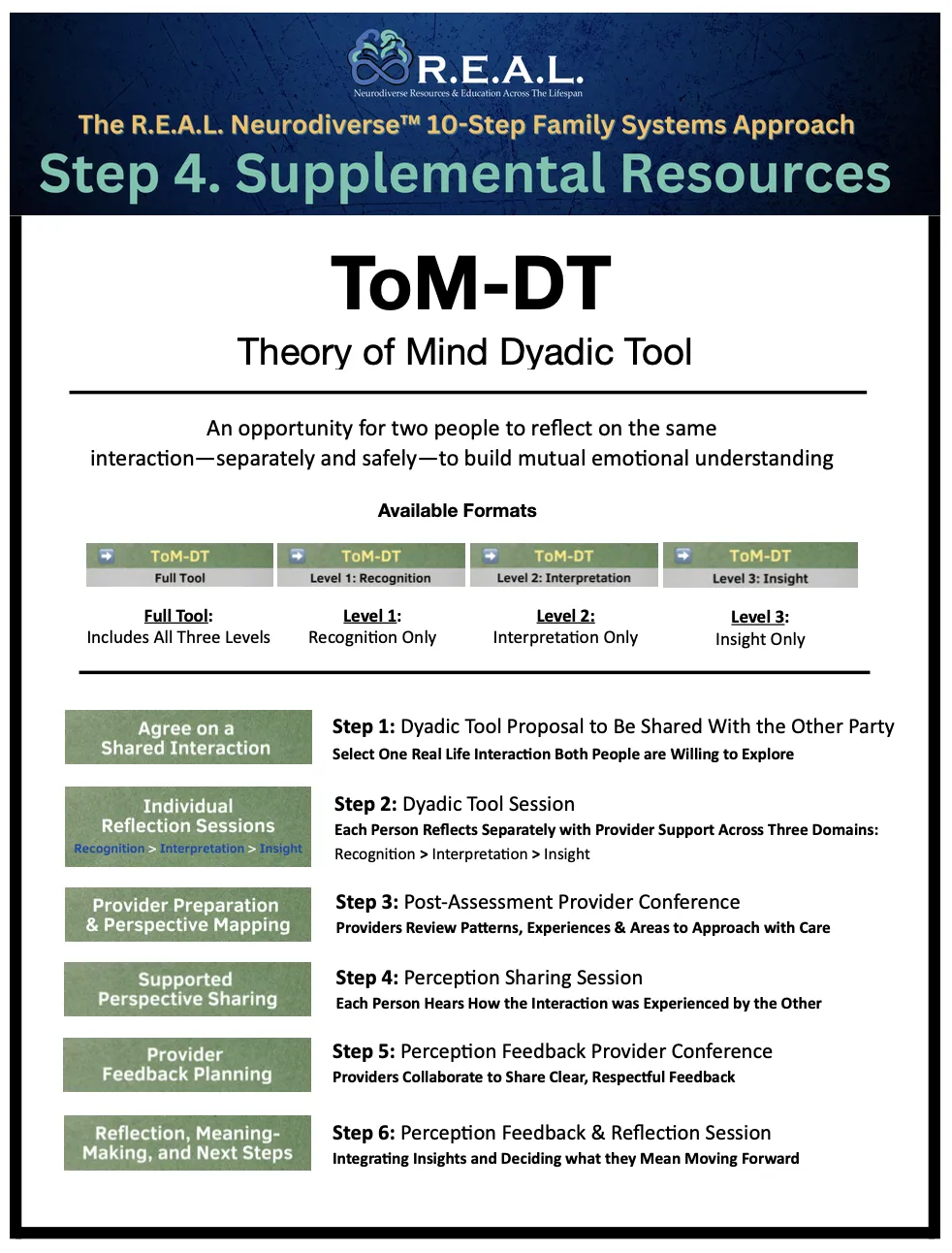
When your provider completes advanced credentialing, the R.E.A.L. framework offers two additional relational tools designed for deeper structured exploration between members of neurodiverse couples or family systems. These tools go beyond reflection and witnessing; they invite clients into a careful, guided examination of how each person interpreted a shared experience, where perception gaps emerged, and what signals were sent but not received.
These tools require advanced credentialing because intersubjective exploration carries real risk of retraumatization without sufficient clinical containment.
The Theory of Mind Dyadic Tool (ToM-DT) is a structured process for exploring how two individuals interpreted each other's thoughts, feelings, and intentions during a specific shared experience. Using a co-selected memory as a reference point, the tool supports clients in identifying the perception gaps and misread signals that are so common and painful in neurodiverse relationships. What one person experienced as warmth, the other may have experienced as pressure. What felt like neutrality to one may have registered as indifference to the other. The ToM-DT makes those divergences visible, discussable, and, with the right support, navigable.
The ToM Video Interaction Analysis (ToM-VIA) takes this process further, using a recorded interaction as the basis for joint analysis and guided provider interpretation. It is particularly useful for understanding nonverbal cues, emotional escalation patterns, and breakdowns in perspective-taking that are difficult to reconstruct from memory alone. Seeing the interaction rather than recalling it changes what becomes available for reflection.
Both tools require NFS-S credentialing or higher, and that requirement exists for good reason. This work involves real-time navigation of divergent perceptions, complex emotional processing, and the ever-present risk of retraumatization when relational wounds are examined too closely without sufficient containment. Providers working at this level bring not just the tools, but the systems-level insight and ethical attunement required to use them safely.
These tools are not a next step every provider will take, and they are not needed for the framework to be fully effective. Post-Step Integration Discussions remain the recommended first level of shared relational support for all clients. The ToM tools are simply available, when the time is right and the credential is in place, for those who are ready to go further.
They are optional, but powerful. And they grow with your credential.
🚪❤️ Sequential Problem Solving™: A Structured Path for Cooperative Decision Making in Neurodiverse Systems
A Structured Path for Cooperative Decision-Making. Available to Any Client, at Any Time.
Sequential Problem Solving™ is a standalone program because not every member of any neurodiverse system is ready for, or interested in, shared reflection. Some families and partnerships need to make decisions before insight is possible. Some clients are navigating separation, co-parenting arrangements, or household transitions with a partner who has no intention of engaging in individual growth work. Sequential Problem Solving™ exists for exactly these situations, offering a structured, neurologically aligned path toward cooperative decision-making that doesn't require emotional readiness, shared language, or mutual participation in insight-based programs.

The framework supports clients in navigating real-life decisions about parenting, finances, cohabitation, transitions, and shared responsibilities in a way that protects neurological differences, prevents emotional overwhelm, and maintains respect for each person's regulation and autonomy. It replaces the unstructured problem-solving attempts that so reliably reactivate historical patterns in neurodiverse systems with something that actually holds.
It is worth being clear about what Sequential Problem Solving™ is not. It is not a substitute for individual insight work. It is not a shortcut to relational repair. And it should not be used as a space for emotional processing or conflict resolution. That work belongs in the R.E.A.L. programs, with the appropriate structure around it.
Sequential Problem Solving™ is a practical tool for practical decisions. When containment, clarity, and forward movement are what the system needs, it delivers exactly that.
Structure makes progress possible, even when insight isn't yet shared.
The Right Tool. The Right Moment. The Right Structure.
Whether you are ready for shared reflection, deeper intersubjective exploration, or simply need a structured path through a practical decision — there is a relational tool built for exactly where you are.
Insight before interpretation. Pacing before problem-solving. Structure in service of every nervous system.
Step in. The structure and the support are already here.


