FAQ
Frequently Asked Questions
Whether you’re considering the R.E.A.L. Neurodiverse™ framework for yourself, your intimate life partnership, or your family, these questions cover the topics clients ask most often. If you don’t find what you’re looking for here, feel free to reach out to us directly.
Getting Started: What to Expect
What is the R.E.A.L. Neurodiverse™ program?
It is a structured, step-by-step program designed to help Level 1 autistic adults, their life partners, and their families understand the invisible dynamics that shape their closest relationships. The program provides neurodiversity-affirming psychoeducational videos, personal reflection tools, and, when the time is right, structured ways to have conversations with the people you are closest to.
Who is this program for?
The program is designed for adults navigating relationships where neurological differences are creating confusion, disconnection, or pain. That includes Level 1 autistic adults, their non-autistic intimate life partners or family members, and anyone who suspects that neurological mismatch may be part of what they’re experiencing. You do not need a formal diagnosis to participate.
Can we use this program even if no one has a formal autism diagnosis?
Yes. Many people begin this program without anyone in their family having a formal diagnosis, and many are actively exploring whether they or their loved ones might be autistic. The program is built to support that exploration.
You each choose the track (autistic or non-autistic) that feels most resonant to you, and if any self-understanding shifts over time, it’s easy to move to a different track without anyone losing their place.
How does the program work?
You work with a provider and have your own cloud-based client portal where you access neurodiversity-affirming psychoeducational videos, and reflection questions tailored to your neurology, autistic or non-autistic, and a full set of integration tools at every step. You can engage with these materials before, during, or between your sessions with your provider.
The program is designed so that what you explore on your own and what you work through in session stay connected. You are never starting from scratch each week. The learning carries forward, and each session builds on what came before. Your provider is moving through the same progression alongside you, so they always know where you are in the process and how to meet you there.
What will I actually do in the program?
At each step, you watch short neurodiversity-affirming psychoeducational videos that introduce concepts, then move into personal reflection and integration work using tools chosen by you and your provider. The integration tools include guided discussions, poetry, artwork, journaling prompts, body-based practices, reflective exercises, and future planning tools. You choose what fits you best. When the time is right and you feel ready, there are also optional structured conversations you can have with a partner or family member.
How long does the program take?
There is no fixed timeline. The program follows a 10-step progression, and the pace is set by you and your provider based on your comfort level, your processing style, and what feels sustainable. Some people move quickly through certain steps and spend more time on others. The structure is there to guide you, not to rush you.
Can I access the materials on my own between sessions?
Yes. You have your own portal with access to the videos, reflection questions, integration tools, and other materials for your current step. You can engage with them at your own pace between sessions. Many clients find that arriving to a session having already reflected on the material makes the time with their provider feel deeper and more productive.
How the Program is Structured
What is the 10-Step Framework?
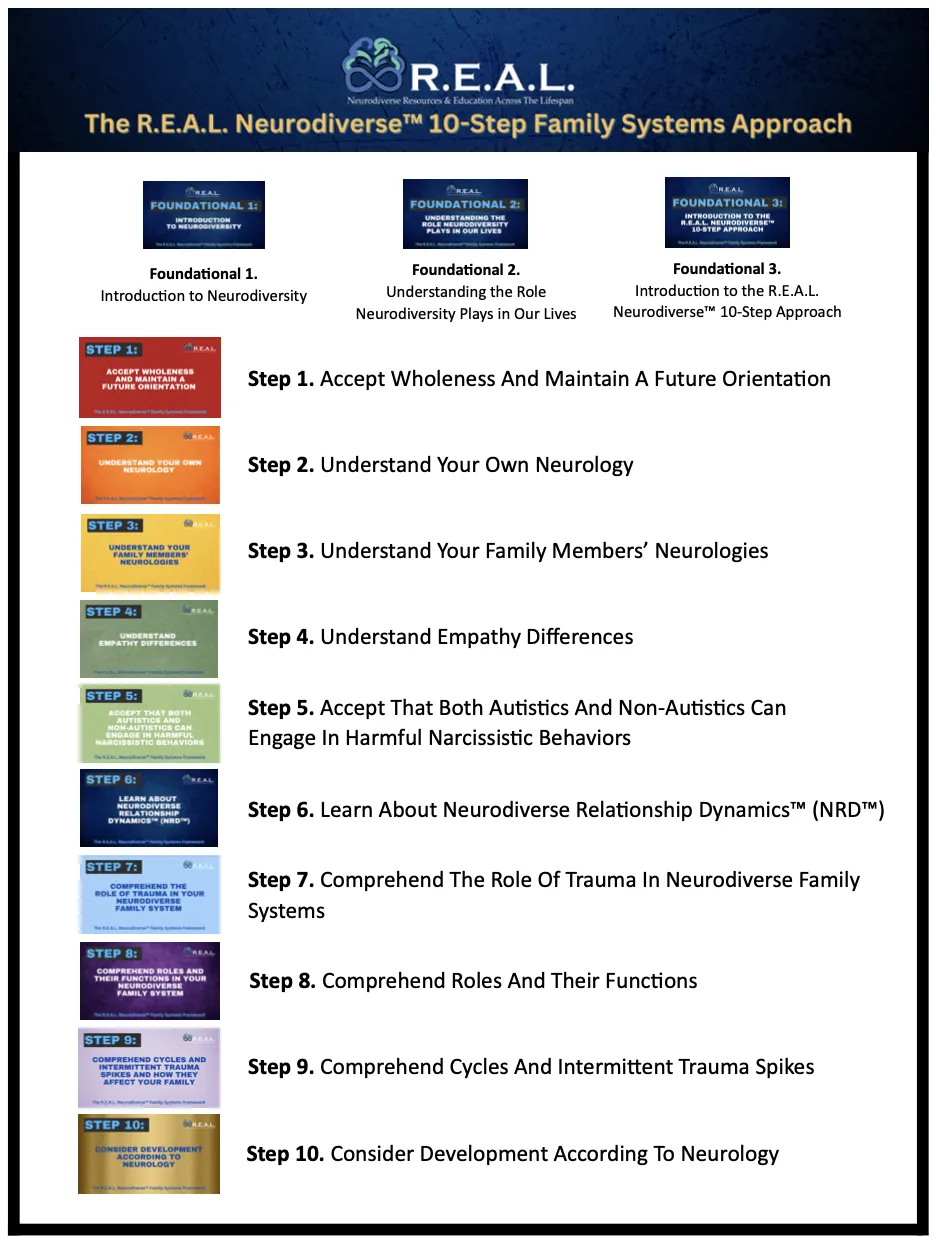
The R.E.A.L. Neurodiverse™ program is organized around ten steps that move in a deliberate sequence, from self-understanding toward relational clarity. Each step builds on the one before it.
What do the ten steps cover?
The arc opens with wholeness and future orientation, establishing personal value and possibility. From there, you build self-knowledge about your own neurology, then expand your understanding outward to the neurologies of the people closest to you. The middle steps explore empathy differences, harmful patterns, and Neurodiverse Relationship Dynamics™ as a full framework. The later steps move into the role of trauma in neurodiverse systems, relational roles and what they protect, cycles and trauma spikes, and finally a forward-looking consideration of development according to neurology.
Do I start at Step 1?
You begin with three foundational lessons that introduce the concept of neurodiversity, help you recognize the role neurodiversity plays in all of our lives, and explain how the program works. These give you a shared starting point before the 10-step progression begins.
What happens at each step?
At every step, you move through the same three-stage process. First, you watch neurodiversity-affirming psychoeducational videos that introduce concepts. Then you engage in personal integration work using tools adapted to your neurology and processing style. And when you’re ready, there is an optional structured conversation you can have with a partner or family member.
This cycle repeats at every step and substep, so the process becomes familiar even as the content deepens.
Why does each step follow the same three-stage process?
Because understanding needs to come before integration, and individual work needs to come before shared conversation. Education gives you the language and clarity you need before personal reflection can be meaningful. Individual integration gives you the chance to process what you've learned through your own neurology before being asked to hold someone else's perspective alongside yours. Shared discussion, when it happens, works because both people have already done their own work. This sequence produces better outcomes at every step. It also creates a familiar, predictable rhythm that many clients find grounding, but the order exists because each stage genuinely depends on the one before it.
Can the order of the steps be adjusted?
You and your provider have the flexibility to revisit earlier steps, slow down, skip ahead, or adjust based on what you need at any given moment. The recommended sequence exists because each step lays groundwork for the next, but your provider’s judgment and your own readiness always come first.
Finding the Right Path: Tracks and Focuses
What are the autistic and non-autistic tracks?
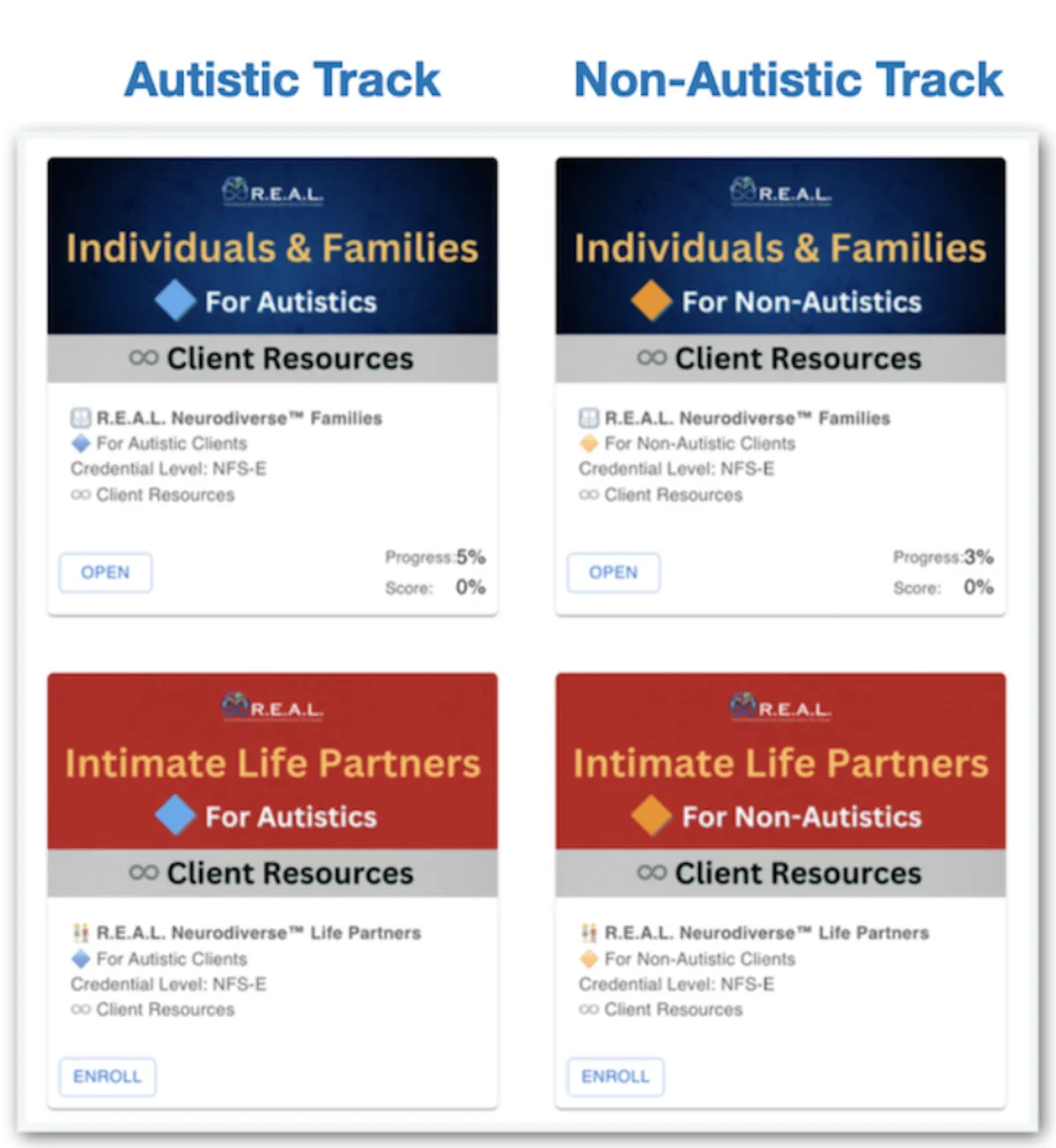
The program offers two parallel tracks: one designed for autistics and one designed for non-autistics. Both tracks follow the same 10-step structure, but the materials, reflection questions, and integration tools are adapted to speak directly to your neurological experience. Neither track is a simplified version of the other. Both are fully developed pathways built from the ground up.
How do I know which track is right for me?
You choose the track that feels most resonant to you. Your provider may share that both tracks are available and describe what each one offers, but the choice is always yours. You do not need a formal diagnosis to choose the autistic track, and no one will assign you to a track based on their own impression of your neurology.
What if I’m not sure whether I’m autistic?
That’s a normal and expected part of this process for many people. You can begin with whichever track feels most aligned with your experience right now. The program’s psychoeducational materials often help people recognize their own neurology over time. If your understanding of yourself shifts, you can move to the other track without losing your place in the progression.
Will this program tell me if I’m autistic?
No. This program is not a diagnostic tool. It is designed to help you understand how your neurology shapes your relational experience. Many people gain significant self-clarity through the program’s psychoeducational content and assessments, and some find that clarity leads them to pursue formal evaluation. Others choose not to seek formal evaluation. Either way, the program itself does not diagnose.
How are the materials different for each track?
Each set of materials is aligned to the neurological perspective of the family member or partner it serves. Autistics' materials honor their processing style with clarity and structure, while also supporting identity reclamation after years of masking, self-understanding that isn't filtered through non-autistic expectations, and insight into how an autistic neurology shapes their relational experience. Non-autistics are supported in stepping out of chronic accommodation patterns, reclaiming their own sense-of-self, and understanding systemic dynamics without blame or shame.
What is the difference between the Families focus and the Intimate Life Partners focus?
The program offers two relational focuses. The Families focus is designed for adults navigating neurodiverse dynamics within their family system, whether as a parent, sibling, adult child, or extended family member. The Life Partners focus is designed for adults in or reflecting on a neurodiverse intimate partnership. Both use the same 10-step structure, but the language, examples, and reflection tools are tailored to the relational context you are actually living in.
Can I switch between the Families focus and the Life Partners focus?
Yes. If your primary relational concern shifts over time, you can move from one focus to the other at any step without starting over. The structure holds your progression regardless of which focus you are working in.
What if I’m dealing with both family and partnership challenges?
Start with the focus that feels most pressing or emotionally complex right now. The insights you gain will carry across relational contexts. Many clients find that understanding gained in one focus illuminates dynamics in the other as well.
What's Included In The Program
What are the psychoeducational videos?
Over 200 short, neurodiversity-affirming, professionally produced videos that introduce the concepts explored at each step of the program. They are designed to make complex neurological and relational ideas feel clear and approachable. Every client, autistic and non-autistic, watches the same videos, which creates a genuinely shared foundation. What differs is the reflection and integration work that follows, which is tailored to your track and focus.
What are the integration tools?
Seven different ways to engage with each step’s content on a personal level. They include guided discussions or modules, poetry, artwork, journaling invitations, body-based somatic practices, retrospective reflections, and future-oriented planning tools. Each one is adapted for autistic and non-autistic processing styles. You don’t have to use all of them. You and your provider choose the ones that feel most meaningful and accessible to you.
What are the empathy assessments?
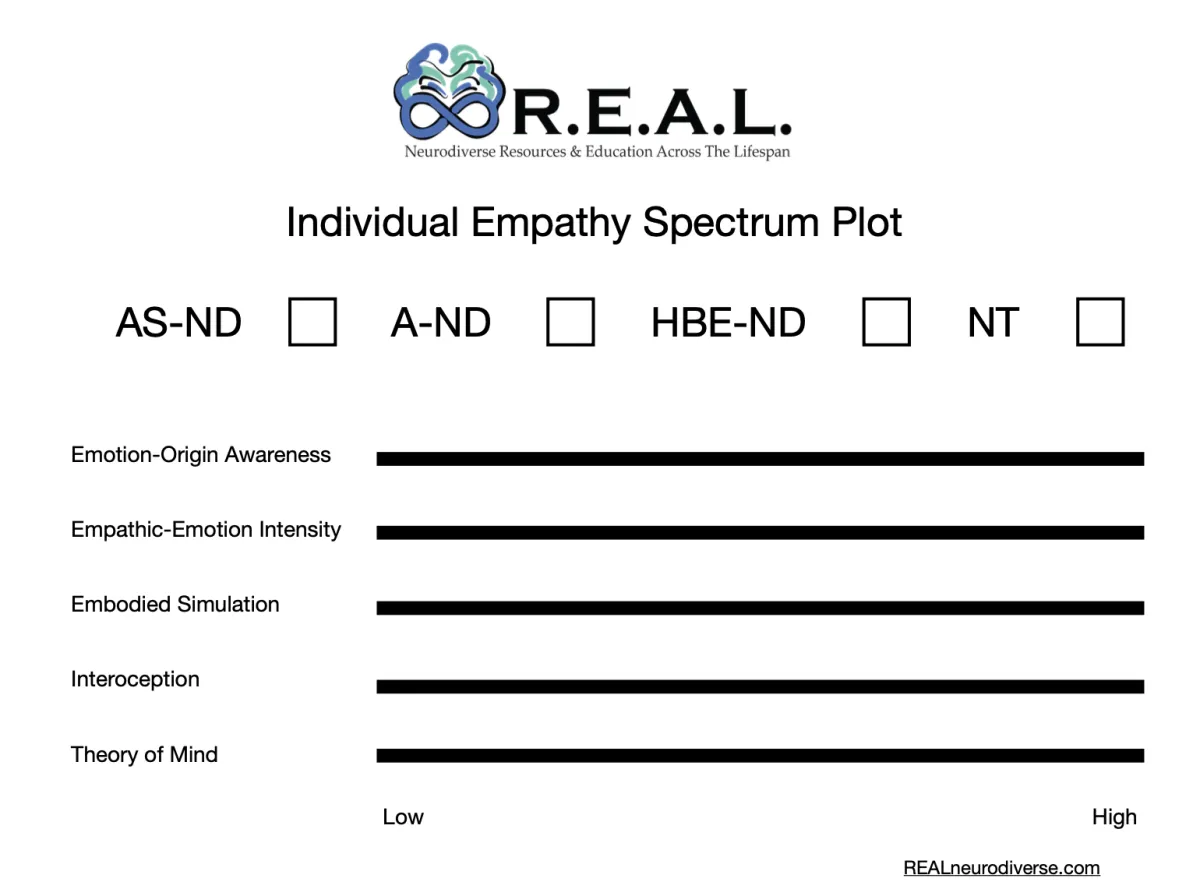
Five structured self-insight tools that help you understand how empathy actually works in your nervous system. They measure five distinct dimensions: how easily you distinguish your emotions from others’, how intensely you feel others’ emotions, how your body mirrors the people around you, how well you read emotional signals from inside your own body, and how you understand what others are thinking and feeling. These are not diagnostic tests. They are tools for self-understanding.
What is the IESP™?
The Individual Empathy Spectrum Plot™ is a visual map of how your nervous system processes empathy across all five dimensions. It is not a diagnostic output or an automated score, but the result of a shared conversation between you and your provider, supported by the quantitative assessment tools.
The plot reflects what you and your provider have explored and discussed, making your internal experience visible in a way that most people have never had access to before. Many clients describe this as a turning point: the moment they could finally see why certain relational patterns kept repeating, and why their experience felt so different from the people closest to them.
What are Framework Papers?
In-depth documents embedded throughout the program that explain the research and theory behind the tools and assessments. They are entirely optional. Some clients enjoy reading them for a deeper understanding of the concepts. Others prefer to engage more experientially through the videos and integration tools. Both approaches are equally valid.
What are the Theory of Mind tools?
Three supplemental resources for moments that call for more insight. The ToM-RS (Theory of Mind Reflection Session) is a provider-guided interview that anchors perspective-taking in your own real-world experiences. The ToM-DT and ToM-DT VIA are structured dyadic tools for exploring how you and your partner or family member interpret a shared experience.
Do I need to use every tool?
No. These tools are available when they serve you. They are designed to deepen insight, not to add complexity for its own sake.
The Three-Stage Insight Pathway: Education, Integration, Relational Discussion
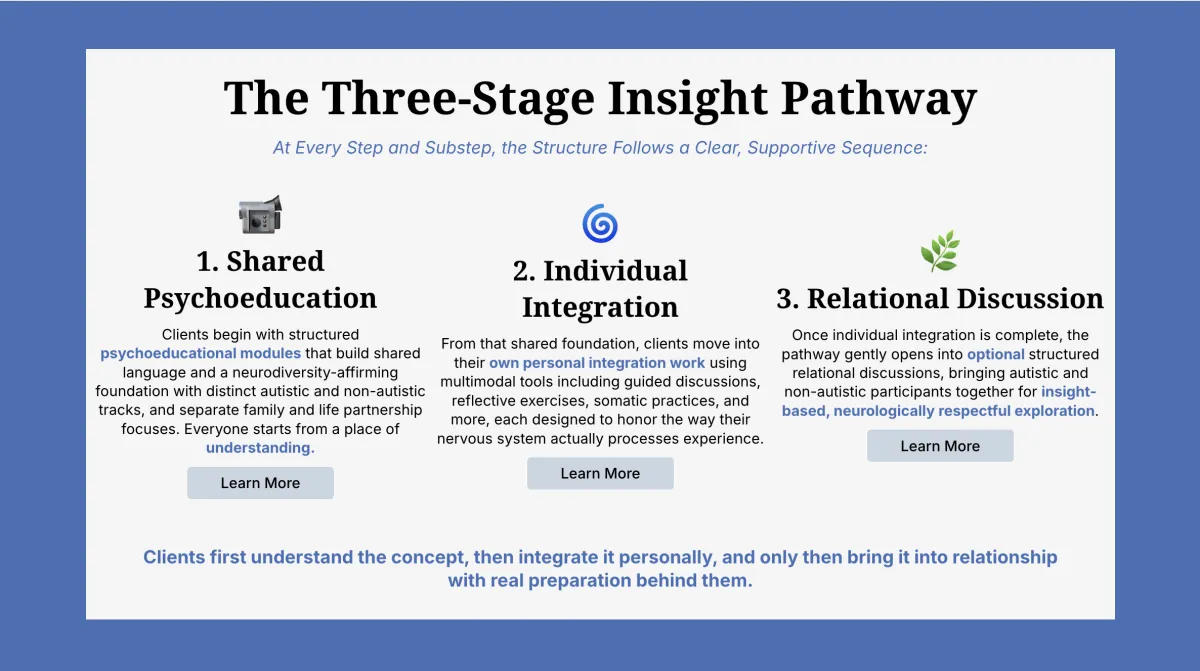
What is the Three-Stage Insight Pathway?
It is the repeating process that drives every step and substep of the 10-Step Framework. At each stage of the progression, you move through the same three phases in the same order: 1) neurodiversity-affirming psychoeducation, 2) individual integration, and 3) optional structured relational discussion. This cycle is the engine of the model.
Why does education come first?
Because clarity has to exist before personal reflection or good decisions are possible. The psychoeducational videos give everyone, autistic and non-autistic, a foundational understanding of the concept being explored at that step. That understanding is valuable in itself.
Many members of neurodiverse relational systems have carried years of confusion about what has been happening in their relationships, and the education stage is often where that confusion begins to lift. From that clarity, you are better equipped to engage in individual integration, to make informed decisions about your own life, and, when appropriate, to enter shared reflection with genuine preparation behind you. Without that common ground, integration work risks being built on assumptions, and relational conversations, when they do happen, risk replaying the same misunderstandings that brought you in for support
Why does individual integration come before relational discussion?
Because in neurodiverse systems, shared conversation without individual preparation almost always backfires. Joint sessions tend to replay existing dynamics: one person masking, the other over-accommodating, both leaving more discouraged than when they arrived. Individual integration gives each of you the chance to understand your own neurology, your own patterns, and your own experience before being asked to hold someone else's perspective alongside it.
Is relational discussion required?
No. Relational discussions are always optional. They are available after you have each has completed your own work for a given step or substep, but they are never mandatory. You can move through the entire program on your own and receive full benefit from the work. The relational stage is there if you feel the time is ever right.
Does this three-stage process ever change?
The content deepens as the steps progress, and the emotional complexity increases, but the process itself remains the same at every step and substep. That consistency is intentional. It creates predictability for you and your provider alike, and it allows insight to accumulate through a rhythm that becomes familiar rather than disorienting.
Why is this sequence especially important for neurodiverse relational systems?
Autistic and non-autistic individuals process emotional and relational information differently. A process that moves too quickly to shared conversation, or that skips individual integration, can overwhelm one person while under-serving the other. The three-stage pathway protects both nervous systems by ensuring that each of you have done your own work before anything work is shared. Structure is not a constraint on connection in neurodiverse systems. It is what makes genuine connection possible.
Individual Work and Shared Reflection
Do I have to do this with my partner or family member?
No. The program is designed to be fully effective as individual work. Many clients move through the entire 10-step progression on their own and receive profound benefit. You do not need anyone else’s participation for the program to help you. The work you do on your own is the whole work, not a partial version of it.
What if my partner or family member doesn’t want to participate?
That's okay. The program was designed for this reality. The work you do on your own is complete in itself. You build self-understanding, gain language for patterns you may have never been able to name, and develop the clarity to make informed decisions about your own life and relationships. None of that depends on anyone else's participation. If your partner or family member becomes interested later, they can enter their own track and focus at any time.
Can we both work with the same provider?
Whenever possible, each person should work with their own provider. This protects emotional safety, ensures each person's experience is fully supported without interpretive bias, and allows both of you to be honest without worrying about how it will affect the other person's relationship with the same provider. In some cases, a single provider may work with more than one member of the same family system, but only after meeting specific experience thresholds within the program. Even then, each person receives separate, individualized sessions. Your provider can help you determine what arrangement works best for your situation.
Why does the program start with individual work instead of couples or family sessions?
Because in neurodiverse relationships, shared conversations without individual preparation often replay the same dynamics that created the problem in the first place. Each person needs to understand their own neurology, their own patterns, and their own experience before shared reflection can feel safe and productive. The program gives you that foundation first.
When do shared conversations happen?
After you and another person have each completed your own individual work for a given step, you may choose to participate in a structured Post-Step Integration Discussion. These are not therapy sessions or problem-solving conversations. They are structured, guided exchanges designed for mutual insight and respectful reflection. They are always optional and only happen when both people are ready.
How are Post-Step Integration Discussions structured?
Discussions may be facilitated by one or both of your providers, or completed independently at home using the clear discussion guides available in your client portal. They follow a step-by-step format: preparation, grounding, mutual sharing, joint reflection, and optional closing rituals. This pacing helps ensure both of you can remain regulated and centered in your own insights while also listening to each other.
Can we work on decisions or shared problems during these discussions?
No. Problem-solving should not take place within Post-Step Integration Discussions. These conversations are designed for mutual insight and reflection, not for negotiation or decision-making. For families and partnerships that need to navigate shared decisions, the R.E.A.L. framework provides a separate resource, Sequential Problem Solving™, which offers a structured approach to cooperative planning around parenting, finances, living arrangements, and transitions. Because unstructured problem-solving so often reactivates historical patterns in neurodiverse systems, keeping these two functions separate protects the integrity of both.
Understanding Neurodiverse Relationship Dyanamics™
Is NRD™ the same as narcissism or emotional immaturity?
Not necessarily. Many behaviors that get labeled as narcissism, avoidance, or emotional immaturity are better understood through the lens of neurological mismatch. But the program does not dismiss those concerns. It does not label people as narcissists, but it directly acknowledges narcissistic behaviors when they are present. The distinction matters: naming a behavior makes it visible and addressable without collapsing a whole person into a single label.
Is NRD™ a diagnosis?
No. NRD™ is not a diagnostic label. It is a lens: a way of seeing invisible patterns and systemic misattunement. It helps providers and clients make sense of complex dynamics that are often misunderstood or mislabeled in traditional frameworks.
What about Cassandra Syndrome and codependency?
Many non-autistic partners arrive carrying one or both of these labels. The program does not dismiss those experiences. What it does is locate them differently. Through the NRD™ lens, what gets called Cassandra Syndrome or codependency is often better understood as the long-term effect of navigating a neurological mismatch that was never named. The pattern lives in the relational system, not in your character. Understanding where it came from is often the beginning of being able to change it.
Can understanding NRD™ save my relationship?
Not always. But it creates the conditions for honest decision-making. You may choose to rebuild with new tools and shared understanding. You may choose to step away with clarity and self-respect. Either path becomes possible when confusion lifts and you can finally see what has been happening. Growth becomes possible where before there was only confusion or shame.
Pace, Structure, and what the Experience Feels Like
How fast will I move through the program?
There is no required speed. You and your provider set the pace together based on your readiness, your processing style, and what feels sustainable. Some steps may move quickly. Others may need more time for reflection and integration. The structure supports you without rushing you.
Does my provider guide me through every step, or can I lead my own process?
You are encouraged to take an active role in your growth. Each step includes user-friendly, client-facing materials that allow you to choose the modalities, sequence, and tools that best fit your needs. Your provider's role is to support, scaffold, and respond to your process, not to control it.
What if I feel overwhelmed?
That may be a sign that the pace needs to slow down or the emotional depth needs to be adjusted. Your provider can simplify the content, revisit earlier material, or create more space for integration. Emotional safety always comes first. The program is designed to hold you, not to push you past what you can process.
What if the material doesn’t feel challenging enough?
Your provider can adjust by introducing deeper content, moving through steps more quickly, or exploring multiple dimensions of a step in parallel. The program is designed to meet you where you are, whether that means faster pacing or more depth.
Do I have to use every tool in the program?
No. The integration tools, assessments, and reflection exercises are all available to you, but you are not expected to use every one. You and your provider choose the tools that feel most meaningful and accessible. The program offers options so that the right tool is always available, not so that you feel obligated to do everything.
Can I revisit earlier steps or skip ahead if needed?
Yes. You are free to repeat, pause, or skip steps depending on what best supports the your growth. The platform accommodates nonlinear progression and dynamic pacing.
Is this program only about learning, or will I actually feel different?
The program is designed to move beyond understanding into lasting change. The psychoeducational videos build shared language and clarity, but the integration tools are where that clarity becomes personal. Through structured reflection, body-based practices, creative expression, and guided exploration, the concepts become part of how you understand yourself and your relationships. Many clients describe a shift not just in what they know, but in how they feel inside their own experience.
Framework Papers: Theory and Research Foundations
What are the Framework Papers in the R.E.A.L. Neurodiverse™ program?
Framework Papers are in-depth, academically grounded documents that explain the theory, research, and rationale behind the assessments, tools, and integration practices used throughout the R.E.A.L. Neurodiverse Family Systems Approach.
Where can I find the Framework Papers?
They are embedded throughout the program and marked with a 🎓 graduation cap icon. You will also find them in the sections associated with each tool or assessment.
What topics do the Framework Papers cover?
The papers span the full breadth of the program. Some cover the theoretical and research foundations behind specific assessments and their subscales, such as the Emotion-Origin Awareness Spectrum, the Empathic-Emotion Intensity Spectrum, the Embodied Simulation Spectrum, and the Interoception and Theory of Mind assessments. Others explain the design rationale behind tools like the Individual Empathy Spectrum Plot™ (IESP™) and its evolutionary and neural foundations, the Theory of Mind Reflection Session (ToM-RS), the Theory of Mind Dyadic Tool (ToM-DT), and the ToM-DT Video Interaction Analysis.
There are also papers grounding each of the Seven Integration Modalities, covering topics such as the clinical value of multiple integration pathways, somatic integration and Emotional Pain Release™, narrative identity reclamation, visual metaphor and non-verbal processing, poetry as a tool for emotional resonance, and future visioning as an act of self-authorship. Later steps introduce papers on constructs like systemizing, systems thinking, and action impact understanding in autism. Many assessments include multiple subscales, and each subscale has its own associated Framework Paper.
Are these papers based on peer-reviewed research?
Many Framework Papers include references to peer-reviewed studies, clinical methodology, and developmental psychology theory. They integrate research and lived experience to support neurodiversity-informed practices.
Provider Credentialing: The NFS-E, NFS-S, and NFS-P
How do I know my provider is qualified to use this program?
Every practice using the R.E.A.L. Neurodiverse™ programs has at least one provider who has completed the NFS-E credential, a professional certification grounded in Anne MacMillan's Neurodiverse Family Systems Theory and the 10-Step R.E.A.L. Approach. The credentialing process includes instructional content, written reflections, comprehension assessments, and a final examination.
What qualifies someone to become a R.E.A.L. Neurodiverse™ provider?
The credentialing program recognizes two eligibility pathways: professional background in a relevant field, and significant lived experience with Level 1 autism in adulthood. This is intentional. In neurodiverse family systems work, lived experience is often the deepest qualification a provider can bring. Many of the most effective providers using this framework understand what you are going through not only because they have been trained, but because they have lived it.
How does my provider stay supported as we move through the program?
The program itself is designed so that providers learn through experience. At every step and substep, your provider receives structured, synchronized guidance that tells them exactly what you are working with, how to support you in session, and how to pace the work responsibly. The framework was built on the principle that the best learning happens through doing, and the platform ensures your provider is never without support as they guide you through the process.
Are there different levels of provider credentialing?
Yes. The NFS-E is the foundational credential and provides everything needed for the core program. Some providers go on to earn advanced credentials, the NFS-S (Specialist) and NFS-P (Practitioner), which unlock additional tools for more complex relational and trauma-related work. If your provider holds an advanced credential, they may offer tools such as the Theory of Mind Dyadic Tool or video interaction analysis that are not available at the foundational level. Your provider can tell you which credential they hold and what it means for the tools available to you.
Is the NFS-E credential the same as a therapy license?
No. The NFS-E is a specialized professional certification issued by R.E.A.L. Neurodiverse™. It is separate from and in addition to whatever professional license or qualification your provider already holds, whether that is as a therapist, counselor, psychologist, social worker, coach, consultant, clergy member, domestic violence advocate or other relational support professional. It means they have added specific neurodiversity-affirming training to the skills they already bring to their work.

Practical Questions
Is this program appropriate for all forms of autism?
All R.E.A.L. programs are designed specifically for relationships involving Level 1 autism. The language and framing assume verbal processing and self-reflective capacity. They are not designed for individuals with higher support needs.
Can I access the program without a provider?
The R.E.A.L. programs are designed to be used with a provider. Your provider holds the clinical or coaching container and helps you interpret, apply, and pace the material in ways that are safe and meaningful for your situation. The client portal gives you independent access to materials between sessions, but the program is built around a supported relationship.
Is the program available in person and virtually?
Yes. The program works in both in-person and virtual settings. You and your provider can watch videos together in session, or you can engage with materials on your own through the client portal and bring your reflections into the session. The format adapts to whatever works best for you.
What is the client portal?
Your portal is a private, secure online space where you access your psychoeducational videos, reflection questions, integration tools, and other materials for your current step. It is hosted on the UnitusTI platform, which is HIPAA-compliant and built for confidentiality. You can use it before, during, and between sessions at your own pace.
How is my information protected?
The program is hosted on the UnitusTI platform, which is HIPAA-compliant, FERPA-compliant, and GDPR-compliant. Your information is handled with the same level of confidentiality you would expect from any clinical or coaching relationship.
From confusion to clarity. For every nervous system in the room.


