Mapping and Visual Tools: The Individual Empathy Spectrum Plot™ (IESP™)
Turning Insight Into Clarity. For Autistics and Non-Autistics Alike.
Most neurodiverse couple and family relational confusion isn’t due to lack of effort, it’s due to invisible dynamics. You feel stuck, but you can’t quite see why. Everyone cares, but language alone isn’t enough to make internal experience feel seen.
That’s exactly where the R.E.A.L.™ mapping tools make a difference: They turn complex emotional, cognitive, and relational data into clear visual understanding that you can see, discuss, and use, right in session.
Step in. The structure and the support are already here.
🗺️
Meet The IESP™
The Individual Empathy Spectrum Plot™
The Foundational R.E.A.L.™ Mapping Tool
Empathy isn't a single trait, and measuring it as though it were has left a lot members of neurodiverse relational systems feeling misunderstood, mislabeled, or just invisible. The IESP™ was built from a different premise entirely: that empathy is a multi-layered process, and that understanding it means looking at how each layer functions, not collapsing everything into one construct.
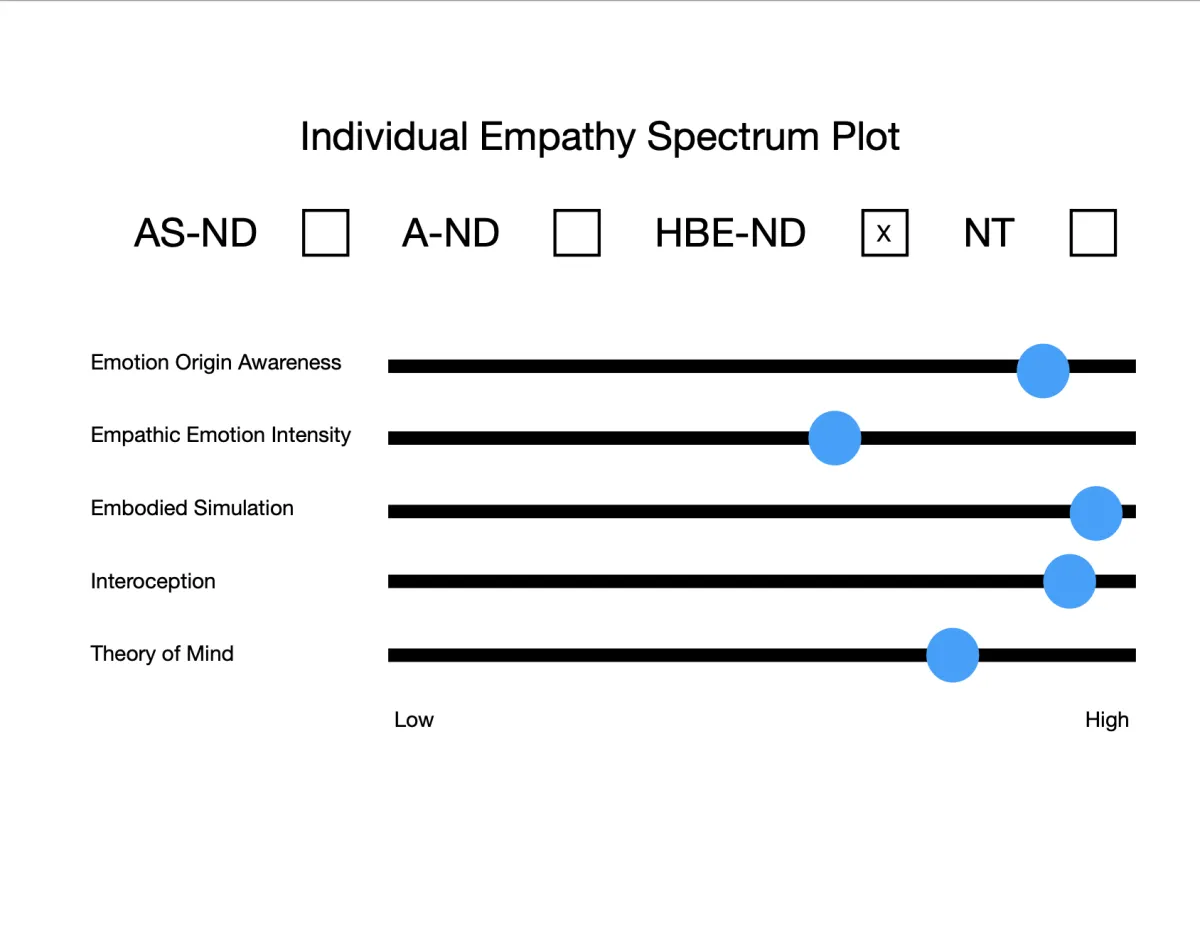
The IESP™ maps empathy across five distinct but interconnected dimensions, progressing in the order they naturally build on one another.
It begins with Emotion-Origin Awareness: the foundational skill of recognizing where an emotion actually comes from. Is this feeling mine, or am I absorbing it from someone else? For those who have spent years confused by their own emotional experience, this single dimension can be quietly revelatory.
Next is Empathic-Emotion Intensity: how strongly emotions are felt in response to others. Some people feel everything deeply; others experience emotional signals in a more muted register. Neither is a deficiency. Both have real implications for how relationships function, and for where you might be burning out without knowing why.
From there, the IESP™ moves into the body. Embodied Simulation captures the degree to which a person physically mirrors the emotional states of those around them, the way someone tenses when another person is anxious, or softens when a room relaxes. This happens largely outside conscious awareness, which is exactly why it matters.
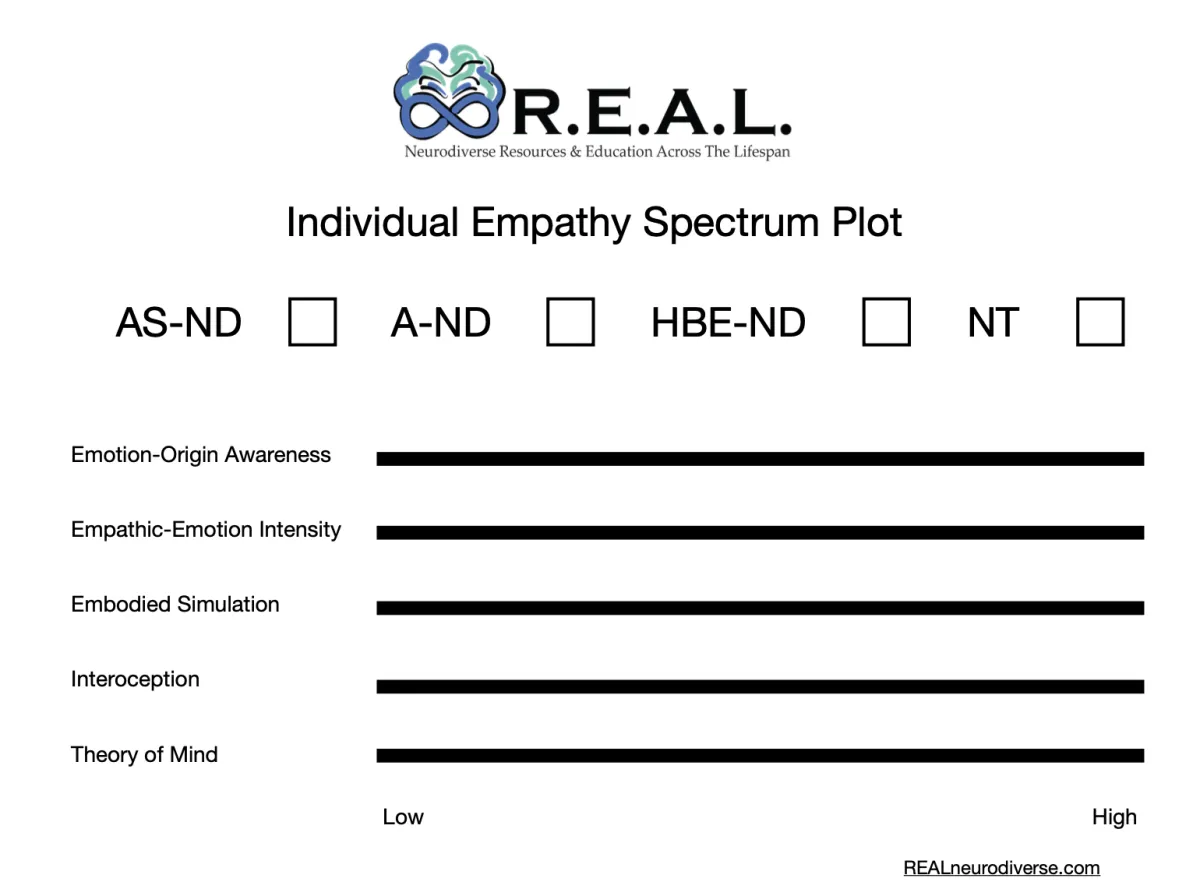
And Interoception, the fourth dimension, measures how well a person reads and interprets the sensations their own body generates in response to emotion. These two physical and sensory lines are often the missing piece in relational work: the place where you recognize, sometimes for the first time, why your body has been holding so much.
The fifth dimension, Theory of Mind, is where cognitive perspective-taking lives, the capacity to infer what another person is thinking, feeling, or intending. This is the highest-order layer of the IESP™, and it doesn't function in isolation. It emerges from everything beneath it. When providers and clients can see how the earlier layers are supporting or straining one's ability to take perspective, the picture of relational difficulty becomes much clearer.

Each dimension is measured, then visually plotted so you can immediately see:
Where strengths naturally lie
Where regulation may be harder than expected
How patterns differ across relationships
Why certain misunderstandings repeat
All without reducing anyone to a label. The IESP™ offers structure, not judgment.
Want a Closer Look at the Practice Tools?
The Individual Empathy Spectrum Plot™ is one part of a broader set of practice tools in the R.E.A.L. framework. If you'd like to understand how it connects to the five empathy spectrum assessments and the supplemental Theory of Mind resources, you can receive a short series of three emails that walks through each tool in turn.
You'll receive three emails about:
The five empathy spectrum assessments and the model of empathy that makes them possible
The Individual Empathy Spectrum Plot™ and how it turns assessment results into something you can see and work with directly in session
The Theory of Mind tools: when to use them, how they work, and how they support relational growth
Each email focuses on one layer of the practice tools suite, with enough detail to understand how the tools fit together.

When Seeing is Understanding
Many neurodiverse misunderstandings don't arise from indifference; they arise because individuals are genuinely operating from different processing baselines. One person's experience of connection looks completely different from another's, and neither of them can fully see that from the inside.
Some insights stay stuck in words. Others shift when you see them.
When you at your own IESP™ plot and recognize, perhaps for the first time, that your nervous system has been working harder than anyone realized, something moves. Defensiveness softens. Misinterpretation loses its charge. Perspective-taking becomes possible not because someone explained it better, but because the visual itself created room for understanding.
Mapping tools help:
Turn confusion into clarity
Reduce defensiveness and misinterpretation
Support perspective-taking instead of frustration
Ground nervous system responses with visible structure
This is especially true for those who process visually, get overwhelmed by verbal explanation, or simply need something tangible to make internal experience feel real. And you don't have to count on your provider to decode everything for you — the tool supports shared discovery, right there in the room.
Built for Real Support
The IESP™ isn’t something your provider memorizes and then delivers to you. It's something they use with you.
Assessment results, your own reflections, and relational examples come together in real time. Insight emerges in the moment. And because the structure is already built into the tool, your provider can stay present with you.

Client-led. Provider-facilitated. Structure without control. Autonomy with guidance.
Mapping as Part of the Three-Stage
Insight Pathway
The IESP™ doesn't stand alone. It's woven into the R.E.A.L. three-stage process, so mapping always happens in context, never in isolation.
📹
1. Neurodiversity-Affirming Education
You arrive at the IESP™ already holding shared language and a neurodiversity-affirming frame. The visual doesn't have to do all the work; the groundwork is already laid.
🌀
2. Individual Integration
This is where mapping lives. The IESP™ is completed collaboratively in session, provider and client discovering the results together, in real time.
🌿
3. Relational Discussion
When partners or family members have mapped their own profiles, the conversation changes. Instead of trying to explain an invisible experience, you can point to something, and that changes everything.
Mapping tools accelerate insight without overwhelm, letting understanding lead to change.
Ready To Have A Clearer Map?
When you can finally see how empathy moves through your nervous system, and understand why your relationships feel the way they do, something genuinely shifts. That clarity starts here.
Get language for what you've struggled to explain, and tools that illuminate invisible differences.
Step in. The structure and the support are already here.


