Tracks & Focuses
The Right Relational Focus. For the Right Neurology. For Every Client You Serve.
Every client who comes to you carrying the weight of a neurodiverse relationship is navigating something specific — and the R.E.A.L.™ framework is built to meet that specificity. Not with a single pathway that everyone moves through the same way, but with distinct tracks designed for each neurology and distinct focuses designed for each relational context.
This is where the framework gets personal. Here you'll find everything you need to match each client to the right track and focus — and to understand how the system holds together even when only one person in a family or partnership is ready to begin.
Explore Multi-Provider Options | Book A Demo
Step in. The structure — and the support — are already here.
Two Tracks. Two Focuses.
One Coherent System.
The R.E.A.L. framework organizes client support along two dimensions — and understanding both is what allows you to place every client precisely where they need to be.
The first dimension is track — and it follows neurology. Autistic clients move through the Autistic Track, which prioritizes clarity, structure, self-understanding, boundaries, and concrete insight pathways. Non-autistic clients move through the Non-Autistic Track, which centers self-reclamation, boundary work, and untangling the chronic accommodation that accumulates over years in a neurodiverse system. Each track is designed specifically for that neurology's way of processing — not as a modified version of the other, but as its own fully developed pathway.
The second dimension is focus — and it follows relational context. The Families Focus supports adults navigating neurodiverse dynamics within their family system — as parents, siblings, adult children, or extended family members. The Life Partners Focus supports clients who are in, or have been in, a neurodiverse intimate partnership. Each focus shapes how the framework's concepts are framed, applied, and explored — so that the material always speaks directly to the relational reality your client is actually living.
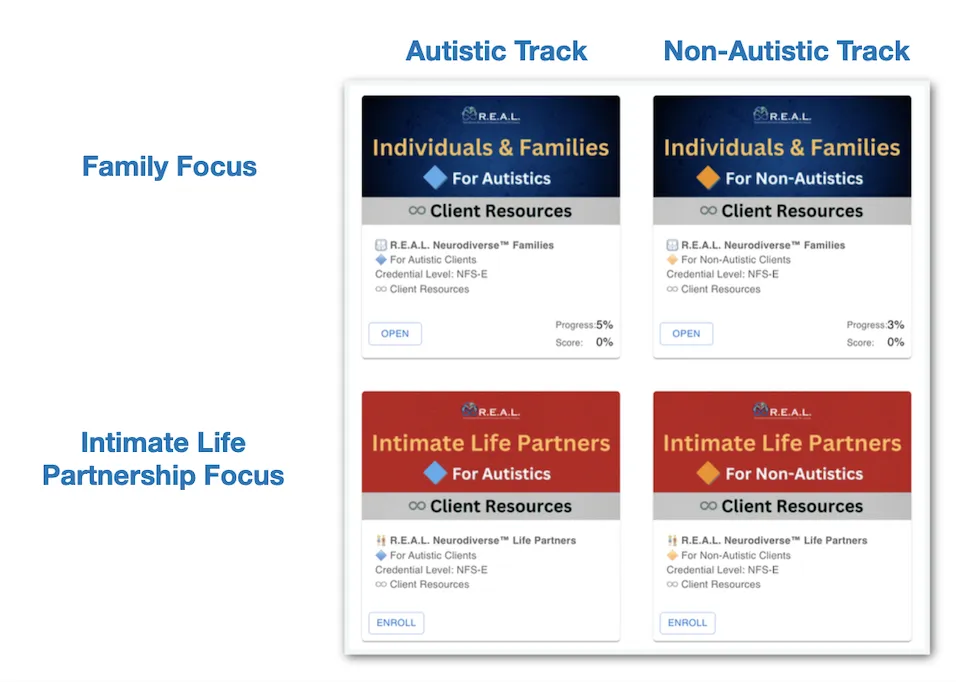
Together, these two dimensions create four distinct client pathways — Autistic/Families, Non-Autistic/Families, Autistic/Life Partners, Non-Autistic/Life Partners — each fully developed, each equally valid, and each running through the same 10-step arc with the same three-stage process at every step.
The focuses are seamlessly interwoven within the platform — meaning clients can move between them as their needs evolve, without losing continuity or coherence. A client who begins in the Families Focus can shift to the Life Partners Focus, without starting over or losing their place in the progression.
Distinct pathways. Shared structure. Every nervous system honored.
You Don't Need the Whole Family in the Room
One of the most important things to understand about the R.E.A.L. framework — and one of the most relieving things for many providers to hear — is this: a client can move through the entire program on their own, without any participation from a partner or family member, and receive full benefit from the work.
This matters because neurodiverse families and partnerships don't always arrive at support together. One person may be ready. Another may be resistant, unavailable, or simply not yet at a place where participation feels possible. Traditional relational models can struggle here — the work stalls when the other person won't come in. The R.E.A.L.™ framework doesn't stall. It was designed for this reality.
Because the model is individual-first by design, a single client moving through their track and focus is doing the whole work — not a partial version of it. They are building self-understanding, gaining language for patterns they've never been able to name, reclaiming identity and boundaries that may have eroded over years, and developing a clearer picture of the relational dynamics shaping their life. That growth is complete in itself. And it affects the relational system continuously — whether or not the other people in that system are participating.
If a partner or family member does choose to engage — now or later — the framework is ready for that too. Each person simply enters their own track and focus and moves through the individual work at their own pace. The structure holds everyone, separately and together, without requiring anyone to be in the same room before they're genuinely ready.

This is what individual-first actually means in practice. Not a consolation model for when the family won't come in. A deliberate design choice that honors every nervous system's need for its own foundation — before shared reflection becomes possible, productive, and safe.
The Three-Stage Insight Pathway
Applied at Every Step and Substep Throughout the Program
📹
1. Neurodiversity-Affirming Education
Clients begin with structured psychoeducational modules that establish shared language and neurodiversity-affirming context —offering autistic and non-autistic tracks and family and life partnership focuses.
🌀
2. Individual Integration
Clients engage in structured individual sessions using multimodal integration tools—including guided discussions or modules, reflective exercises, somatic practices, and more—each designed to honor individual neurological processing styles.
🌿
3. Relational Discussion
At the completion of each step or substep, individual track work culminates in optional structured shared discussions—bringing autistic and non-autistic participants together for insight-based, neurologically respectful exploration.
When clients understand first, reflect individually next, and only then come together for conversation, insight replaces reactivity—and change becomes more sustainable.
Choosing the Right Focus for Your Client

Once you've identified a client's track, the next question is focus. The two available focuses — Families and Life Partners — share the same 10-step structure and the same three-stage process at every step. What differs is how the material is framed, which relational dynamics are centered, and how integration tools are applied to the specific context your client is navigating.
The Families Focus is designed for any adult working through Neurodiverse Relationship Dynamics™ within their family system. This might be a parent coming to terms with their own or a family member's neurodivergence, an adult child beginning to understand patterns that shaped their childhood, or a sibling navigating a relationship that has always felt asymmetrical in ways they couldn't explain. The Families Focus addresses identity, boundaries, and relational roles within the broader family system — and is particularly well suited for clients whose primary source of relational pain is rooted in family-of-origin or parenting dynamics.
The Life Partners Focus is designed for clients who are in, or have been in, a neurodiverse intimate partnership. It speaks directly to the dynamics of long-term intimate relationships — emotional labor, attachment patterns, communication breakdowns, and the particular kind of loneliness that can develop when two people who love each other genuinely cannot find a shared map. This focus is equally relevant for clients who are working toward greater clarity within an ongoing partnership and for those who are making sense of a relationship that has already ended.
A client can engage with both focuses — sequentially — moving from one to the other as their needs and insights evolve. Someone who begins in the Families Focus and realizes midway through that the Life Partners Focus speaks more directly to their current reality can switch at any step, picking up exactly where they left off, with full continuity intact. The framework holds the progression regardless of which focus a client is working in at any given time.
One important scope note: all programs in the R.E.A.L. suite are developed specifically for relationships involving Level 1 autism. The framework's theory, tools, and integration materials are built around the relational and emotional experiences characteristic of Level 1 autistic individuals and those closest to them. It is not designed for higher support needs.
When Relational Tools Enter the Picture
The R.E.A.L.™ framework is individual-first — and that principle holds all the way through. But there are moments in the work when shared reflection becomes possible, appropriate, and genuinely valuable. The framework has tools for those moments too, each with a distinct purpose and a clear place in the progression.
The first and most accessible are Post-Step Integration Discussions — structured, insight-based conversations that become available after each individual has completed their own work for a given step or substep. These aren't joint therapy sessions. They are neurologically respectful spaces for mutual witnessing — an opportunity for partners or family members to hear and be heard, through a format that protects pacing, emotional safety, and individual progress. They are available to all providers with access to the R.E.A.L. programs and require no additional credentialing.
For providers with advanced credentialing, the Theory of Mind Dyadic Tools — the ToM-DT and ToM-DT VIA — offer a deeper level of structured intersubjective exploration. These tools support clients in examining how each person interpreted a shared experience, where perception gaps emerged, and what signals were sent but not received. They are reserved for providers holding the NFS-S credential or higher, and are best used when each client has their own individual provider support in place.
Entirely separate from the insight-based work is Sequential Problem Solving™ — a standalone practical framework for navigating shared decisions across neurotypes. Sold separately, it doesn't require participation in the R.E.A.L. programs and can be used at any point, with or without a partner or family member's involvement in the broader framework. When the relational system needs to make decisions — about parenting, finances, living arrangements, or transitions — Sequential Problem Solving™ provides the structure to do that safely, without collapsing into the patterns that unstructured problem-solving so often reactivates.
These tools are optional. They are not the heart of the work — the individual track and focus are. But when the moment is right, they open doors that individual work alone cannot open.
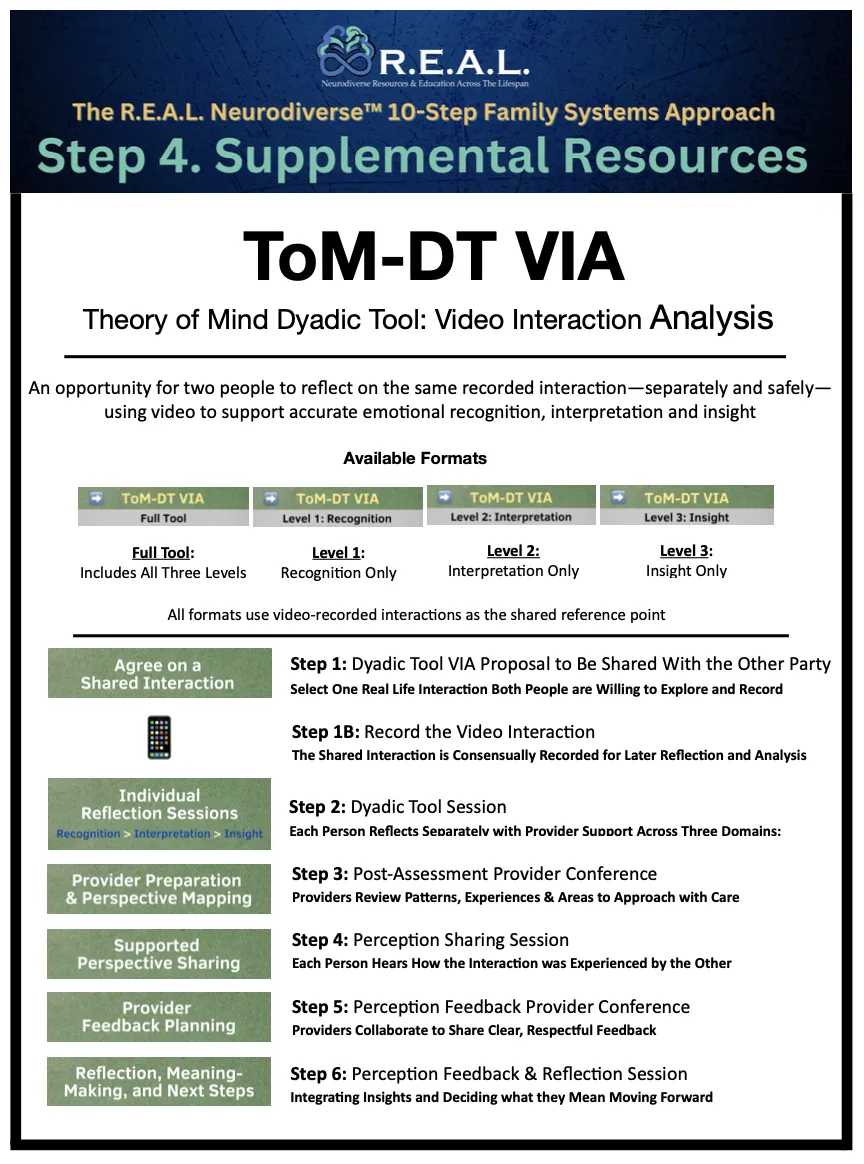
They are optional — but powerful. And they grow with your credential.
The Right Support — for Every Client, Every Neurology, Every Relational Context
Whether your client is autistic or non-autistic, navigating family dynamics or an intimate partnership, ready to begin alone or alongside someone else — there is a track and a focus built for exactly where they are. The structure is already in place. The pathways are already differentiated. The work can begin today.
From the first session to the last step — every nervous system has a place here.
Explore Multi-Provider Options | Book A Demo
Step in. The structure — and the support — are already here.


