Neurodiversity-Affirming Education: Over 200 Videos Building the Shared Language Your Clients Need
Bringing Neurodiverse Couples and Families to the Same Page. One Step at a Time
At the foundation of every step and substep in the R.E.A.L.™ framework is a set of neurodiversity-affirming psychoeducational videos: brief, professionally produced, and carefully crafted to explain complex concepts in language that is accessible, affirming, and immediately relevant to the relational realities your autistic and non-autistic clients are navigating. These aren't supplementary resources. They are the educational core of the entire program: the shared starting point from which all individual integration and relational reflection grows.
For providers, they are equally foundational. Every video comes with synchronized provider resources built directly into the platform, so you always know exactly what your client has watched, what it covered, and how to meet them where they are when they walk into session.
The R.E.A.L. Neurodiverse™ Framework begins with an educational lens. A way of seeing what has always been there so individual and relational integration can follow.
Transforming Neurodiverse Couples and Family Therapy. One video and one step at a time.
Step in. The structure and the support are already here.
A Shared Starting Point. Across Every Neurology.
One of the most quietly powerful design choices in the R.E.A.L. framework is this: every client watches the same videos.
Regardless of track, autistic or non-autistic, and regardless of focus, families or life partners, all clients begin each step and substep with the same psychoeducational content. The same concepts. The same language. The same foundational understanding of what is being explored at that stage of the work.
This matters enormously in practice. When a client and their partner or family member are both moving through the program, they are building a genuinely shared reference point; not two separate versions of the same idea, but the same idea, encountered together. They can speak to each other about what they watched. They can arrive at a shared session having already oriented to the same material. The common ground is real, because it was built from the same place.
What differs, and differs meaningfully, is what comes after the video. The support questions each client receives are tailored specifically to their track and focus, designed to guide reflection through the lens of their own neurology and relational context. An autistic client and their non-autistic partner watch the same video and then move into their own distinct integration work, each supported in the way their nervous system actually processes the material.
Same foundation. Different integration. That is neurologically respectful design in practice.
See It for Yourself: A Sample From the Neurodiversity-Affirming Video Library
Every video in the library is brief, professionally edited, and designed to make complex neurological and relational concepts feel clear and approachable for clients and providers alike.
Here is one example from the foundational lessons.
This foundational video introduces one of the most important, and most overlooked, realities in neurodiverse relational work: that many Level 1 autistic adults have never been diagnosed, and that their neurology is often invisible to the people closest to them, including themselves. As autistic individuals develop, they draw on declarative memory and learned social strategies to navigate a world that wasn't built for their neurology, often successfully enough that their autism goes unrecognized entirely. The result is that neurodiverse miscommunication is happening constantly, in families, workplaces, and communities, with no shared language to explain why. This video establishes that shared language; the essential first step toward understanding the relational dynamics the R.E.A.L. framework is built to address.
What Clients Receive With Every Video
Vocabulary, reflection, and research. Tailored to every neurology. Clear language. Personal reflection. Right in the portal.
Each video in the library arrives with a small but carefully considered set of supporting resources designed to deepen engagement, support self-directed learning, and make the content personally meaningful rather than abstractly educational
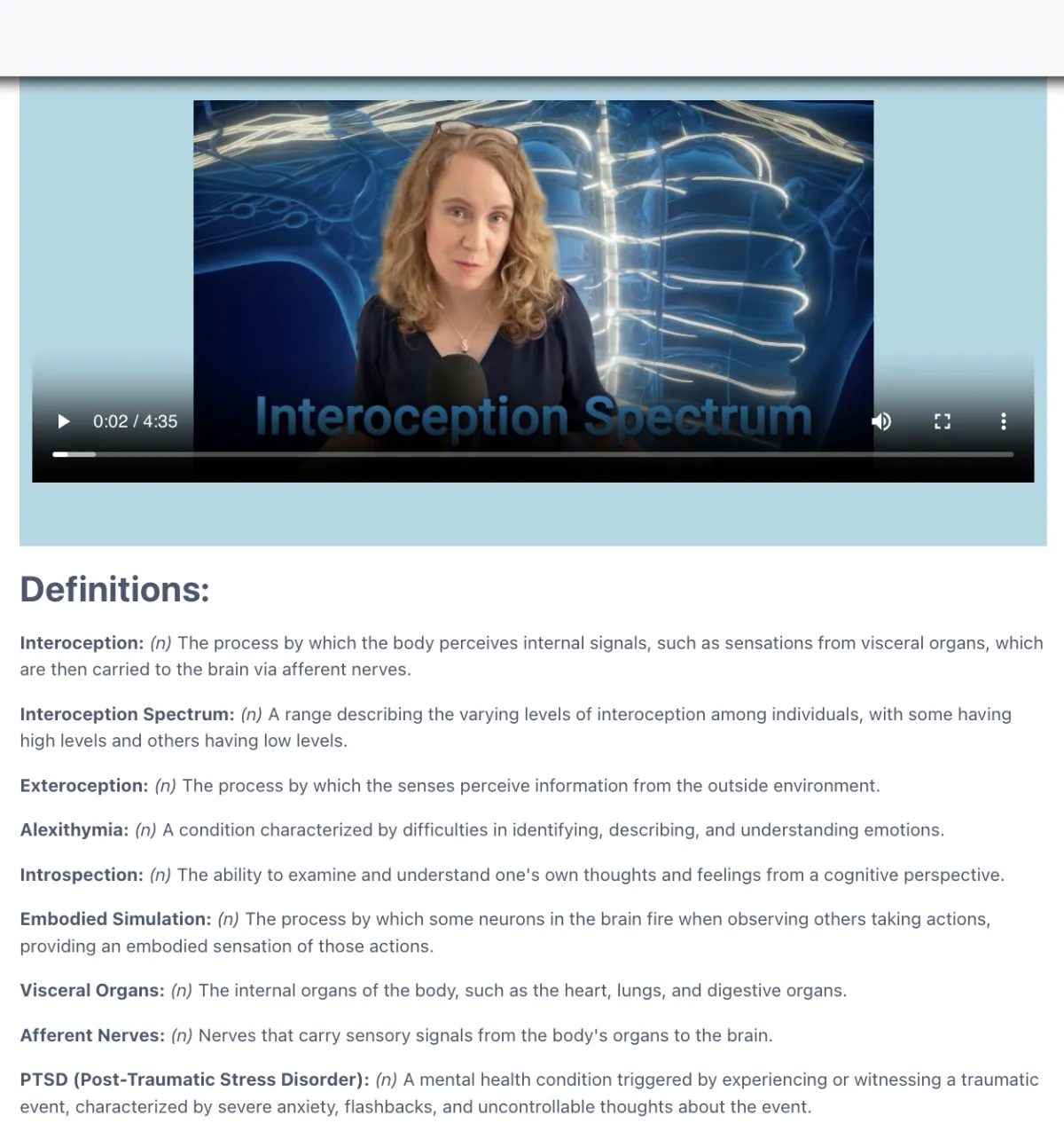
Alongside every video, clients find a set of vocabulary definitions for key terms introduced in the content: clear, accessible language that ensures nothing gets lost in unfamiliar terminology. Where relevant, links to pertinent research and further reading are included for clients who want to explore a concept more deeply at their own pace.
Most importantly, each video comes with three support questions tailored specifically to the client's track and focus. An autistic client working in the Families Focus receives questions written for their neurology and their relational context. A non-autistic client working in the Life Partners Focus receives a different set written for theirs. The questions are designed not to test comprehension but to invite personal reflection: to help each client connect what they've just watched to their own experience, their own patterns, and their own life.
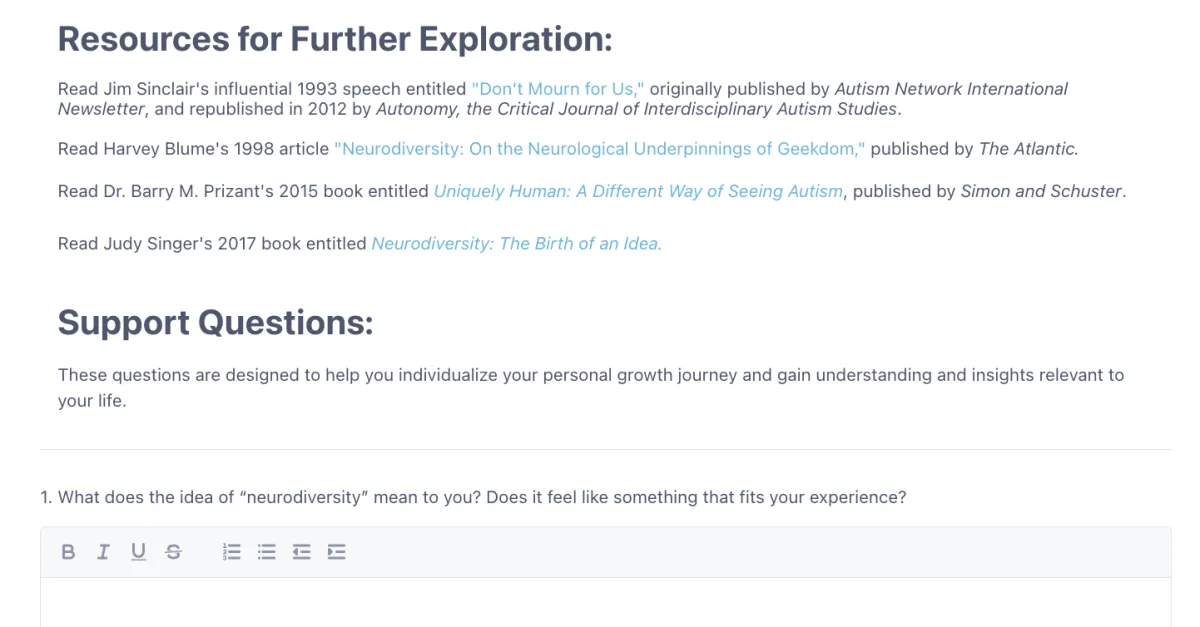
These resources are available to clients directly through their portal. They can be accessible between sessions, at clients' own pace, and in the moments when reflection feels most natural. Clients arrive to session having already sat with the material. The work in the room can go deeper because the preparation has already happened.
Every video prepares the client, so every session can go deeper.
What Providers Receive With Every Video
Your resources are built to match your clients' — fully synchronized, and always within reach.
For every video in the library, you receive a summary of the main points covered, consistent across all tracks and focuses, so you always have a clear picture of exactly what your client watched and what concepts they were introduced to. You never have to guess what the video covered or ask your client to recap it for you. The foundation is already shared before your session begins.
From there, your resources become tailored. Each video comes with a provider guide specific to your client's track and focus, giving you clinical context, session guidance, and support for how to process the material with that particular client in that particular relational context. The guide speaks directly to what an autistic client or a non-autistic client is likely to bring into the room after engaging with this content, and how to meet them there with precision and care.
And because your client's support questions are visible right within your provider resources, without having to navigate away or open a separate document, you always know exactly what your client has been reflecting on between sessions. You can follow their lead, build on their reflections, and move the work forward with full awareness of what they've already been sitting with.
The platform keeps everything in one place. Your attention stays where it belongs: with your client.
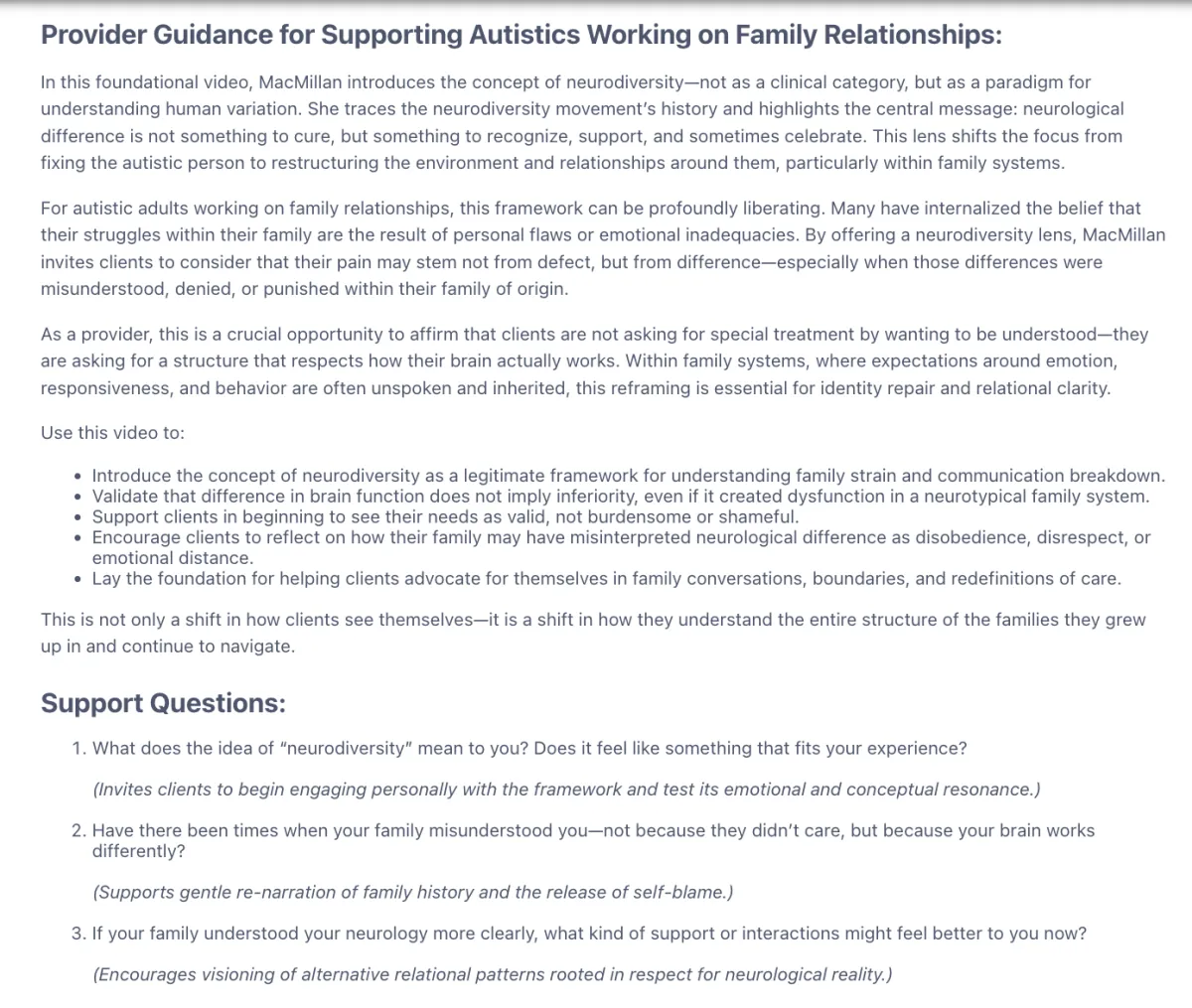
Every video. Every track. Every focus. Fully supported.
Over 200 Videos. One Coherent Arc.
Brief by design. Substantial by intention.
The R.E.A.L. video library is not a collection of standalone educational clips. It is a carefully sequenced body of work built to move through the full 10-step progression with the same coherence and developmental intentionality that runs through every other part of the framework.
Each video is brief by design. Complex neurological and relational concepts are distilled into clear, accessible language without oversimplifying what is genuinely nuanced, and without overwhelming clients who are already carrying a great deal. The production is professional and consistent throughout, creating a viewing experience that feels considered and respectful rather than clinical or generic.
A generation of autistic adults is arriving at a significant moment of self-recognition, many for the first time. This video explores how changes in diagnostic criteria since the 1990s created a lost generation of undiagnosed autistic adults, and how the growing visibility of autism online is now helping those adults find language for experiences they've carried their whole lives. For providers, this context matters: many clients who have cycled through misdiagnoses such as anxiety, bipolar disorder, borderline personality disorder, eating disorders, etc. may be autistic adults who simply never had their neurology recognized. Understanding this moment is part of understanding who is sitting across from you.
Across more than 200 videos, the library builds something that is difficult to achieve through any other format: a shared language. Step by step, concept by concept, clients develop a vocabulary and a framework for understanding their own experience that they carry with them into every session, every conversation, and every moment of reflection between them. That language doesn't reset. It accumulates. It becomes the foundation on which everything else is built: the integration work, the relational discussions, the insight that changes things.
For providers, the library means you are never starting from scratch. The education has already happened. The language is already in place. Your role is to go deeper, and the structure is always there to support you in doing exactly that.
Shared language. Progressive depth. Built to hold together over time.
The Three-Stage Insight Pathway
Applied at Every Step and Substep Throughout the Program
📹
1. Neurodiversity-Affirming Education
Every step and substep begins here: with brief, professionally produced videos that build shared language and a neurodiversity-affirming foundation, offered across autistic and non-autistic tracks and family and life partnership focuses.
We Are Here
🌀
2. Individual Integration
The videos create the foundation. From there, each client moves into their own integration work with support questions, modalities, and reflection tools tailored specifically to their neurology and relational focus.
🌿
3. Relational Discussion
When individual integration is complete, the shared videos become a bridge, giving partners and family members a common reference point from which to begin neurologically respectful, insight-based conversation.
The videos are where shared understanding begins. Everything that follows is built on that foundation.
Want a Clear Walkthrough of the Three Stages?
Neurodiversity-affirming education is only one part of the process. It works alongside Individual Integration and Relational Discussion to support lasting change.
If you would like to understand how these three stages function together in practice, you can receive a short, structured series of emails focused specifically on the 3-Stage Insight Pathway.
Explains how each stage builds on the others
Clarifies how providers move from insight to application
Designed to support real-world implementation
This is not additional content. It is an organized way to understand what you are already exploring here, delivered straight to your email inbox.
The Education Is Already Built.
The Language Is Already There.
Over 200 carefully sequenced videos. Synchronized provider resources at every step. Client support questions tailored to every track and focus. All of it organized, accessible, and ready to use from the moment your subscription begins.
From the first video to the last step, the foundation is already in place.
Step in. The structure and the support are already here.


