FAQ
Frequently Asked Questions for Solo Providers
Whether you’re considering the R.E.A.L. Neurodiverse™ framework for your practice or you’ve just attended a demo, these questions cover the topics providers ask most often. If you don’t find what you’re looking for here, feel free to reach out to us directly.
Step in. The structure and the support are already here.
Getting Started: What to Expect When You Enroll
What happens when I enroll?
Your subscription is typically activated within three business days. From that point, you have full access to the entire R.E.A.L. Neurodiverse™ program: provider pathways, all client resources, assessments, integration tools, the full video library, and your NFS-E credentialing coursework. There is no gated onboarding period. Everything is available from day one.
How quickly can I start working with clients?
Immediately. The program is designed so that you begin using the materials with clients from the day your access is activated. Your credentialing coursework unfolds in parallel with your client work, so you are learning as you go, not preparing before you start.
Do I need to master all of the program content before I begin using it with clients?
No. The R.E.A.L. programs are designed for experiential learning. You do not need to memorize or master the material in advance. You can learn alongside your client, using the step-by-step guides, videos, and support materials as you go. The synchronized provider and client pathways mean you always know what your client is engaging with and how to respond.
What is the UnitusTI platform?
UnitusTI is the cloud-based therapy and education platform that hosts the R.E.A.L. Neurodiverse™ provider and client pathways. It is HIPAA-compliant, FERPA-compliant, and GDPR-compliant, with a 10-year track record of supporting practitioners across a range of disciplines. Everything lives in one place: videos, integration tools, provider guides, synchronized tracks, scheduling, and progress tracking. A one-time $100 setup fee is charged by UnitusTI upon account activation, covering the configuration of your provider and client portals.
Does the R.E.A.L.™ framework replace my existing therapeutic or coaching modalities?
No. The R.E.A.L. framework is designed to complement and enhance the skills you already bring to your practice. It provides a structured lens, shared language, and neurodiversity-specific tools that work alongside your existing modalities. Many providers find that it fills a gap they had been sensing in their relational work without requiring them to abandon anything that is already effective.
What's Included For Solo Providers: Full Program Access From Day One
What do I get access to when I enroll?
You receive full access to the entire R.E.A.L. Neurodiverse™ program: the 10-Step Framework, over 200 psychoeducational videos, the Seven Integration Modalities, five Empathy Spectrum Assessments, the Individual Empathy Spectrum Plot™ (IESP™), structured Relational Discussion templates, supplemental Theory of Mind tools, synchronized provider and client pathways, and your NFS-E credentialing coursework. Everything is available from the day your subscription is activated.
How many videos are included?
Over 200 psychoeducational videos, carefully sequenced across the full 10-step progression. Each one comes with vocabulary definitions, tailored support questions for every track and focus, and a synchronized provider guide..
What are the Seven Integration Modalities?
Seven structured tools for individual integration: Integration Discussions or Modules, Integration Poems, Integration Artwork, Integration Invitations, Somatic Integration Practices, Retrospective Reflections, and Future Narratives/Mapping. Each modality is adapted for autistic and non-autistic processing styles and available to clients at every step.
What assessments are included?
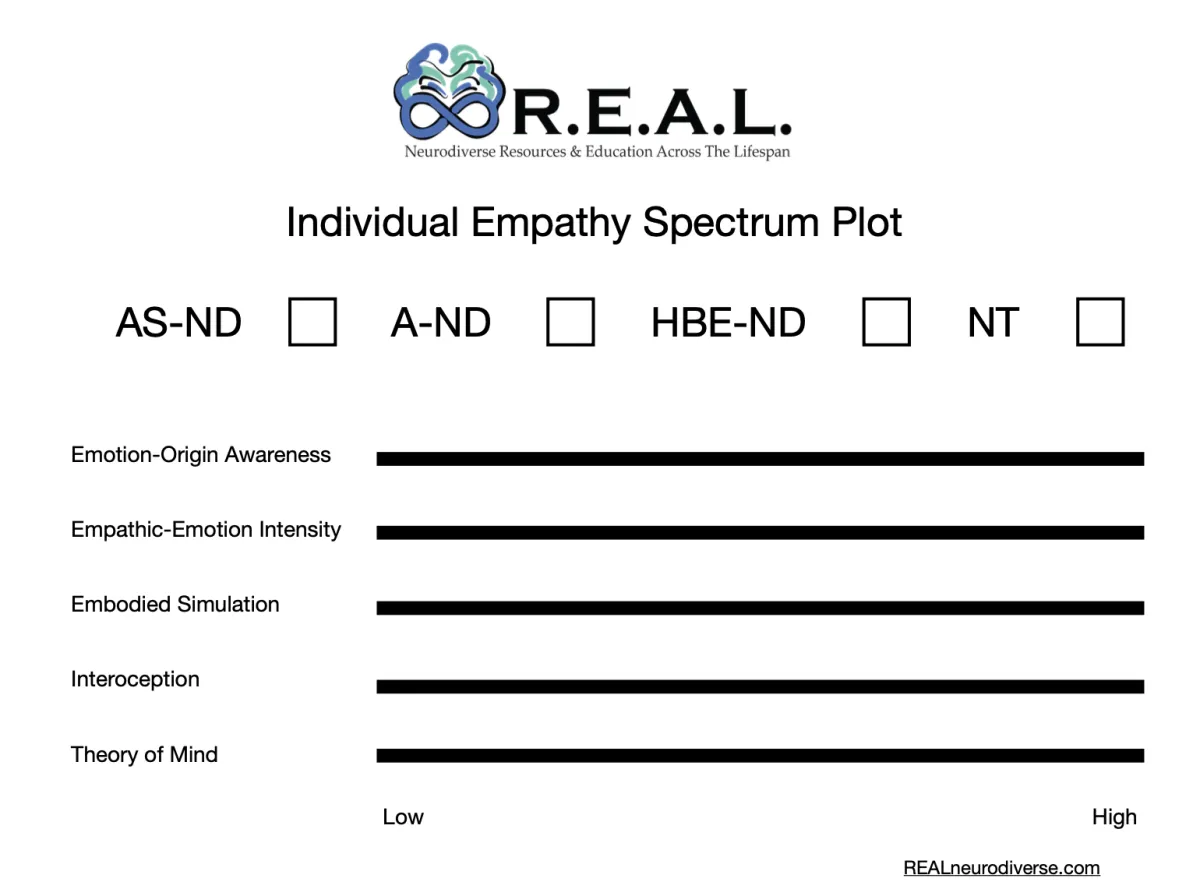
Five Empathy Spectrum Assessments measuring Emotion-Origin Awareness, Empathic-Emotion Intensity, Embodied Simulation, Interoception, and Theory of Mind. Results feed into the Individual Empathy Spectrum Plot™ (IESP™), a visual mapping tool used collaboratively in session. Additional assessment tools become available at advanced credential levels.
Are the Relational Discussion tools included?
Yes. Post-Step Integration Discussions are included with NFS-E access and require no additional credentialing. The advanced Theory of Mind Dyadic Tools (ToM-DT and ToM-DT VIA) become available with NFS-S or NFS-P credentials.
Is the Theory of Mind Reflection Session (ToM-RS) included?
Yes. The ToM-RS is included with NFS-E credential access and can be integrated whenever a client's process calls for it.
Are Framework Papers included?
Yes. In-depth research and theory documents are embedded throughout the platform, marked with a 🎓 graduation cap icon. They are optional but available for providers and clients who want to explore the academic foundations more deeply.
How many client portal spots are included?
Your subscription includes active client portal access for up to three clients. Additional clients may be added at $39/month per client, with no cap on the number of clients you can support.
Does the program continue to grow?
Yes. New content, tools, and features are continually added based on feedback from the R.E.A.L. provider community. The program grows alongside your practice.
Synchronized Provider and Client Pathways: How the Platform Keeps You Connected
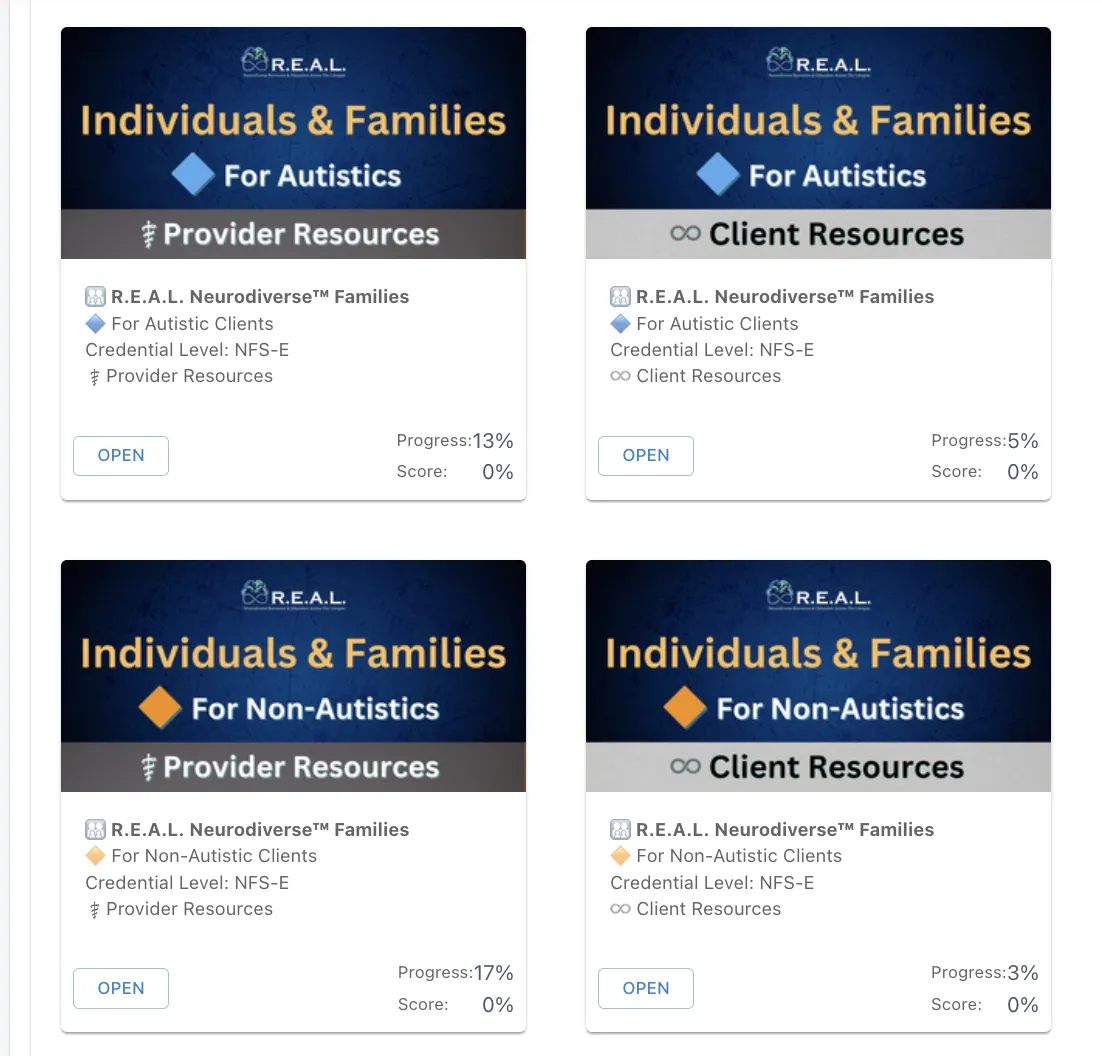
What does it mean that the provider and client pathways are synchronized?
It means that at every step and substep of the 10-Step Framework, you receive provider-specific resources that are directly aligned with what your client is engaging with in their own portal. You have access to what your client is engaging with, what they've been reflecting on, and what to explore in session.
What do clients have access to in their portal?
Clients have direct access to the psychoeducational videos, vocabulary and research links, tailored support questions for their track and focus, the Seven Integration Modalities, and structured relational discussion templates when appropriate. These materials are available before, during, and between sessions, at the client's own pace.
Why does client access between sessions matter?
When clients can engage with materials on their own time, they arrive to session having already reflected, already holding language for what they're noticing, and already ready to go deeper. Your 50 minutes together becomes a space for processing and guided exploration rather than content delivery. The learning doesn't reset each week. It carries forward.
What do I receive as the provider at each step?
For every video in the library, you receive a summary of the main points, a provider guide tailored to your client's track and focus, session guidance for the current step, recommendations for applying each of the Seven Integration Modalities, and visibility into your client's support questions. These are structured professional resources, not summaries of the client content.
Can I see what my client is working with?
Yes. You have access to every client track alongside your own provider resources. You can see the videos, support questions, and integration tools your client is engaging with, so the work stays connected and builds over time.
Does this synchronized design change how sessions feel?
Providers consistently describe the experience as more connected and less fragmented. Because both you and your client are moving through the same progression with distinct but aligned resources, insight accumulates rather than resetting. Each session builds on the last, and both of you know where you are in the process.
The 10-Step Framework: Intentional Sequencing For Lasting Change
What is the 10-Step Framework?
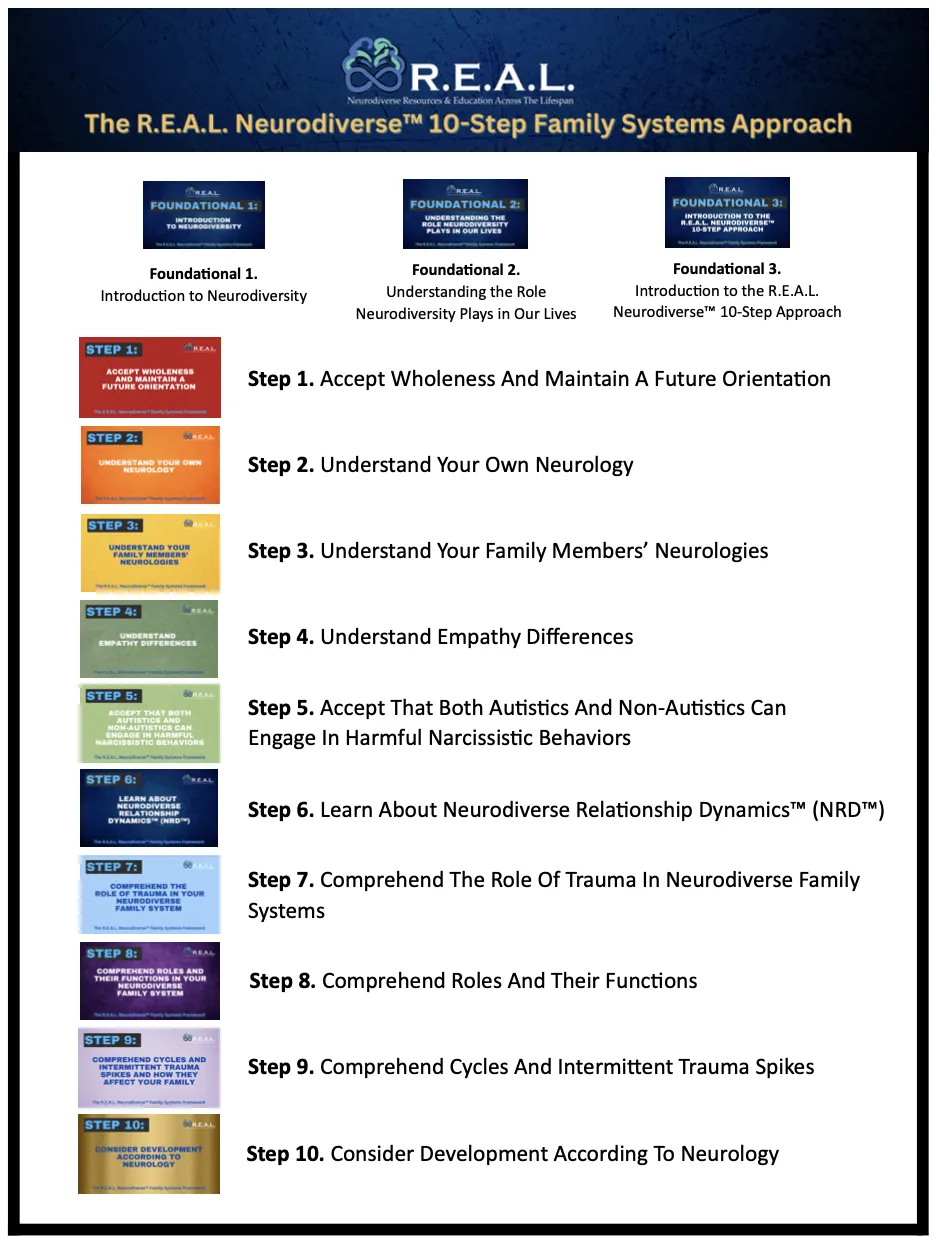
The R.E.A.L. Neurodiverse™ 10-Step Model is a developmental arc that guides clients from self-understanding outward toward relational clarity. It moves through ten distinct territories in a deliberate sequence, with each step building on the one before it. The progression is designed to feel like a journey rather than a checklist.
What do the ten steps cover?
The arc opens with wholeness and future orientation, establishing dignity and possibility before any difficult material is introduced. From there, clients build self-knowledge about their own neurology, then expand that understanding outward to the neurologies of the people closest to them. The middle steps explore empathy differences, harmful patterns, and Neurodiverse Relationship Dynamics™ as a full framework. The later steps move into the role of trauma in neurodiverse systems, relational roles and what they protect, cycles and trauma spikes, and finally a forward-looking consideration of development according to neurology.
Why does the sequence matter?
Each step is designed to arrive only after the emotional and cognitive groundwork for it has been laid. Introducing empathy differences before self-knowledge is established, or naming harmful patterns before clients have language for neurological mismatch, can cause confusion, defensiveness, or shame. The sequencing protects emotional safety and allows insight to accumulate rather than fragment.
Do clients start at Step 1?
Clients begin with three foundational lessons before entering Step 1. These lessons introduce the concept of neurodiversity, help clients recognize how their own neurology shapes stress and communication, and explain the 10-step structure itself. This shared orientation gives every client, regardless of neurology or relational focus, a common starting point before the developmental work begins.
Does the same process happen at every step?
Yes. At every step and substep, clients move through the same three-stage insight pathway: neurodiversity-affirming education, individual integration using the Seven Modalities, and optional structured relational discussion. This consistency is part of what makes the work effective. The content deepens as the steps progress, but the process remains familiar and predictable.
Can I adjust the sequence based on what a client needs?
The recommended sequence exists for good reason, but you have flexibility within it. You can revisit earlier steps, slow down, skip ahead, or adjust depth based on a client's readiness. What stays constant is the three-stage process and the synchronized provider and client pathways that keep the work coherent regardless of how the delivery adapts.
Where does the 10-step arc lead?
Step 10 culminates in MacMillan's two models of psychosocial development: the Spiral Model™ for non-autistic clients and the Staircase Model™ for autistic clients. Every step in the framework is designed to support movement along whichever developmental path reflects each client's neurology, bringing the work full circle to the developmental foundation it was built on.
The Three-Stage Insight Pathway: Education, Integration, Relational Discussion
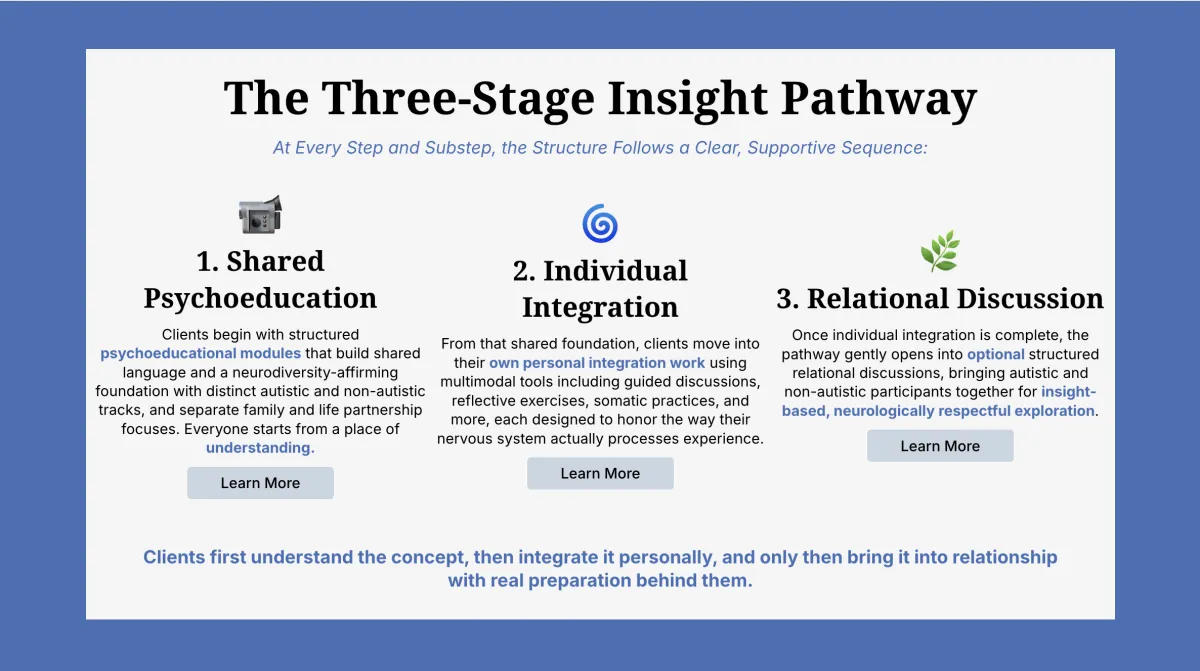
What is the Three-Stage Insight Pathway?
It is the repeating process that drives every step and substep of the 10-Step Framework. At each stage of the progression, clients move through the same three phases in the same order: neurodiversity-affirming education, individual integration, and optional structured relational discussion. This cycle is the engine of the model.
Why does education come first?
Because clarity has to exist before personal reflection or good decisions are possible. The psychoeducational videos give every client, autistic and non-autistic, a foundational understanding of the concept being explored at that step. That understanding is valuable in itself. Many clients arrive carrying years of confusion about what has been happening in their relationships, and the education stage is often where that confusion begins to lift. From that clarity, clients are better equipped to engage in individual integration, to make informed decisions about their own lives, and, when appropriate, to enter shared reflection with genuine preparation behind them. Without that common ground, integration work risks being built on assumptions, and relational conversations, when they do happen, risk replaying the same misunderstandings that brought clients in.
Why does individual integration come before relational discussion?
Because in neurodiverse systems, shared conversation without individual preparation almost always backfires. Joint sessions tend to replay existing dynamics: one person masking, the other over-accommodating, both leaving more discouraged than when they arrived. Individual integration gives each person the chance to understand their own neurology, their own patterns, and their own experience before being asked to hold someone else's perspective alongside it.
Is relational discussion required?
No. Relational discussions are always optional. They are available after each individual has completed their own work for a given step or substep, but they are never mandatory. A client can move through the entire program on their own and receive full benefit from the work. The relational stage is there when readiness and willingness align.
Does this three-stage process ever change?
No. The content deepens as the steps progress, and the emotional complexity increases, but the process itself remains the same at every step and substep. That consistency is intentional. It creates predictability for clients and providers alike, and it allows insight to accumulate through a rhythm that becomes familiar rather than disorienting.
Why is this sequence especially important for neurodiverse relational systems?
Autistic and non-autistic individuals process emotional and relational information differently. A process that moves too quickly to shared conversation, or that skips individual integration, can overwhelm one person while under-serving the other. The three-stage pathway protects both nervous systems by ensuring that each person has done their own work before anything shared is introduced. Structure is not a constraint on connection in neurodiverse systems. It is what makes genuine connection possible.
Practice Tools: Assessments, Mapping, Theory of Mind
What practice tools are included in the framework?
The R.E.A.L.™ framework includes five Empathy Spectrum Assessments, the Individual Empathy Spectrum Plot™ (IESP™) visual mapping tool, and supplemental Theory of Mind tools. Together, these give you structured, quantitative ways to make invisible relational dynamics visible, both for yourself and for your clients.
What do the five Empathy Spectrums and their Assessments measure?
Each assessment maps a distinct dimension of how empathy moves through a person's nervous system: Emotion-Origin Awareness (distinguishing your emotions from others'), Empathic-Emotion Intensity (how strongly you feel others' emotions), Embodied Simulation (nonverbal attunement and internal mirroring), Interoception (reading emotional signals from within the body), and Theory of Mind (cognitive perspective-taking). Both autistic and non-autistic individuals fall somewhere on each of these spectrums.
Are these assessments diagnostic tools?
No. They are structured self-insight tools designed to support guided reflection, not diagnosis. Their purpose is clarity: helping clients understand how empathy actually works in their nervous system so they can make sense of patterns that have felt confusing or personal.
What is the IESP™?
The Individual Empathy Spectrum Plot™ is a visual mapping tool that takes each client's assessment results and plots them across all five dimensions. It turns complex emotional and cognitive patterns into something clients can actually see, discuss, and work with in session. Providers and clients complete it collaboratively in real time.
Why does visual mapping matter?
Many neurodiverse misunderstandings arise because individuals are operating from genuinely different processing baselines, but neither person can see that from the inside. When a client looks at their own IESP™ and recognizes where their nervous system has been working harder than anyone realized, something shifts. Defensiveness softens. Perspective-taking becomes possible. When partners or family members compare their plots, the relational picture becomes clearer without anyone needing to be blamed.
What are the Theory of Mind tools?
Three supplemental resources for moments that call for more precision. The ToM-RS (Theory of Mind Reflection Session) is a provider-guided interview that anchors perspective-taking in a client's own real-world experiences rather than hypothetical scenarios. It is included with NFS-E access. The ToM-DT and ToM-DT VIA are structured dyadic tools for exploring how two people interpreted a shared experience, available with advanced NFS-S or NFS-P credentials.
Do I need to use every tool with every client?
No. These tools are available when they serve the work. Use your clinical or coaching judgment to decide which tools are relevant for each client at each stage. They are designed to deepen insight, not to add complexity for its own sake.
Why Separate Tracks for Autistic and Non-Autistic Clients
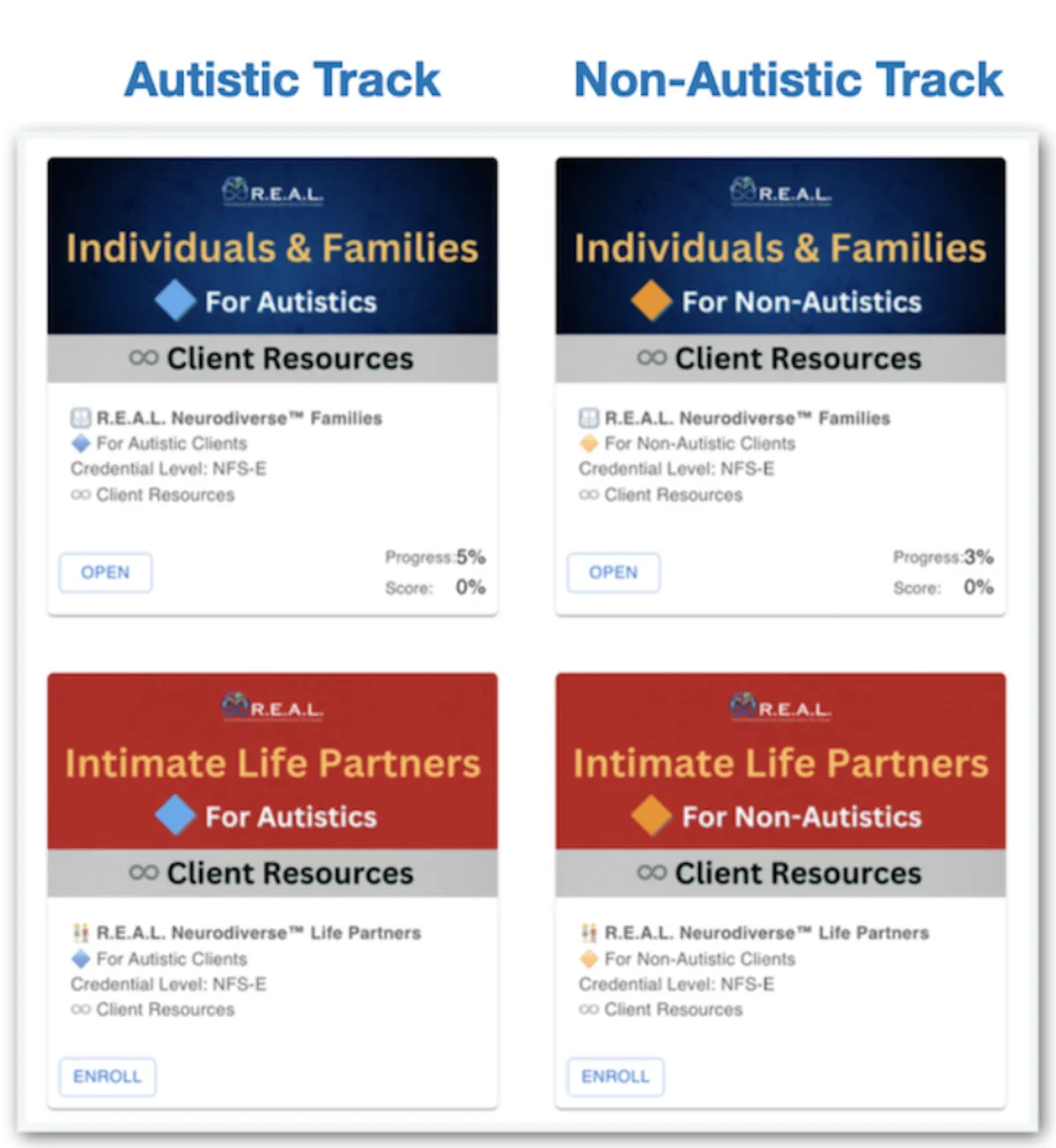
Why are there separate materials for autistic and non-autistic clients?
Because autistic and non-autistic individuals often process relational experiences in profoundly different ways. Separate materials ensure that each person receives support that aligns with their unique neurological processing style, emotional needs, and relational challenges.
What kinds of differences does the program account for?
The program addresses neurological differences in areas such as sensory processing, interoception, emotional regulation, empathy style, attachment needs, and communication pacing. These differences are not preferences. They are neurobiological realities that require tailored support.
What provider resources are available for each group?
You receive separate provider guides, reflection tools, integration prompts, and session guidance for autistic and non-autistic clients. Each set is designed to help you support that client’s growth without projecting assumptions from another neurological experience.
Why is this dual-track system considered ethical?
Because it honors difference instead of erasing it. Asking all clients to grow within a single framework, often based on non-autistic norms, can reinforce historical imbalances and pathologize difference. The R.E.A.L. approach offers neurologically aligned care for each client’s needs.
How does this approach support relational healing?
Healing begins with differentiated insight: understanding and respecting difference at a structural level. When clients are supported according to their own neurology, they are more likely to reconnect with their authentic self and engage in relationships with greater clarity, safety, and possibility.
How are the materials different for each track?
Each set of materials is aligned to the neurological perspective of the client it serves. Autistic clients are guided through materials that honor their processing style with clarity and structure, while also supporting identity reclamation after years of masking, self-understanding that isn't filtered through non-autistic expectations, and insight into how their neurology shapes their relational experience.
Non-autistic clients are supported in stepping out of chronic accommodation patterns, reclaiming their own sense-of-self, and understanding systemic dynamics without blame or shame. Neither track is a simplified version of the other. Both are fully developed pathways built from the ground up for that neurology's way of experiencing relationships.
Do both sets of materials follow the same structure?
Yes. Both autistic and non-autistic clients work through the same 10-step program framework, but each step is adapted in language, tone, and focus to support the needs and processing strengths of that group.
Can I use the same tools and questions with both autistic and non-autistic clients?
The tools and materials are designed differently for each track, and using them as intended produces the best results. Each track is built to speak directly to the neurological perspective of the client it serves, and mixing materials across tracks can dilute that specificity. Follow the client's self-identified track, and use the materials that correspond to it.
What if a client is still exploring whether they are autistic?
Many clients enter the program without a formal diagnosis, and some may be actively questioning their neurological identity. This is a normal and expected part of the process. Providers should make both tracks available to any questioning client and allow the client to choose the one that feels most resonant. If clarity shifts over time, the client can move to the other track without losing their place in the progression.
Should I assign a client to a track based on my own assessment of their neurology?
No. Track selection is always the client's choice. Providers using this framework are not diagnosing autism, and assigning a client to the autistic track based on a provider's impression — however well-intentioned — moves beyond the scope of this work and risks mislabeling, harm, and a breach of trust. Many autistic adults arrive saying they are not autistic, and that perspective must be respected. The program is designed so that insight can emerge naturally over time through the psychoeducational materials and integration work. A client who begins in the non-autistic track and later recognizes themselves in the autistic materials can shift tracks when they are ready, on their own terms.
How do I handle it if I suspect a client may be autistic but they don't identify that way?
You can share that both tracks are available and briefly describe what each one offers, without steering the client toward either one. Beyond that, the framework itself does much of the work. The psychoeducational videos and integration materials often help clients recognize their own neurology over time, without the provider needing to name it for them. Pushing a client toward a neurological identity they haven't arrived at themselves can damage the therapeutic relationship and replicate the very dynamic this framework is designed to interrupt.
What if a client chooses a track that doesn't seem to match their processing style?
Trust the client's choice. The materials within each track are designed to meet the client where they are, and self-identification is a foundational principle of neurodiversity-affirming care. If a mismatch becomes apparent over time, the client will often recognize it through the work itself. Your role is to hold the space for that recognition, not to impose it.
Choosing the Right Focus: Families, Life Partners, or Both
How do I know which R.E.A.L. program is right for my client?
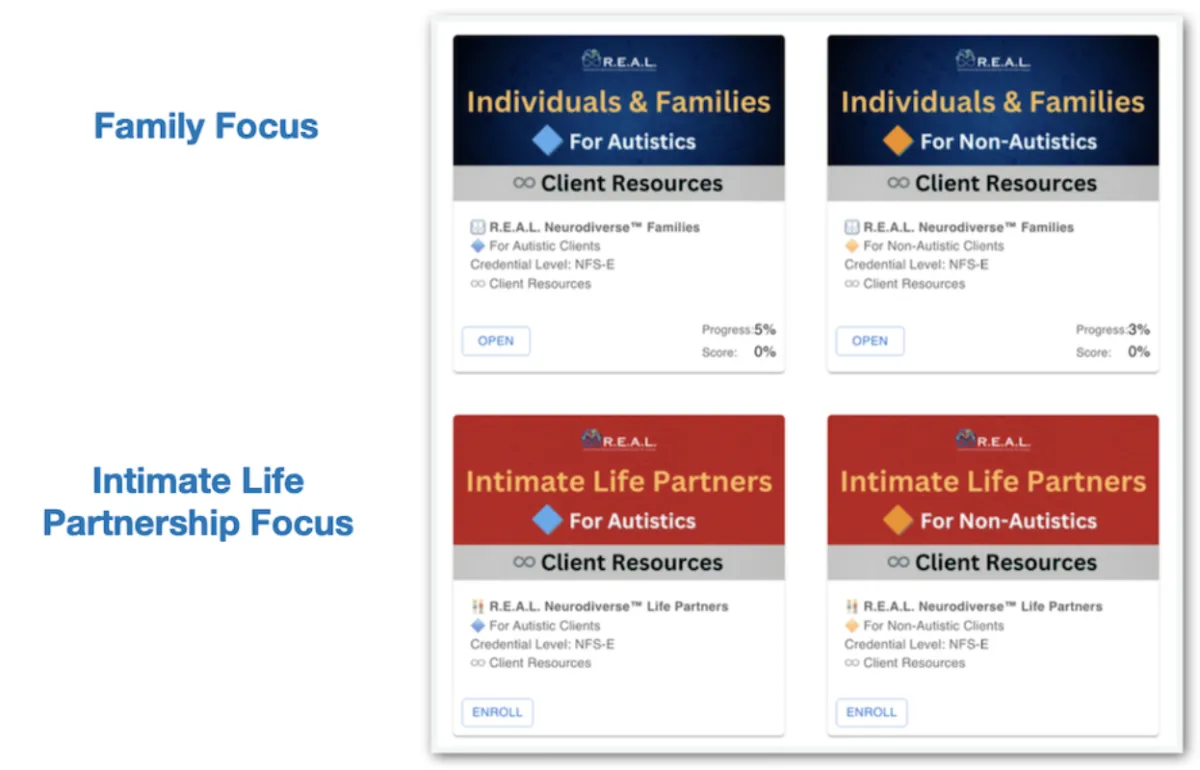
Start with the client’s primary relational focus. If they are working on family dynamics, choose the Families focus. If they are focused on a romantic or long-term intimate partnership, choose the Life Partners focus. Both share the same core structure but are tailored by relational context.
What’s the difference between the Families and Life Partners programs?
Both use the same 10-step framework and integration structure, but the Families program focuses on roles like parent, sibling, or adult child, while the Life Partners program is centered around romantic and intimate partnership experiences. The language, examples, and reflection tools are adapted accordingly.
What if my client is navigating multiple relational challenges?
Select the program that aligns with their current priority or source of greatest emotional complexity. All programs include crossover insights, so clients will often gain clarity in other relational domains as well.
Can I switch my client from one program to another if their focus changes?
Yes. Because the structure is consistent across programs, transitioning is straightforward. Clients can shift from the Families focus to the Life Partners focus or vice versa at any step, without losing their place in the progression.
Are these programs appropriate for all forms of autism?
No. All current programs in the R.E.A.L.™ suite are designed specifically for relationships involving Level 1 autism. They are not intended for individuals, partnerships, or families with higher support needs, as the language and cognitive framing assume verbal processing and self-reflective capacity.
Can I use these programs with clients who are questioning whether they are autistic?
Yes. Many clients begin the process without a formal diagnosis. The programs are built to support exploration, identity clarification, and relational insight, regardless of whether a diagnosis has been confirmed.
What if a client wants to work on parenting or workplace issues?
Dedicated programs for parenting, co-parenting, and professional contexts are in development. In the meantime, you can use the Families or Life Partners program that best fits the emotional core of the client’s situation, while helping them apply the insights to broader domains.
From Individual Work to Shared Reflection: When and How to Use Relational Tools
Can I use this program with an individual client, even if they are not in contact with a partner or family member?
Yes. The program is designed to be fully effective as a standalone individual support system. Many clients use it to work through past or current relationships, build clarity, and strengthen their identity and boundaries, regardless of whether others are involved.
Do I need to work with both members of a couple or family to use this program effectively?
No. The program supports the growth of each individual regardless of who else participates. Each client receives tailored content based on their own neurology and relational goals.
Can I start with couples or family work right away?
No. This program is designed to prioritize individual insight and neurological processing before any shared conversations take place. Each person must complete their own reflection and integration for each step before participating in any relational work. This ensures emotional safety, reduces confusion, and supports long-term growth rooted in self-awareness rather than premature intervention.
Why is it important to begin with individual work?
Many neurodiverse families and couples are locked in reactive cycles that cannot be interrupted through shared sessions alone. Each person brings a distinct neurological profile, trauma history, and relational role. The program works by helping clients understand and integrate these layers individually, so they can show up to relational work with more clarity, regulation, and choice. Jumping ahead to relational problem-solving can lead to retraumatization or regression.
When can relational conversations happen?
After each individual completes their work for a given step, they may optionally participate in a Post-Step Integration Discussion. These are structured conversations designed not for repair or decision-making, but for mutual insight and respectful reflection. Participants share what they’ve learned, compare neurological experiences, and begin to recognize shared patterns. These conversations should never be used to force agreement or push for behavioral change.
How are Post-Step Integration Discussions structured?
Discussions may be facilitated by one or both providers, or completed independently at home using clear preparation materials. They follow a step-by-step format: preparation, grounding, mutual sharing, joint reflection, and optional closing rituals. This pacing helps ensure both individuals can remain regulated and centered in their own insights.
Can we work on decisions or shared problems during these discussions?
No. Problem-solving should not take place within Post-Step Integration Discussions. These conversations are designed for mutual insight and reflection, not for negotiation or decision-making. For families and partnerships that need to navigate shared decisions, the R.E.A.L. framework provides a separate resource, Sequential Problem Solving™, which offers a structured approach to cooperative planning around parenting, finances, living arrangements, and transitions. Because unstructured problem-solving so often reactivates historical patterns in neurodiverse systems, keeping these two functions separate protects the integrity of both.
What other tools are available for shared insight?
Two advanced tools are available to providers who have earned the NFS-S credential. The Theory of Mind Dyadic Tool (ToM-DT) is a structured process for exploring how two individuals interpreted a shared experience, where perception gaps emerged, and what signals were sent but not received. Both parties reflect separately with their respective providers before perspectives are shared. The ToM-DT Video Interaction Analysis (ToM-DT VIA) extends this process by using a consensually recorded interaction as the basis for reflection, removing the limitations of memory and making nonverbal cues and emotional timing visible in ways that recall alone cannot. Both tools require advanced credentialing because intersubjective exploration carries real risk of retraumatization without sufficient clinical containment.
What if both members of a couple or family want to participate?
Whenever possible, each member should be assigned their own provider. This ensures emotional safety, reduces interpretive bias, and supports each client’s unique neurological processing.
I work in a group practice. Can we serve both members of a couple or family?
Yes. In most cases, each member of the couple or family system should work with their own provider. If a single provider wishes to work individually with more than one member of the same system, they should first meet the program’s experience thresholds: at least one year of use with 10 or more concurrent clients, or at least three years of use with fewer than 10 concurrent clients. Even in these cases, each client should continue to receive separate, individualized sessions..
I’m a solo practitioner. Can I work with multiple members of the same family system?
Only after meeting experience thresholds. If you have 10 or more concurrent clients, wait at least one year before seeing more than one member of the same system. If you have fewer than 10 clients, wait at least three years. Once experienced, maintain strict boundaries and separate planning structures.
Understanding Neurodiverse Relationship Dyanamics™
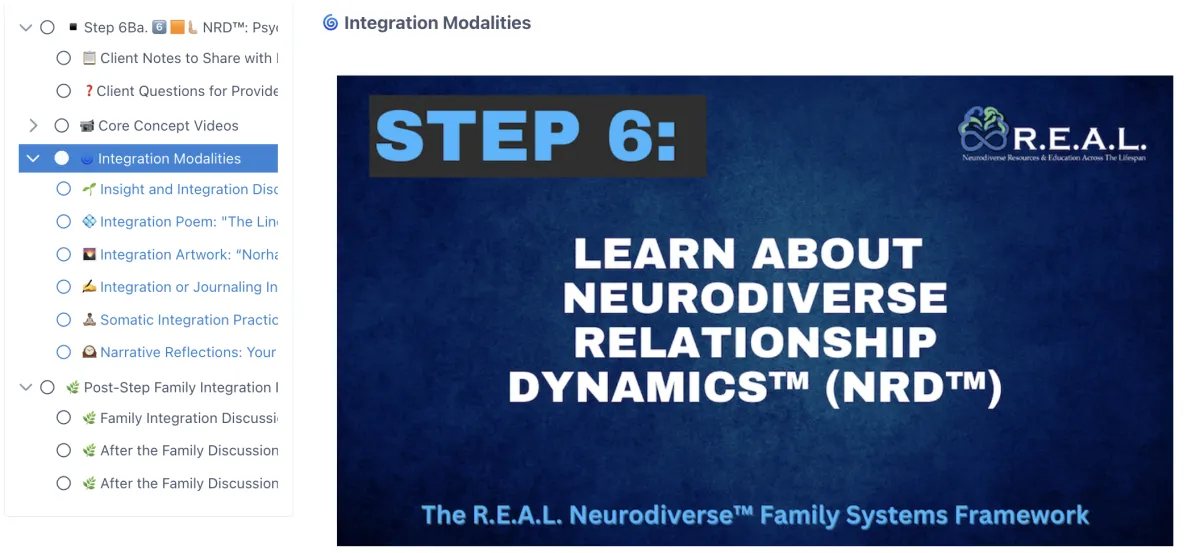
What are Neurodiverse Relationship Dynamics™ (NRD™)?
NRD refers to the distinct, recurring patterns that emerge when individuals with different neurologies, typically autistic and non-autistic, attempt to relate closely. These dynamics are shaped by neurological mismatch, not by dysfunction or failure.
Why do these patterns cause so much relational pain?
Because the two nervous systems often send and receive signals in very different ways. Emotional cues, boundaries, tone, and feedback may be misread or missed altogether, leading to frustration, disconnection, or emotional overload, even when there are good intentions on both sides.
Where do NRD™ patterns tend to show up?
NRD can appear in any close relationship, including marriages, parenting, sibling relationships, friendships, caregiving roles, and workplace teams. Any space where people with different neurologies are connected without shared interpretation tools may show signs of NRD.
What are some common NRD™ patterns?
Examples include boundary confusion, attachment ruptures, identity erosion, emotional exhaustion, and communication shutdowns. These patterns often build slowly and silently until they erupt in trauma spikes: moments of overwhelming emotional release or rupture.
Is NRD™ the same as emotional immaturity, narcissism, or avoidance?
No. These labels are often applied to behaviors that are better understood through the lens of neurological mismatch. Many patterns that look like avoidance, rigidity, or emotional unavailability may be sophisticated survival strategies or adaptive responses to overwhelm, sensory overload, or a lifetime of navigating a world not built for that person's neurology. The NRD lens makes it possible to ask a different question before reaching for a familiar label. But it does not assume that every harmful behavior is explained by neurology alone.
Does the NRD™ lens mean that all behavior in neurodiverse relationships is unintentional?
No. The NRD lens offers a way to understand the neurological drivers behind many relational patterns, but it is not a blanket explanation for all behavior, and it should never be used to excuse harm. Some behaviors in relationships are genuinely destructive, and some are intentional. The R.E.A.L. framework takes this seriously. Neurological difference may explain why certain patterns develop, but it does not exempt anyone from accountability for how they treat the people closest to them.
How does the R.E.A.L. framework handle narcissistic behavior?
The framework does not label people as narcissists, but it directly acknowledges narcissistic behaviors when they are present. The distinction matters. Labeling a person collapses their entire identity into a diagnosis that may or may not be accurate. Naming a behavior makes it visible, discussable, and addressable without reducing anyone to a single trait. Providers are supported in holding both realities at once: that neurological mismatch is real and that harmful behavior is also real, and that clients on both sides of a neurodiverse relationship deserve honesty about what is happening, not just compassion for why it might be happening.
How does recognizing NRD™ change the way we support clients?
It shifts the focus from blame to structure. Instead of asking clients to try harder or be more accommodating, we help them understand how their nervous systems interact and what each person needs to thrive based on their neurotype.
Is NRD™ a diagnosis?
No. NRD™ is not a diagnostic label. It is a lens: a way of seeing invisible patterns and systemic misattunement. It helps providers and clients make sense of complex dynamics that are often misunderstood or mislabeled in traditional frameworks.
Can understanding NRD™ repair all relationships?
Not always. But it creates the conditions for honest decision-making. Clients can choose to rebuild with new tools, or step away with clarity and self-respect. Growth becomes possible where before there was often only confusion or shame.
What is my role as a provider in working with NRD™?
Your role is to recognize these patterns, support neurologically aligned growth, and offer tools that match your client’s unique processing style. By naming what was previously invisible, you empower clients to transform suffering into insight and reclaim their agency within complex relationships.
Structure with Flexibility: Pacing, Delivery and Meeting Clients Where They Are
Is the program structured or flexible?
Both. The program provides a clear and organized structure through its 10-step framework, consistent formatting, and integration tools. At the same time, it is intentionally flexible, allowing for adaptations based on the client’s neurology, readiness, and learning style.
Is there a required order in which the program must be delivered?
The program is structured around a developmentally sequenced 10-step framework, and the materials are placed within the platform in a recommended order that supports emotional safety and cumulative insight. That said, the sequence exists to guide you, not to hold you to it. Providers are free to move ahead, revisit earlier steps, or adjust the order based on what a client needs at any given moment. The structure provides a clear path through the work, but your clinical or coaching judgment determines how you and your client actually move through it.
What are the main delivery options available to me?
The program is designed to fit the way you actually work with clients. You might watch a video together in session and process it in real time. You might assign materials between sessions and use your time together to go deeper into what your client noticed or felt. You might follow your client's lead entirely, letting what they bring from their own portal exploration shape the direction of the session. Some providers blend all of these approaches depending on the client and the moment. There is no single correct way to deliver the material. What matters is that the work stays connected to the client's pace, readiness, and processing style, and the platform supports all of these approaches equally.
Can clients lead their own process, or do I need to guide them through every step?
Clients are encouraged to take an active role in their growth. Each step includes user-friendly, client-facing materials that allow them to choose the modalities, sequence, and tools that best fit their needs. Your role is to support, scaffold, and respond to their process, not to control it.
How do I know what pace is best for my client?
Use your clinical or coaching judgment to assess each client’s processing style, emotional capacity, and tolerance for challenge. Some clients will thrive with slow, steady structure. Others will benefit from more stimulation and flexibility. The goal is to find the pace that promotes engagement, insight, and safety.
Can I revisit earlier steps or skip ahead if needed?
Yes. You are free to repeat, pause, or skip steps depending on what best supports the client’s growth. The platform accommodates nonlinear progression and dynamic pacing.
What if a client becomes overwhelmed?
Overwhelm may signal that the pace is too fast or the emotional depth is too intense. Slow down, simplify the content, and create space for integration. Emotional safety always takes priority over linear progress.
What if a client becomes bored or disengaged?
This may be a sign that the material is not providing enough challenge. Consider adjusting the pace, introducing deeper content, or exploring multiple steps in parallel. Matching the client’s ability level with the right amount of challenge supports optimal engagement.
Do I have to use every assessment and tool provided in the program?
No. Supplemental materials like assessments and mapping tools are optional. Use your clinical or coaching judgment to decide which tools are relevant for each client. These resources are there to deepen insight, not to add unnecessary complexity.
Is there a correct speed for moving through the program?
No. There is only the right speed for this client, in this relationship, at this moment. The structure is there to support your work, not to limit it.
What is my role as a provider in this flexible structure?
You are a guide, not an enforcer. Your job is to support your client in interpreting, applying, and adapting the material in ways that feel authentic and meaningful to them. The structured backbone supports both of you. The flexibility honors your client’s individuality.
Framework Papers: Theory and Research Foundations
What are the Framework Papers in the R.E.A.L. Neurodiverse™ program?
Framework Papers are in-depth, academically grounded documents that explain the theory, research, and rationale behind the assessments, tools, and integration practices used throughout the R.E.A.L. Neurodiverse Family Systems Approach.
Are Framework Papers required reading for providers?
No. Reading them is entirely optional. All essential guidance for using the tools and assessments is included in the Provider Resources. The papers are offered for those who want to deepen their understanding or explore the academic foundations more thoroughly.
Are these papers appropriate for clients as well?
Yes. Clients who enjoy engaging intellectually may find them useful for self-directed education. Others may prefer to skip them and work more experientially with the tools. All engagement styles are respected and valid.
Where can I find the Framework Papers?
They are embedded throughout the program and marked with a 🎓 graduation cap icon. You will also find them in the Provider Resources and Client Resources and the sections associated with each tool or assessment.
What topics do the Framework Papers cover?
The papers span the full breadth of the program. Some cover the theoretical and research foundations behind specific assessments and their subscales, such as the Emotion-Origin Awareness Spectrum, the Empathic-Emotion Intensity Spectrum, the Embodied Simulation Spectrum, and the Interoception and Theory of Mind assessments. Others explain the design rationale behind tools like the Individual Empathy Spectrum Plot™ (IESP™) and its evolutionary and neural foundations, the Theory of Mind Reflection Session (ToM-RS), the Theory of Mind Dyadic Tool (ToM-DT), and the ToM-DT Video Interaction Analysis.
There are also papers grounding each of the Seven Integration Modalities, covering topics such as the clinical value of multiple integration pathways, somatic integration and Emotional Pain Release™, narrative identity reclamation, visual metaphor and non-verbal processing, poetry as a tool for emotional resonance, and future visioning as an act of self-authorship. Later steps introduce papers on constructs like systemizing, systems thinking, and action impact understanding in autism. Many assessments include multiple subscales, and each subscale has its own associated Framework Paper housed in the Provider Resources.
Do I need to read these papers before working with a tool or assessment?
No. You can begin using the tools and assessments immediately. The program is designed to be accessible without requiring prior mastery of theoretical material. You can engage with the papers as your interest or clinical curiosity grows.
Are these papers based on peer-reviewed research?
Many Framework Papers include references to peer-reviewed studies, clinical methodology, and developmental psychology theory. They integrate research and lived experience to support neurodiversity-informed practices.
Credentialing: The NFS-E, NFS-S, and NFS-P

What is the NFS-E Credential?
The Neurodiverse Family Systems Educator (NFS-E) credential is the entry-level professional certification for the R.E.A.L. Neurodiverse™ framework. It is based on Anne MacMillan’s R.E.A.L. Neurodiverse™ Family Systems Theory and the 10-Step R.E.A.L. Approach.
Who is this credential for?
The NFS-E credential is designed for therapists, psychologists, coaches, social workers, clergy, domestic violence advocates, and other professionals seeking to improve their ability to support individuals in neurodiverse family systems.
What does the NFS-E credential include?
Upon completion, providers receive official certification and gain access to client-facing programs, psychoeducational videos, assessments, provider tools, and other resources on the UnitusTI platform.
Is the NFS-E credential required to access the R.E.A.L. Neurodiverse™ programming?
Yes. Each multi-provider practice must have at least one credentialed provider. Solo practitioners must complete the NFS-E credential themselves. The credential must be completed within your first two months of enrollment.
What are the eligibility requirements?
Applicants must meet one of two pathways: hold a bachelor’s degree or post-bachelor’s certificate in a relevant field such as psychology, social work, human development, education, divinity, or domestic violence advocacy; or hold a bachelor’s degree in any field and have at least 10 years of lived experience with Level 1 autism in adulthood, either as an autistic individual or through a direct family or partnership role.
What are the completion requirements for the NFS-E credential?
To earn the credential, participants must watch all required instructional content, score 90% or higher on all subsection check-in questions, complete all written reflection questions, score 90% or higher on each section final quiz, and pass the final exam with at least 85% (680 out of 800 points).
How is the NFS-E credential different from other trainings?
This is the first credentialing program grounded in a systemic, trauma-informed, and neurodiversity-affirming theory of family relationships. It focuses not just on understanding autism, but on supporting both autistic and non-autistic clients through relational transformation using practical tools and structured reflection.
Is this credential recognized by licensing boards?
The NFS-E is a proprietary credential issued by R.E.A.L. Neurodiverse™, grounding providers in the specific theory, tools, and clinical framework of the R.E.A.L. model. It is not currently tied to external licensing boards, but is designed to complement and elevate existing professional licensure.
Are there advanced credentials beyond NFS-E?
Yes. The R.E.A.L. framework offers two advanced credentials for providers who have demonstrated sustained competence using the programs: the NFS-S (Specialist) and the NFS-P (Practitioner). These are entirely optional and intended for providers who wish to work with more complex relational and trauma-related dynamics. The NFS-E provides everything needed to support meaningful individual growth and foundational relational insight.
What is the NFS-S credential?
The Neurodiverse Family Systems Specialist credential recognizes providers who consistently apply the R.E.A.L. approach with depth and reliability. It marks a transition from foundational implementation to systems-aware relational work. Requirements include holding NFS-E for a minimum of one year, completing at least 100 documented client hours, 12 hours of supervised clinical work under an NFS-P trainer, and passing the NFS-S examination. It unlocks access to the ToM-DT, ToM-DT VIA, and Step 6 NRD™ assessments.
What is the NFS-P credential?
The Neurodiverse Family Systems Practitioner credential is the highest level of certification, designed for providers engaging with complex trauma dynamics in neurodiverse family systems. Requirements include holding NFS-S for a minimum of six months, completing at least 150 documented client hours as an NFS-S provider under NFS-P supervision, 12 hours of supervised clinical work, and passing the NFS-P examination. It unlocks access to Step 7 trauma-focused assessments, coordinated empathy subscale mapping tools, and targeted skill-building exercises. None of the R.E.A.L. programs are considered trauma therapy, and this credential does not constitute a license to practice trauma therapy or facilitate trauma excavation.
Why are advanced tools restricted to higher credential levels?
These tools require strong clinical judgment, systems-level insight, and demonstrated capacity to support multiple nervous systems safely and ethically. Restricting access ensures fidelity to the model, protects clients, and supports responsible, developmentally aligned use.
What principle guides progression through credential levels?
Competence before complexity. Providers are supported in building skill, confidence, and discernment over time before accessing tools designed for higher-risk or higher-impact relational work.
In-Person and Virtual Sessions: Screen Use and Material Access
Can I use the R.E.A.L.™ program in both in-person and virtual settings?
Yes. The program is designed to support both in-person and virtual delivery. Materials are accessible in both contexts and can be used flexibly depending on your session format and client preferences.
How should I use the provider materials during in-person sessions?
Keep the provider materials open on a private screen that is not visible to the client. These materials contain session flow guidance, video summaries, and support prompts. If you choose to show client-facing videos or tools in real time, set up a separate screen visible to the client that only displays materials from the client portal.
What setup is recommended for virtual sessions?
A dual-monitor setup is ideal. One screen for your private access to provider materials, and the second for viewing the client or sharing client-facing content. You may also open client-facing materials in a browser tab and share that tab during the session.
Can clients access the materials on their own during virtual sessions?
Yes. Clients may view assigned videos or materials from home, either before or during the session. Your provider materials include references to client-facing content, so you can track what they have seen and structure your conversation accordingly.
Should clients ever see the provider materials?
No. Provider materials are meant to support your professional role and should never be shared with clients. All client-facing materials are available in a separate portal.
Ready to Bring This Work Into Your Practice?
The framework is built. The platform is ready. The clients are already there, carrying dynamics that finally have a name. Now there's a way to help.
Step in. The structure and the support are already here.
From confusion to clarity. For every nervous system in the room.


