Get R.E.A.L. Through Your Home Provider
You don't have to start over with someone new. You can get the R.E.A.L. approach through the provider you already trust.

Found Something That Finally Makes Sense?

If you've been reading about the R.E.A.L. Neurodiverse™ approach and thinking "this is what I've been looking for"—but you already have a therapist, coach, or counselor you trust—you don't have to choose.
Your provider can bring R.E.A.L. into your work together.
What You Can Do
How To Introduce R.E.A.L. To Your Provider
We've created a simple guide you can share with your provider. It Explains:
What the R.E.A.L. Neurodiverse™ Framework is
How providers access the programs
What credentialing involves
Where to learn more
You can email it, print it, or bring it to your next session.
What's Available To Providers
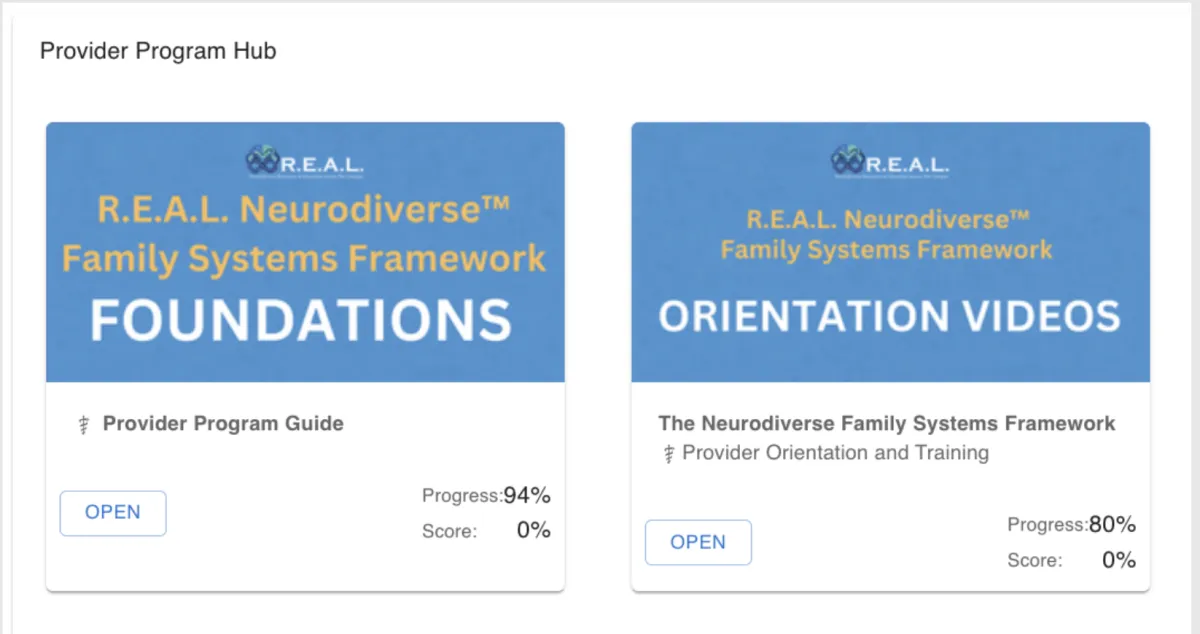
A structured yet flexible, 10-step framework designed for neurodiverse individuals and relationships
Over 200 psychoeducational videos for clients
Separate resource tracks for autistic and non-autistic clients
Distinct focus materials for individuals, couples and families
Step-by-step implementation guides
Quantitative assessments and mapping tools
Ongoing program updates
Everything they need to support you with clarity and confidence.
This Isn't Just For Therapists
The R.E.A.L.™ programs are designed for a wide range of helping professionals.
Therapists and counselors
Life coaches and relationship coaches
Clergy and pastoral counselors
Social workers
Domestic violence advocates
Educators working with adults

If your provider supports people through conversation, guidance, or structured support—they may be a fit.
What To Expect
Once Your Provider Visits the Site:
1. They'll learn about the R.E.A.L. framework on our For Practices page
2. They can explore the credentialing pathway
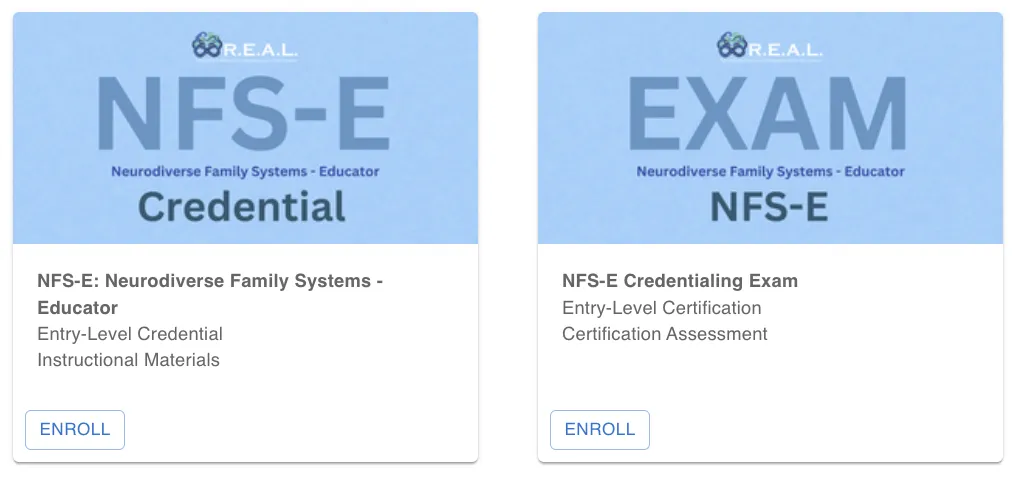
3. If it's a fit, they'll complete the NFS-E credential (Neurodiverse Family Systems – Educator)
4. Then they'll have full access to use R.E.A.L. with you
Note: You don't need to wait for your provider to get credentialed to start exploring. You can start with the R.E.A.L. team if you'd like to begin directly.
Ready To Share?
Download the Provider Introduction
Share With Your Provider
You Deserve Support That Understands
And Now Your Provider Can Offer It
Whether you're an autistic adult trying to make sense of your experiences, a non-autistic partner struggling to hold onto yourself in a relationship that doesn't follow familiar rules, or a family member caught in patterns you can't seem to change—you know how hard it is to find support that actually fits.
You may have already tried therapy, coaching, books, communication tools—and still felt more confused, not less. You may have worked with providers who meant well but didn't quite get it.
And then you found R.E.A.L.
A structured, neurodiversity-affirming approach that finally makes sense. One that doesn't ask you to mask, doesn't pathologize difference, and doesn't assume one person is the problem.
Here's what you need to know: You don't have to choose between this approach and the provider you already trust.
Your therapist, coach, counselor, or clergy can access the full R.E.A.L. Neurodiverse™ Framework—and offer it to you directly.
That means:
A clear, 10-step framework that honors both autistic and non-autistic ways of processing
Separate tools and tracks designed for your neurotype and relational context
Over 200 psychoeducational videos you can access between sessions
Seven Integration Modalities
Structure with that builds insight over time—without pressure or pathologizing

You're not starting over. You're bringing something that finally fits to someone who already knows you.
Real Change Takes More Than Awareness
Transformational support doesn’t happen by chance — it happens with structure, clarity, and intentional integration.
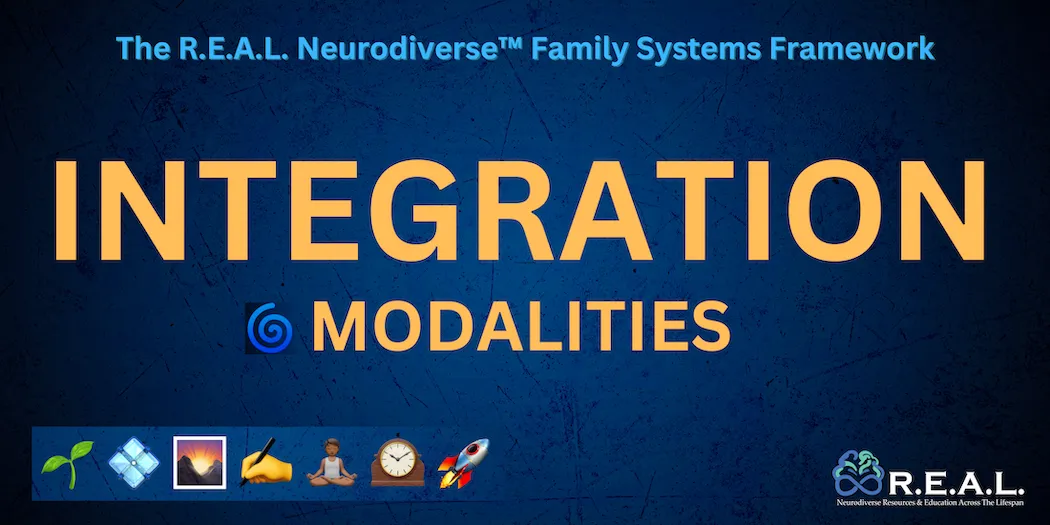
The Seven R.E.A.L. Neurodiverse™ Integration Modalities
Our programs also include access to a diverse set of optional tools, designed to match different ways of processing, learning, and growth. These modalities support true integration — helping insights move from awareness into daily life.
1. Insight & Integration Tools: Guided discussions (non-autistic) or structured modules (autistic) that help make sense of key concepts — at your own pace, in your own way.
2. Integration Poems: Emotionally resonant poems that support self-recognition, validation, and clarity — without pressure to explain or perform.
3. Integration Artwork: Visual metaphors and symbolic images that support emotional insight or sensory grounding — helpful for both verbal and nonverbal processing.
4. Journaling Invitations: Flexible prompts for private reflection, drawing, mapping, or silent thought. Use them in your own time — or not at all
5. Somatic Integration: Body-based tools for emotional regulation, sensory balance, and nervous system clarity — adapted for different interoceptive styles.
6. Reflective Mapping: Story-based identity reflections (non-autistic) or structured pattern/sequence mapping (autistic) to make sense of past roles, relationships, and change.
7. Future Visioning: Present-tense visioning (non-autistic) or structured futures mapping (autistic) — helping you imagine forward with clarity and self-alignment.
You don’t need to use every modality. Choose the ones that resonate. Integration is not about doing everything — it’s about finding what supports your growth, at your pace, in your way.
The R.E.A.L. Neurodiverse™ materials and sessions are designed to meet you where you are neurologically, help you learn how your nervous system works, and guide you toward lasting insight, connection, and confidence in yourself and your relationships.
Ready To Share?
Download the Provider Introduction
Share With Your Provider
Anne MacMillan
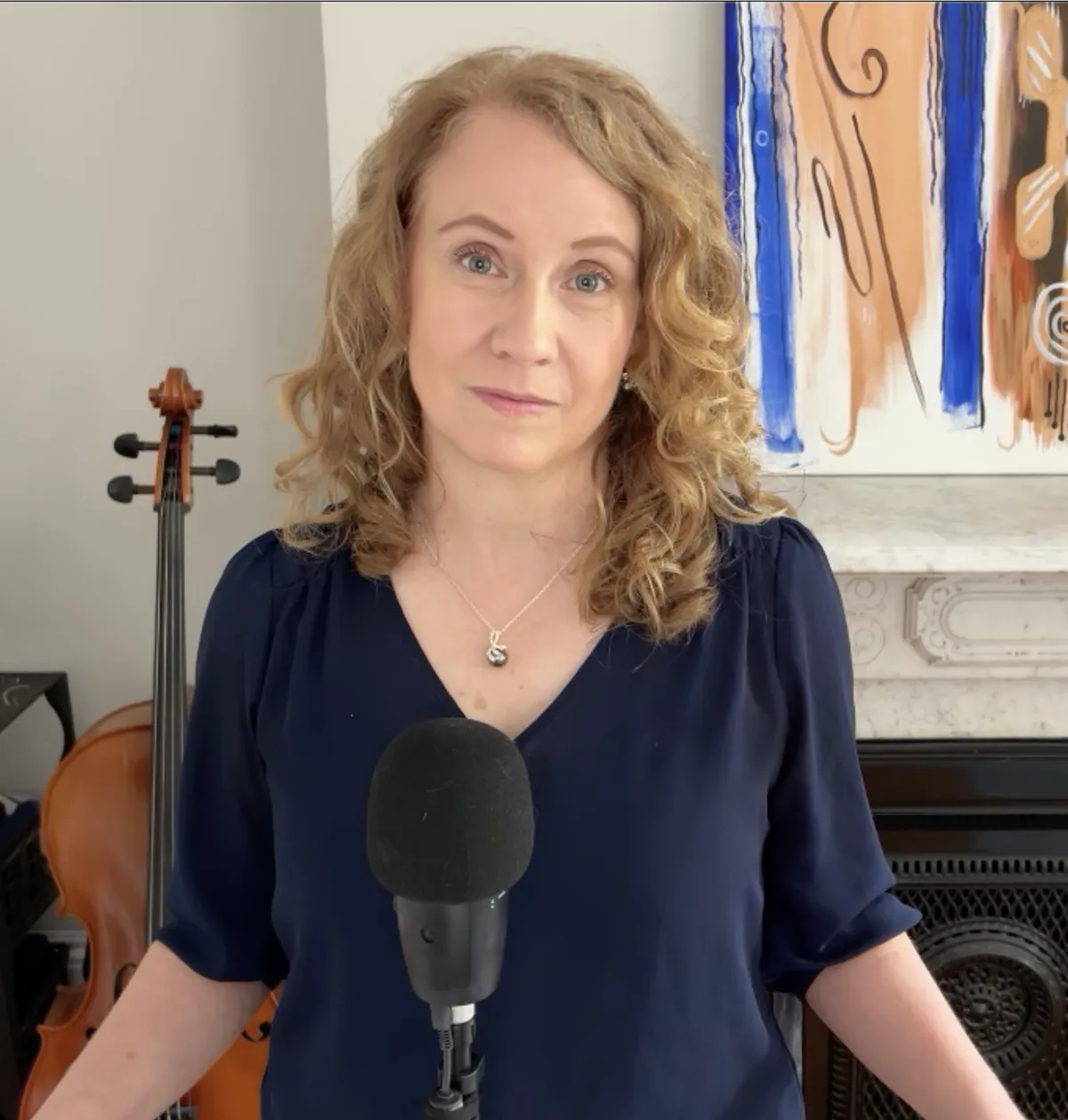
Anne MacMillan, MLA
Founder of the R.E.A.L. Neurodiverse™ 10-Step Family Systems Approach, Speaker, Researcher, Consultant, Coach, and Educator
About Anne MacMillan
MacMillan is the creator of the R.E.A.L. Neurodiverse™ Family Systems Approach — the first comprehensive, educational 10-step model designed to help autistics, non-autistics, and professionals understand the neurological foundations of relational conflict and connection. Her work integrates developmental psychology, systems theory, and over five decades of lived experience inside profoundly neurodiverse family systems.
MacMillan originally developed the Neurodiverse Family Systems Theory based on her education, personal history, and the insights she gained in the private neurodiverse services practice she founded in 2017. Since then, the work has evolved into a clear, scalable framework that professionals can use to guide their clients through complex neurodiverse dynamics with structure, clarity, and compassion.
MacMillan holds a research-based master’s degree in psychology from Harvard University, where she received the Director’s Thesis Award for one of the world’s first quantitative studies on Level 1 autism in intimate life partnerships. Her graduate and undergraduate studies focused on developmental psychology — work that continues to inform every aspect of the R.E.A.L. approach.
She has an entire lifetime of personal experience with neurodiverse family systems.
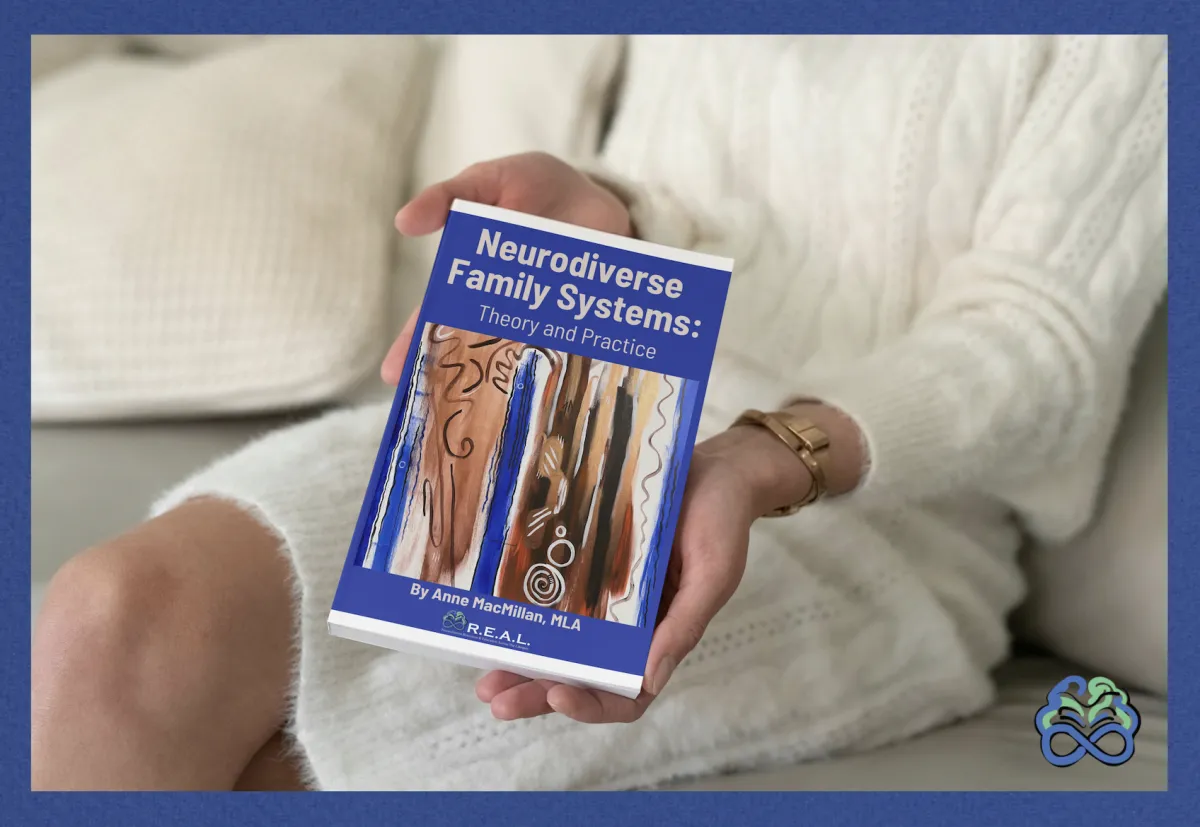
Pre-Order Your
Copy Today
Neurodiverse Family Systems: Theory and Practice
By Anne MacMillan, MLA
© 2026 R.E.A.L. Neurodiverse™
All Rights Reserved
anne@REALneurodiverse.com
Text or WhatsApp: (617) 489-2913 (United States)