
Work Directly With Anne
Individual, Couples and Family Support Using the 10-Step R.E.A.L. Neurodiverse™ Approach
Is This Right For You?

This Work Is For:
• Level 1 autistic adults seeking to understand themselves in relationship
• Non-autistic partners and family members trying to comprehend the communication gap
• Couples in neurodiverse relationships who feel stuck in painful patterns
• Families navigating a late-in-life autism discovery
• Individuals who sense something is different but can't name it
If you're a helping professional looking for training and resources, visit the For Practices page instead.
The R.E.A.L Neurodiverse™ 10-Step Approach
A Structured Yet Flexible Pathway From Confusion To Clarity
This isn't open-ended talk therapy or coaching that waits for answers to surface. The R.E.A.L. Approach is a developmentally-sequenced journey designed specifically for neurodiverse individuals and relationships—structured enough to provide clarity, flexible enough to meet you where you are.
The Three Foundational Modules
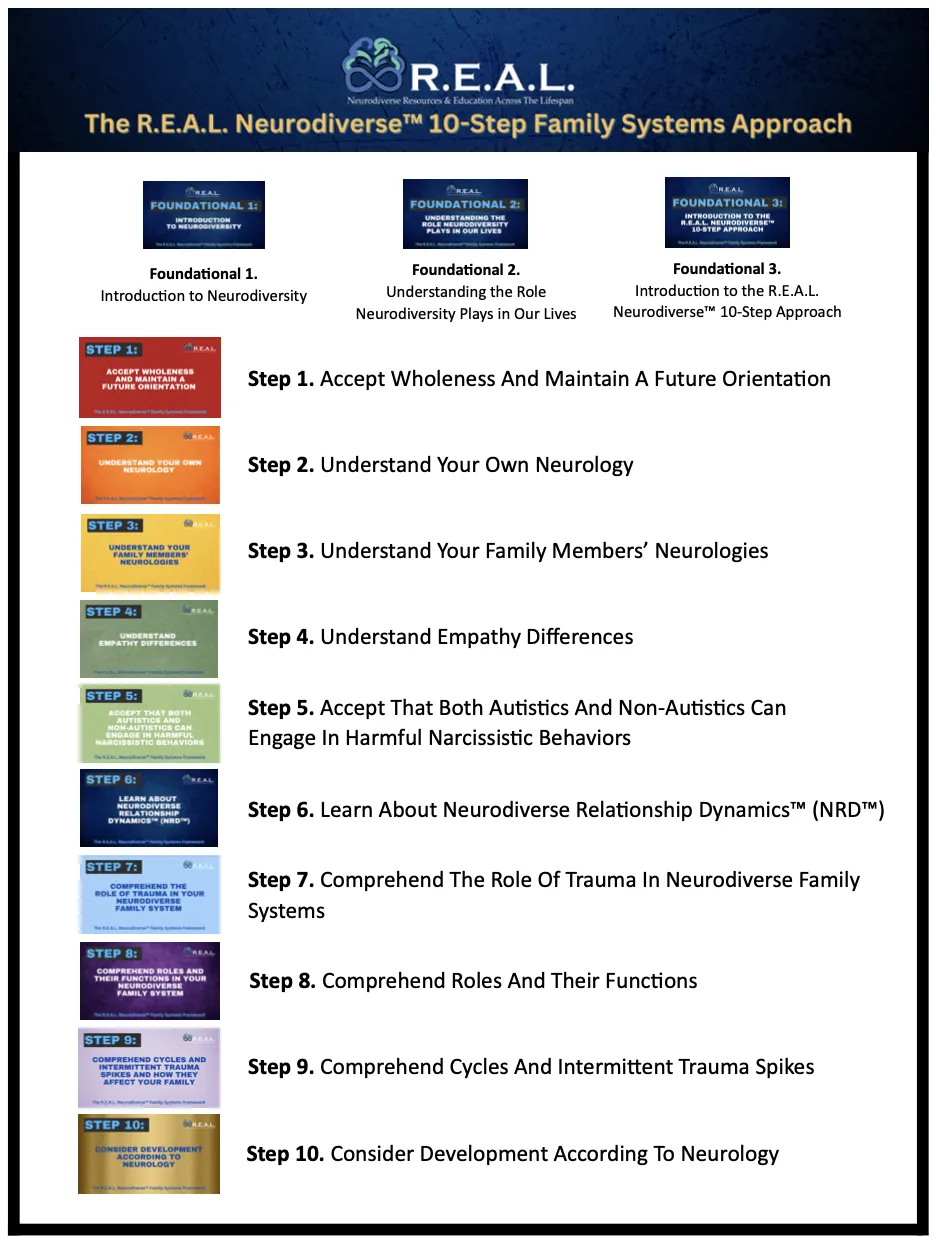
Foundational 1: Introduction to Neurodiversity — Establishes shared language for neurodiversity, neurological difference, and inclusive interpretation of behavior.
Foundational 2: Understanding the Role Neurodiversity Plays in Our Lives — Helps you identify how neurology shapes stress patterns, communication, needs, and relational expectations across the lifespan.
Foundational 3: Introduction to the R.E.A.L. Neurodiverse™ 10-Step Approach — Explains how the program is structured, why the sequence supports development, and how integration builds over time.
The 10 Steps at a Glance
Step 1: Accept Wholeness and Maintain a Future Orientation — Sets a grounding stance of dignity, growth, and possibility—without denial of present reality.
Step 2: Understand Your Own Neurology — Builds self-knowledge about how your nervous system processes experience, stress, emotion, and meaning.
Step 3: Understand Your Intimate Life Partner's or Family Members' Neurologies — Expands perspective-taking by learning how different nervous systems interpret the same events differently.
Step 4: Understand Empathy Differences — Clarifies how empathy can vary across emotional, sensory, and cognitive processes—and how mismatches can create conflict.
Step 5: Accept That Both Autistics and Non-Autistics Can Engage in Harmful Narcissistic Behaviors — Identifies harmful patterns without reducing anyone to a label: supporting accountability, clarity, and safety.
Step 6: Learn About Neurodiverse Relationship Dynamics™ (NRD™) — Explains recurring interaction cycles in neurodiverse systems, translates common relational and psychological concepts into a neurodiversity paradigm, and supports more sustainable relational choices.
Step 7: Comprehend the Role of Trauma in Neurodiverse Family Systems — Connects trauma, stress responses, and nervous system protection strategies to relational dynamics and capacity.
Step 8: Comprehend Roles and Their Functions — Helps you recognize relational roles, what they protect, and how they shape identity, responsibility, and power.
Step 9: Comprehend Cycles and Intermittent Trauma Spikes — Supports recognition of repeating patterns and escalation cycles so you can respond earlier and more intentionally.
Step 10: Consider Development According to Neurology — Integrates the full model by focusing on growth trajectories, capacity, and sustainable development across neurologies.
Your Pathway to Clarity, Connection, and Sustainable Growth
The R.E.A.L. Neurodiverse™ 10‑Step Approach is a structured yet flexible journey designed to help you move from confusion and overwhelm to understanding, skillful connection, and relational resilience—no matter where you are in your neurodiverse experience.
Start Your Transformation Today With A Free 30‑Minute Consultation.
What's Included
Live Sessions & Personalized Support
Direct one‑on‑one coaching and consulting — Tailored guidance through the R.E.A.L. 10‑Step Approach that meet you where you are and help you make real, integrated progress. Video and phone sessions available.
Individual Work — Individual sessions are the foundation of this program. Because each person’s neurology shapes how they process insight, change, and emotion, we begin with one-on-one work before inviting relational sessions. This allows you to understand your own patterns, needs, and growth path first — ensuring that shared work, when it occurs, is grounded in clarity and self-awareness.
Structured family or intimate partnership discussions — Relational sessions are offered after individual work has established clarity, boundaries, and self‑understanding. These discussions are carefully structured and only take place when all participants wish to engage. Their purpose is not problem‑solving or emotional performance, but shared understanding — creating space to explore differences in perception, needs, and impact with support, pacing, and clear structure.
Foundational Framework & Theory
A structured yet flexible roadmap for lasting insight. This includes:
The R.E.A.L. Neurodiverse™ 10‑Step Approach — a sequenced pathway from self‑understanding to relational clarity.
Divergent Development Pathways — distinct support tailored for autistic and non‑autistic needs across every step.
Research‑grounded Materials & Framework Papers — theory, trauma‑informed foundations, and evidence‑aligned resources.
Cloud‑Based Client Resources
Accessible tools to support learning and growth:
Psychoeducational Video Series — easy‑to‑follow videos that reinforce learning and pacing.
Structured Reflection & Journaling Tools — program-aligned exercises to support meaning‑making at your own pace.
Session‑by‑Session Insight & Integration Materials — guides that help you connect session breakthroughs to lived change.
Assessment & Progress Mapping
Quantitative Assessments — formal measures of interoception, emotional processing, theory of mind, and relational dynamics.
Mapping Tools — visual representations of where you are in the process and how your insight is expanding.
Choose Your Focus:
Family or Intimate Partership
Each person comes to this work with a different focus. Some are navigating family relationships — with parents, children, or siblings. Others are working to understand an intimate life partnership.
The R.E.A.L. Neurodiverse™ Approach offers two distinct tracks to support these paths. While the tools and concepts are shared across both, the language, examples, and reflections are tailored to the relational context you’re working in.
You can start with one track and shift to the other at any time. The structure stays the same — only the focus changes.
Your growth doesn’t reset — it refocuses.
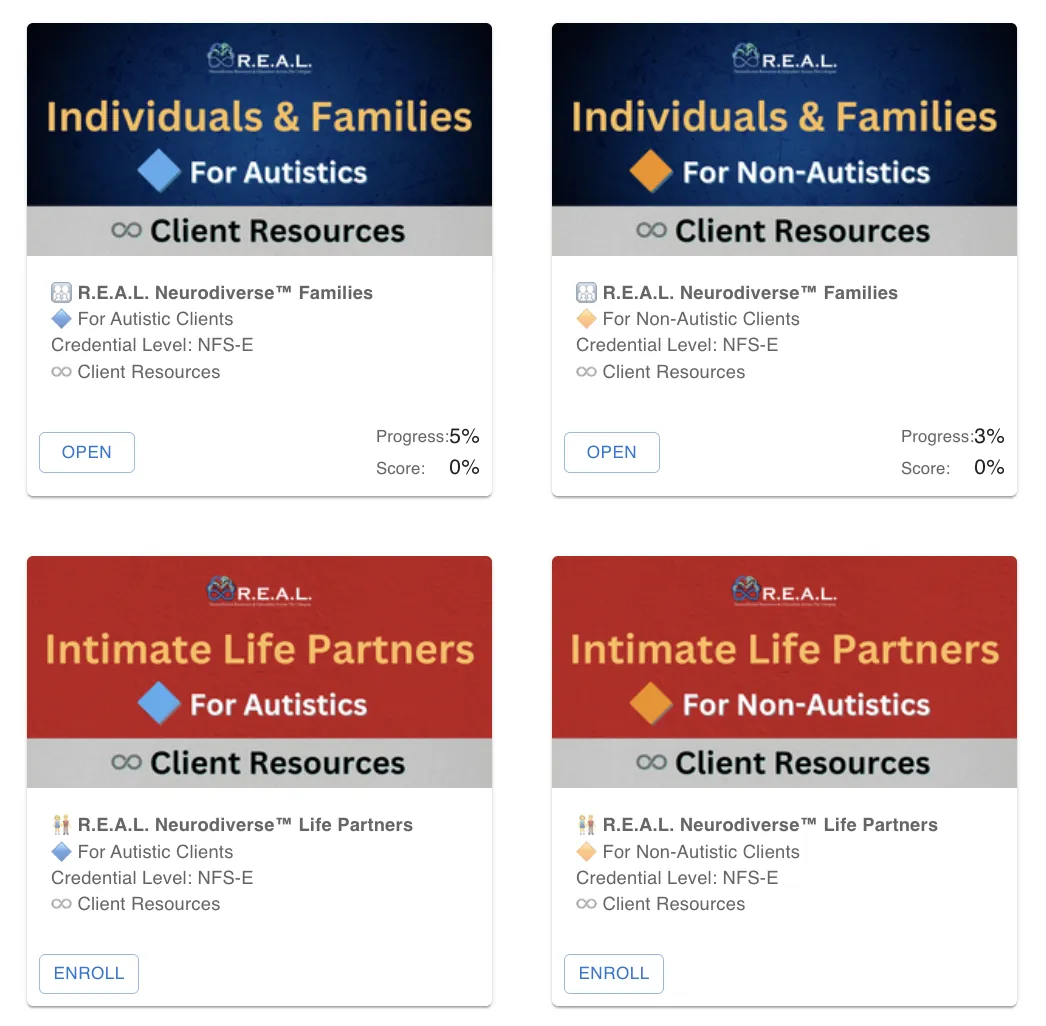
Divergent Client Resources
Separate resource tracks to support unique neurotypes
Because autistic and non‑autistic brains learn, process, and integrate differently, we offer dedicated materials to support distinct developmental needs — without reducing anyone to a label.
Why This Matters
Instead of one‑size‑fits‑all therapy or coaching that waits for insight to happen, the R.E.A.L. approach gives you:
• Structure that reduces overwhelm
• Clarity that increases confidence
• Tools that support real change — not just conversations
Progress happens when clients understand each step and how it builds toward capacity and connection.
You Don't Have To Figure This Out Alone
Whether you're an autistic adult trying to make sense of your experiences, a non-autistic partner struggling to hold onto yourself in a relationship that doesn't follow familiar rules, or a family member caught in patterns you can’t seem to change — this may be one of the most confusing and painful challenges you've ever faced.
What makes it harder is how few providers truly understand it.
You may have tried books, therapy, communication tools — and still felt more overwhelmed, not less. You may have blamed yourself, or felt blamed by others. You may have wondered if understanding is even possible between such different brains.
With the R.E.A.L. Neurodiverse™ Approach, that changes.
You don’t have to figure it out alone.
You’ll have:
• A clear, 10-Step framework that honors both autistic and non-autistic ways of processing
• Separate tools and tracks for different neurotypes and relational roles
• A structure that reduces confusion and builds insight over time
• Flexible options that support emotional clarity, identity work, and relational understanding — without pressure or pathologizing.
You’re not starting over.
You’re starting with support that finally fits.

Real Change Takes More Than Awareness
Transformational support doesn’t happen by chance — it happens with structure, clarity, and intentional integration.
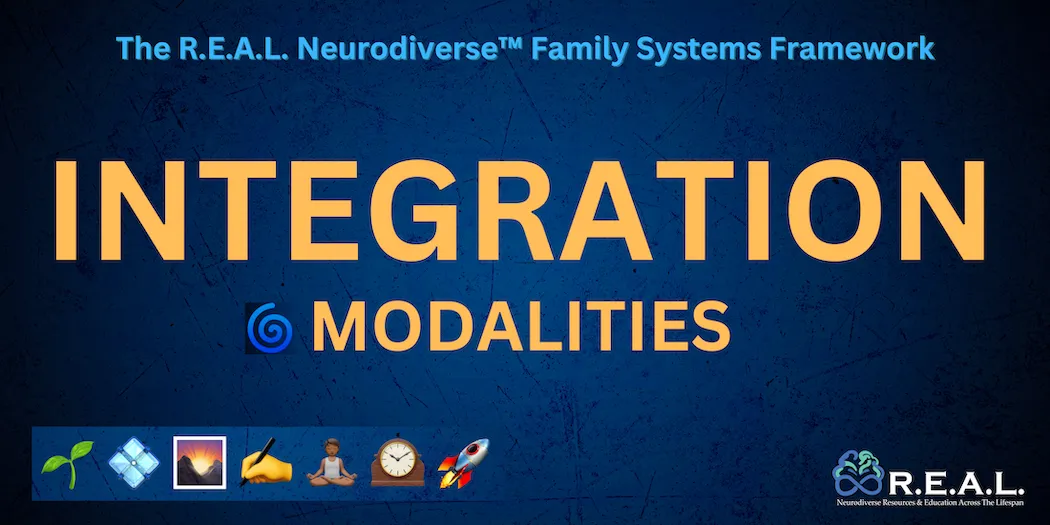
The Seven R.E.A.L. Neurodiverse™ Integration Modalities
Our programs also include access to a diverse set of optional tools, designed to match different ways of processing, learning, and growth. These modalities support true integration — helping insights move from awareness into daily life.
1. Insight & Integration Tools: Guided discussions (non-autistic) or structured modules (autistic) that help make sense of key concepts — at your own pace, in your own way.
2. Integration Poems: Emotionally resonant poems that support self-recognition, validation, and clarity — without pressure to explain or perform.
3. Integration Artwork: Visual metaphors and symbolic images that support emotional insight or sensory grounding — helpful for both verbal and nonverbal processing.
4. Journaling Invitations: Flexible prompts for private reflection, drawing, mapping, or silent thought. Use them in your own time — or not at all
5. Somatic Integration: Body-based tools for emotional regulation, sensory balance, and nervous system clarity — adapted for different interoceptive styles.
6. Reflective Mapping: Story-based identity reflections (non-autistic) or structured pattern/sequence mapping (autistic) to make sense of past roles, relationships, and change.
7. Future Visioning: Present-tense visioning (non-autistic) or structured futures mapping (autistic) — helping you imagine forward with clarity and self-alignment.
You don’t need to use every modality. Choose the ones that resonate. Integration is not about doing everything — it’s about finding what supports your growth, at your pace, in your way.
The R.E.A.L. Neurodiverse™ materials and sessions are designed to meet you where you are neurologically, help you learn how your nervous system works, and guide you toward lasting insight, connection, and confidence in yourself and your relationships.
How To Get Started

Step 1: Schedule A Free 30-Minute Consultation
Step 2: Explain Your Situation To Find Out If The R.E.A.L. Programs Are Right For You
Step 3: Schedule A Weekly Recurring Session Time
Free Resources:
The Neurodiverse Lens™
Explore 16 Reading Pathways Covering Everything From Empathy And Interoception To Neurodiverse Relationship Dynamics™ And AI Perspectives On Neurodiversity.
Ready To Make Real Change?

Anne MacMillan
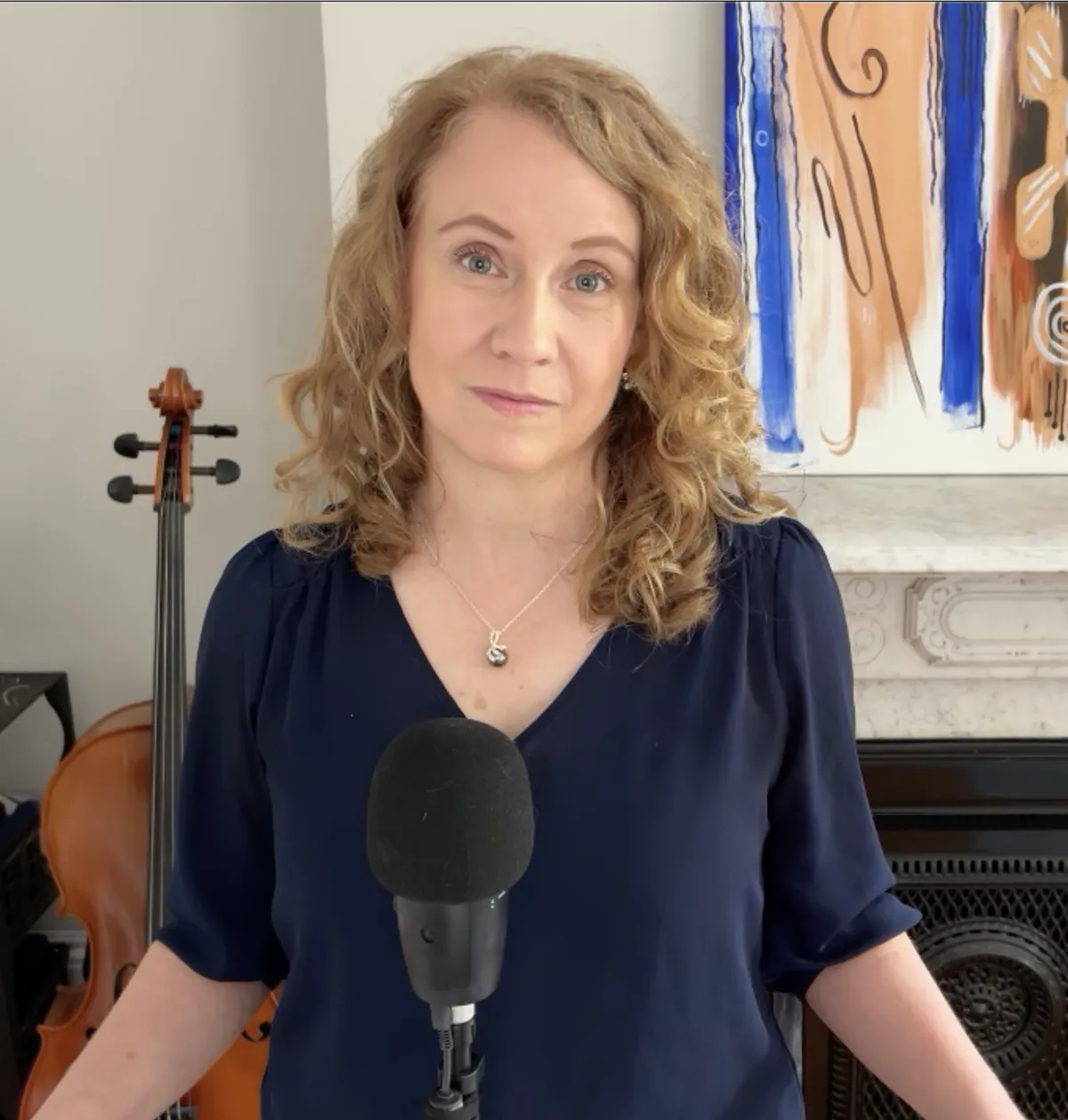
Anne MacMillan, MLA
Founder of the R.E.A.L. Neurodiverse™ 10-Step Family Systems Approach, Speaker, Researcher, Consultant, Coach, and Educator
About Anne MacMillan
MacMillan is the creator of the R.E.A.L. Neurodiverse™ Family Systems Approach — the first comprehensive, educational 10-step model designed to help autistics, non-autistics, and professionals understand the neurological foundations of relational conflict and connection. Her work integrates developmental psychology, systems theory, and over five decades of lived experience inside profoundly neurodiverse family systems.
MacMillan originally developed the Neurodiverse Family Systems Theory based on her education, personal history, and the insights she gained in the private neurodiverse services practice she founded in 2017. Since then, the work has evolved into a clear, scalable framework that professionals can use to guide their clients through complex neurodiverse dynamics with structure, clarity, and compassion.
MacMillan holds a research-based master’s degree in psychology from Harvard University, where she received the Director’s Thesis Award for one of the world’s first quantitative studies on Level 1 autism in intimate life partnerships. Her graduate and undergraduate studies focused on developmental psychology — work that continues to inform every aspect of the R.E.A.L. approach.
She has an entire lifetime of personal experience with neurodiverse family systems.
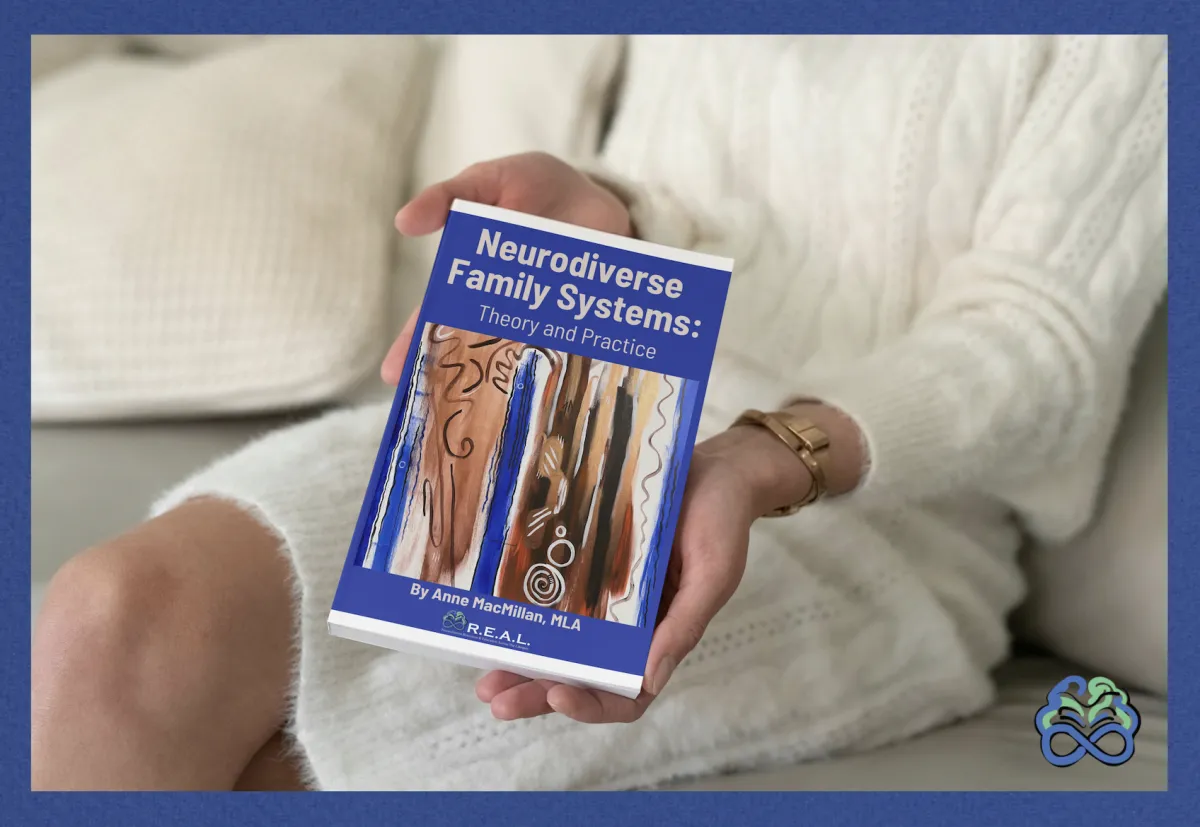
Pre-Order Your
Copy Today
Neurodiverse Family Systems: Theory and Practice
By Anne MacMillan, MLA
© 2026 R.E.A.L. Neurodiverse™
All Rights Reserved
anne@REALneurodiverse.com
Text: (617) 489-2913 (United States)