Join Our Team
Build your own practice. Use your expertise.
Stop worrying about where your next client is coming from.

We Value Two Kinds of Expertise — And We're Looking For Both
The R.E.A.L. Neurodiverse™ Framework recognizes that meaningful expertise in autism emerges through different pathways, including formal education and lived experience. Both forms of knowledge are valued and integrated within R.E.A.L.

For Professionals Ready to Build a Neurodiversity-Focused Practice
Therapists, coaches, social workers, psychologists, and counselors are increasingly noticing a pattern that mainstream models often fail to address. A significant portion of clinical and coaching work involves neurodivergence. It appears in couples who cannot bridge communication gaps despite repeated interventions, in individuals whose lived experiences do not align neatly with standard diagnostic frameworks, and in families where genuine effort and care still fail to produce lasting change.
You know something different is needed. You just haven't had a framework that actually addresses it — until now.
The R.E.A.L. Neurodiverse™ Framework combines structured training, applied clinical tools, and a formal credentialing pathway for professionals seeking to specialize in neurodiverse systems. Credentialed providers may also be eligible to participate in a referral network that connects professionals with clients seeking neurodiversity-informed care.

What Participation Includes:
• A formal credential that recognizes existing knowledge — the NFS-E (Neurodiverse Family Systems Educator) certification establishes professional standing for expertise developed through lived experience.
• A structured framework for experiential knowledge — the 10-Step R.E.A.L. Approach organizes intuitive and experiential understanding into a coherent system that can be taught, applied, and shared.
• A supported pathway to independent practice — including access to client referrals, supervision, and guidance, reducing the need to navigate the business infrastructure alone.
• A professional identity grounded in lived experience — not in spite of it, but as its foundation.
For Those Whose Lived Experience Is The Expertise
Many individuals arrive at this work through lived experience rather than formal education. Years — and often decades — of navigating autism within themselves or their families lead to a depth of practical understanding that exceeds what many existing models address. As a result, they are frequently sought out by others for guidance, perspective, and support grounded in authentic experience.
Lived experience does not come with credentials, leaving doors closed — sometimes to those with the deepest understanding.
The R.E.A.L. Neurodiverse™ Framework was designed around a clear principle: that some of the most important expertise in autism comes from lived experience. This expertise is not treated as a consolation or an exception, but as a substantive and legitimate form of knowledge. Accordingly, lived experience is recognized as a formal eligibility pathway within the credentialing structure — not as a workaround, but as an acknowledgment of demonstrated understanding developed through sustained, real-world engagement.

What Participation Provides:
• A structured, credentialed framework to specialize in neurodiversity — not a weekend workshop, but a comprehensive system grounded in neurodiverse family systems theory
• A steady stream of client referrals through the R.E.A.L. network — so you can focus on the work instead of constantly building your caseload from scratch
• The freedom to run your own independent practice with the support of a proven system behind you
• Ongoing supervision and professional development directly from the framework's creator, Anne MacMillan
From Application To Practice: The Path
Participation in R.E.A.L. follows a structured, intentional process. This structure exists for a reason: individuals, couples, and families engaging in this work deserve providers who are genuinely prepared. The pathway below outlines how professionals and lived-experience practitioners move from application to active practice within the R.E.A.L. framework.
Step 1: Application and Interview
The process begins with a conversation. The application and interview phase is designed to understand an applicant’s background, motivation, and alignment with this work. This includes discussion of professional training, lived experience, or a combination of both, as well as clarity around the role the applicant hopes to hold within the framework.
Not every applicant will be the right fit, and selectivity is intentional. The work requires discernment, emotional responsibility, and readiness to engage with complex neurodiverse systems. Careful matching protects both providers and the individuals they will eventually support.
Step 2: Completion of the NFS-E Credential
Accepted applicants complete the NFS-E (Neurodiverse Family Systems Educator) credential, the foundational certification required of all R.E.A.L. providers. This training establishes a shared conceptual language and ethical framework across the practice.
The credential covers the R.E.A.L. Neurodiverse™ Family Systems Theory, the 10-Step R.E.A.L. Approach, the seven integration modalities, and the core tools used in direct work with clients. The credentialing process includes instructional coursework, written reflections, subsection quizzes, and a comprehensive final exam. The depth of the process is intentional, reflecting the level of trust clients place in R.E.A.L. providers.
Step 3: Supervised Practice
After credentialing, providers begin working with clients under direct supervision. Supervision is a core component of the framework and is treated as an essential learning phase rather than a procedural requirement.
During this stage, providers deepen their ability to apply the framework in real-world contexts — navigating relational dynamics, family systems, and long-standing patterns with support and guidance. Supervision supports quality of care, strengthens clinical judgment, and protects both providers and clients. Supervisory hours are arranged based on individual needs and are discussed during onboarding.
Step 4: Caseload Development
Credentialed providers are integrated into the R.E.A.L. referral network. Clients seeking neurodiversity-informed support are referred directly to providers whose training and scope align with their needs.
This structure allows providers to focus on direct work rather than ongoing self-marketing or independent client acquisition. Caseload development occurs within the framework, while R.E.A.L. manages visibility, referral coordination, and alignment between client needs and provider expertise.
A Professional Practice With Compensation And A Network Of Providers

Work conducted through the R.E.A.L. Neurodiverse™ network is compensated professional work, not volunteer engagement or an unpaid extension of training. Providers working with clients through the network earn income for their services within a structured practice model.
Credentialed team members receive the majority of the revenue generated from their client work. A portion of revenue is allocated to R.E.A.L. to support the systems that make the practice viable and sustainable, including referral coordination, ongoing program development, platform infrastructure, and credentialing administration.
Specific details regarding supervision rates, revenue distribution, and practice structure are discussed during the application and interview process. Compensation arrangements vary based on background, role, and scope of practice, and are designed to align with both professional standards and individual capacity.
At its core, this is a functioning practice model with real earning potential, structured to allow providers to focus on client work while the broader framework supports referrals, systems, and continuity.
Who Can Apply?
Participation in R.E.A.L. requires meeting the eligibility criteria for the NFS-E (Neurodiverse Family Systems Educator) credential. The framework recognizes two formal eligibility pathways.
Eligibility Pathway 1: Professional Background
Applicants may qualify through formal education by holding a bachelor’s degree or post-bachelor’s certificate in a relevant field. Examples include, but are not limited to, psychology, social work, education, divinity, and domestic violence advocacy.
Eligibility Pathway 2: Lived Experience
Applicants may also qualify through lived experience by holding a bachelor’s degree in any field and demonstrating a minimum of ten years of sustained lived experience with Level 1 autism in adulthood. This experience may be as an autistic individual or through a direct family, partnership, or caregiving role.

Professional Values and Commitments

Beyond meeting credential eligibility requirements, R.E.A.L. seeks individuals who demonstrate:
• A genuine commitment to neurodiversity-affirming work, including a clear departure from deficit-based or “fixing” models, and an understanding of how different neurologies experience the world.
• Willingness to engage in ongoing professional development, recognizing that the credentialing process is rigorous and that learning continues beyond certification.
• Capacity to work within a structured methodology and under supervision, with respect for the fidelity of the R.E.A.L. Neurodiverse™ Approach and its application.
• Interest in building a meaningful and sustainable practice, rather than simply adding a credential, with the intention of serving individuals, couples, and families who need neurodiversity-informed support.
FAQ
Do applicants need to already have a private practice?
No. Many participants enter R.E.A.L. while building their first independent practice. The credentialing process, referral network, and supervision structure are designed to support providers from the earliest stages of practice development. Applicants are not expected to have a fully established business prior to applying.
Can autistic individuals serve as providers within R.E.A.L.?
Yes. Autistic providers are actively sought and valued within the framework. Lived experience with autism—whether as an autistic individual or through sustained roles as a partner, parent, or family member—is one of the two formal eligibility pathways for the NFS-E credential. The framework recognizes lived experience as a legitimate and essential source of expertise.
How is compensation determined?
Compensation is structured as a percentage of income generated through client work within the R.E.A.L. network, with terms varying based on caseload, scope of work, and stage of professional development. Specific details are reviewed during the application and interview process.
Is this an employment role or an independent practice?
Providers operate independent practices. R.E.A.L. supplies the credentialing pathway, referral infrastructure, and supervision, while providers retain ownership of their business, determine their schedules, and set their professional pace. The framework is intended to support autonomy while offering systems typically unavailable to independent practitioners.
What does supervision involve?
Supervision consists of regular consultation sessions focused on applying the R.E.A.L. framework to real client work, strengthening professional judgment, and maintaining quality of care. Supervision supports the transition from theory to practice and ensures consistency within the methodology. Supervisory hours and rates are discussed during onboarding and tailored to individual experience levels and needs.
Is it possible to begin while maintaining other professional or personal commitments?
Yes. Many providers begin participating alongside existing work or responsibilities and expand their caseload gradually. There is no requirement to transition to full-time practice immediately. Caseload growth and pacing are structured collaboratively to align with individual capacity and circumstances.
What if eligibility is uncertain?
Applicants who are unsure whether they meet eligibility criteria are encouraged to apply. When experience or qualifications fall near the requirements, discussion is often more appropriate than self-exclusion. Eligibility questions can be explored during an initial conversation to determine fit and possible pathways forward.
The R.E.A.L Neurodiverse™ 10-Step Approach
A Structured Yet Flexible Pathway From Confusion To Clarity
This isn't open-ended talk therapy or coaching that waits for answers to surface. The R.E.A.L. Approach is a developmentally-sequenced journey designed specifically for neurodiverse individuals and relationships—structured enough to provide clarity, flexible enough to meet you where you are.
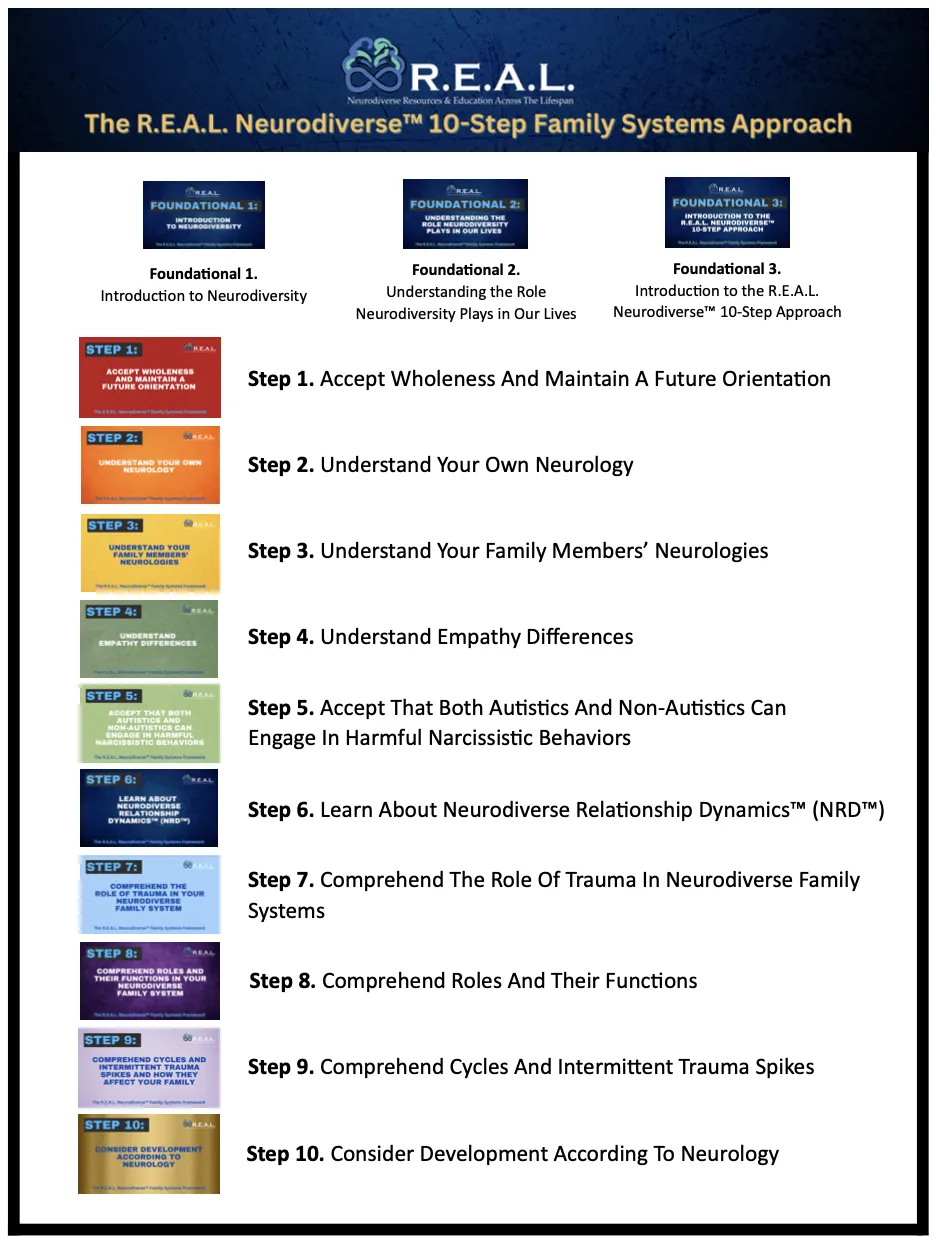
The Three Foundational Modules
Foundational 1: Introduction to Neurodiversity — Establishes shared language for neurodiversity, neurological difference, and inclusive interpretation of behavior.
Foundational 2: Understanding the Role Neurodiversity Plays in Our Lives — Helps you identify how neurology shapes stress patterns, communication, needs, and relational expectations across the lifespan.
Foundational 3: Introduction to the R.E.A.L. Neurodiverse™ 10-Step Approach — Explains how the program is structured, why the sequence supports development, and how integration builds over time.
The 10 Steps at a Glance
Step 1: Accept Wholeness and Maintain a Future Orientation — Sets a grounding stance of dignity, growth, and possibility—without denial of present reality.
Step 2: Understand Your Own Neurology — Builds self-knowledge about how your nervous system processes experience, stress, emotion, and meaning.
Step 3: Understand Your Intimate Life Partner's or Family Members' Neurologies — Expands perspective-taking by learning how different nervous systems interpret the same events differently.
Step 4: Understand Empathy Differences — Clarifies how empathy can vary across emotional, sensory, and cognitive processes—and how mismatches can create conflict.
Step 5: Accept That Both Autistics and Non-Autistics Can Engage in Harmful Narcissistic Behaviors — Identifies harmful patterns without reducing anyone to a label: supporting accountability, clarity, and safety.
Step 6: Learn About Neurodiverse Relationship Dynamics™ (NRD™) — Explains recurring interaction cycles in neurodiverse systems, translates common relational and psychological concepts into a neurodiversity paradigm, and supports more sustainable relational choices.
Step 7: Comprehend the Role of Trauma in Neurodiverse Family Systems — Connects trauma, stress responses, and nervous system protection strategies to relational dynamics and capacity.
Step 8: Comprehend Roles and Their Functions — Helps you recognize relational roles, what they protect, and how they shape identity, responsibility, and power.
Step 9: Comprehend Cycles and Intermittent Trauma Spikes — Supports recognition of repeating patterns and escalation cycles so you can respond earlier and more intentionally.
Step 10: Consider Development According to Neurology — Integrates the full model by focusing on growth trajectories, capacity, and sustainable development across neurologies.
The R.E.A.L. Pathway to Clarity, Connection, and Sustainable Growth
The R.E.A.L. Neurodiverse™ 10‑Step Approach is a structured yet flexible journey designed to help clients move from confusion and overwhelm to understanding, skillful connection, and relational resilience—no matter where they are in their neurodiverse experience.
Real Change Takes More Than Awareness
Transformational support doesn’t happen by chance — it happens with structure, clarity, and intentional integration.
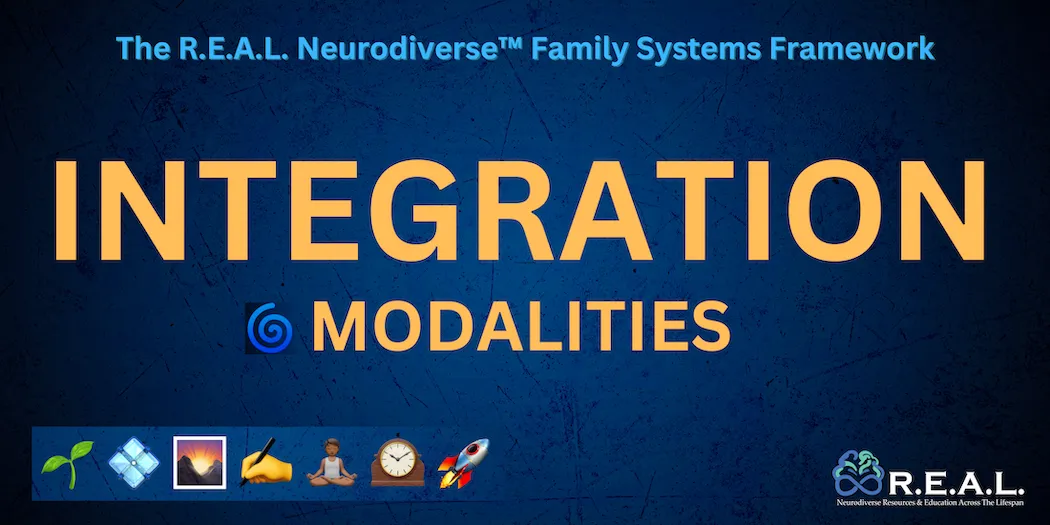
The Seven R.E.A.L. Neurodiverse™ Integration Modalities
Our programs also include access to a diverse set of optional tools, designed to match different ways of processing, learning, and growth. These modalities support true integration — helping insights move from awareness into daily life.
1. Insight & Integration Tools: Guided discussions (non-autistic) or structured modules (autistic) that help make sense of key concepts — at your own pace, in your own way.
2. Integration Poems: Emotionally resonant poems that support self-recognition, validation, and clarity — without pressure to explain or perform.
3. Integration Artwork: Visual metaphors and symbolic images that support emotional insight or sensory grounding — helpful for both verbal and nonverbal processing.
4. Journaling Invitations: Flexible prompts for private reflection, drawing, mapping, or silent thought. Use them in your own time — or not at all
5. Somatic Integration: Body-based tools for emotional regulation, sensory balance, and nervous system clarity — adapted for different interoceptive styles.
6. Reflective Mapping: Story-based identity reflections (non-autistic) or structured pattern/sequence mapping (autistic) to make sense of past roles, relationships, and change.
7. Future Visioning: Present-tense visioning (non-autistic) or structured futures mapping (autistic) — helping you imagine forward with clarity and self-alignment.
Clients don’t need to use every modality. They choose the ones that resonate. Integration is not about doing everything — it’s about finding what supports growth, at clients' pace, in their way.
The R.E.A.L. Neurodiverse™ materials and sessions are designed to meet clients where they are neurologically, help them learn how their nervous system works, and guide them toward lasting insight, connection, and confidence in themselves and their relationships.
The Neurodiverse Lens™
Explore 16 Reading Pathways Covering Everything From Empathy And Interoception To Neurodiverse Relationship Dynamics™ And AI Perspectives On Neurodiversity.
Anne MacMillan
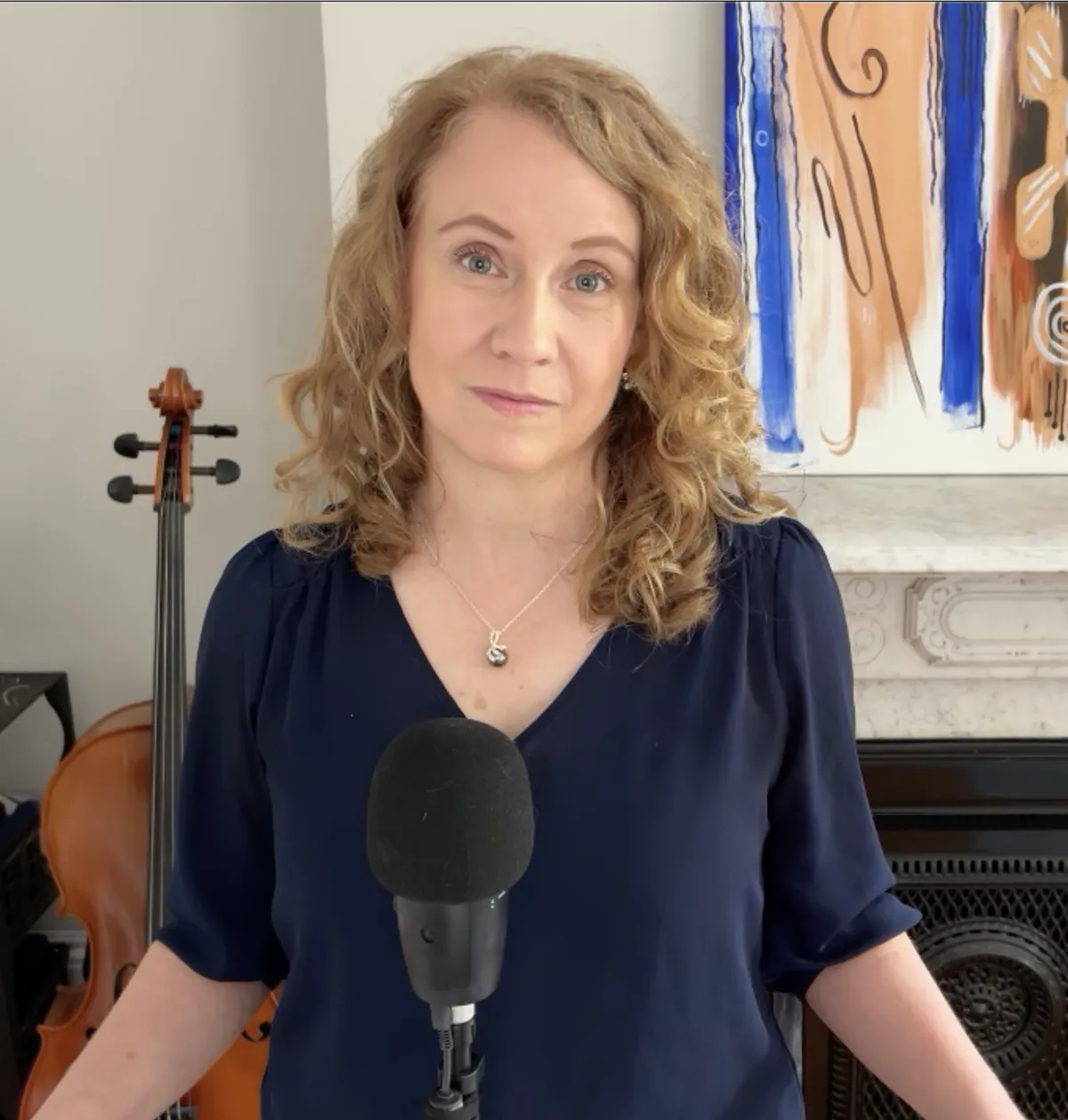
Anne MacMillan, MLA
Founder of the R.E.A.L. Neurodiverse™ 10-Step Family Systems Approach, Speaker, Researcher, Consultant, Coach, and Educator
About Anne MacMillan
MacMillan is the creator of the R.E.A.L. Neurodiverse™ Family Systems Approach — the first comprehensive, educational 10-step model designed to help autistics, non-autistics, and professionals understand the neurological foundations of relational conflict and connection. Her work integrates developmental psychology, systems theory, and over five decades of lived experience inside profoundly neurodiverse family systems.
MacMillan originally developed the Neurodiverse Family Systems Theory based on her education, personal history, and the insights she gained in the private neurodiverse services practice she founded in 2017. Since then, the work has evolved into a clear, scalable framework that professionals can use to guide their clients through complex neurodiverse dynamics with structure, clarity, and compassion.
MacMillan holds a research-based master’s degree in psychology from Harvard University, where she received the Director’s Thesis Award for one of the world’s first quantitative studies on Level 1 autism in intimate life partnerships. Her graduate and undergraduate studies focused on developmental psychology — work that continues to inform every aspect of the R.E.A.L. approach.
She has an entire lifetime of personal experience with neurodiverse family systems.
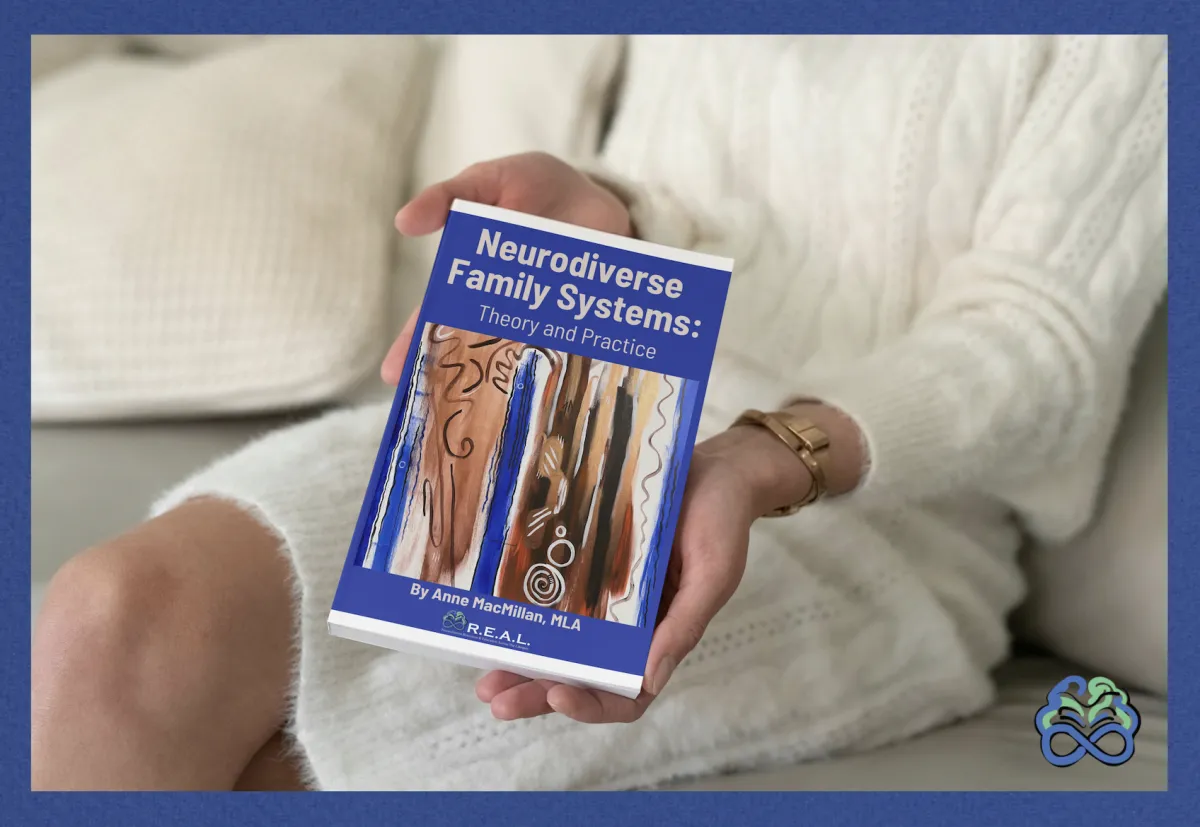
Pre-Order Your
Copy Today
Neurodiverse Family Systems: Theory and Practice
By Anne MacMillan, MLA
© 2026 R.E.A.L. Neurodiverse™
All Rights Reserved
hello@REALneurodiverse.com
Text or WhatsApp: (617) 489-2913 (United States)