The R.E.A.L.™ 10-Step Model: A Structured Framework for Every Nervous System
10 Steps. One Repeating Arc. Every Nervous System Honored.
The R.E.A.L. Neurodiverse™ 10-Step Model is not a curriculum. It is a living system you move through with your provider. It builds progressively, moves at your pace, and adapts to how you actually process things.
The ten steps provide the developmental arc. The three-stage insight pathway provides the engine. And the principle of structure with flexibility ensures that the work remains responsive to you, your relationship with your provider, and the moment.
Step by Step. Neurodiversity-Affirming. Designed for You.
What you'll find here is a framework that holds together over time. Not because it's rigid, but because every part of it is intentionally designed to reinforce every other part and the system as a whole.
Contact Your Home Provider To Get Started
What is a Neurodiverse Family System?
You may have spent your entire life living in a neurodiverse family system, without ever knowing it.

When autistic individuals, high body empathetics, attention neurodivergents (ADHD), and neurotypicals share a household or an intimate life partnership, they form a system. And like any system, every part affects every other part.
The patterns that emerge in those systems, the miscommunication, the exhausting cycles, the roles people settle into and can't seem to leave, are not signs that anyone is broken. They are the predictable result of people with genuinely different neurologies interacting with each other, often across years or decades, often without ever understanding why the same patterns keep returning.
This is the core insight of the Neurodiverse Family Systems Theory Framework that underlies R.E.A.L.: the issues are systemic, not individual. And they won't resolve through approaches that weren't designed with neurological difference in mind.
What changes things is understanding; not just of any one neurology, but of how different neurologies interact, where they misread each other, and what each person in the system actually needs in order to move forward.
The confusion wasn't a failure of effort. It was a failure of framework. Now there's a better way forward.
A Single Cycle, Repeated at Every Step
At the heart of the R.E.A.L. model is a process that repeats consistently and reliably at every step and substep of the 10-step progression. It doesn't change as the content deepens. It doesn't vary across neurologies or relational focuses. It is the same three-stage sequence every time, and that consistency is part of what makes the work so effective.
This three-stage cycle of neurodiversity-affirming education, individual integration, and relational discussion repeats at every step and every substep across the entire program.
🔃
Insight accumulates. Patterns become clearer. Each rotation of the cycle builds on the one before it.
📹
1. Neurodiversity-Affirming Education
Each step begins with structured learning that builds shared language and a neurodiversity-affirming foundation. Autistic and non-autistic clients each have their own track, and the material is further shaped for life partnerships and family relationships. Everyone starts from a place of understanding, not assumption.
🌀
2. Individual Integration
From there, you engage with the material in your own way, using tools designed to fit how your nervous system actually processes things. This is client-led exploration, with your provider facilitating and you choosing the approaches that work best for you.
🌿
3. Relational Discussion
Once individual integration is complete, the pathway can open into structured shared conversations between autistic and non-autistic participants. These conversations happen after each person has already done their own individual work. The timing matters. The preparation matters. The structure protects everyone involved.
Clients first understand the concept, then integrate it personally, and only then bring it into relationship: with real preparation behind them.
Before the Ten Steps Begin:
Three Foundational Lessons
Before you enter Step 1, the program opens with three foundational lessons that give every client a shared starting point, regardless of neurology, relational focus, or prior experience.
The first introduces the concept of neurodiversity itself and builds a shared vocabulary for neurological difference. The second helps you begin to recognize how your own neurology shapes stress, communication, and the patterns that have defined your closest relationships. The third introduces the 10-step approach directly, explaining how the program is structured and why the sequence matters.
These lessons don't create a common destination or a uniform path. They create a shared foundation from which your individual journey can unfold with clarity and direction.
The Ten Steps: A Developmental Arc
The ten steps of the R.E.A.L. model follow a deliberate developmental sequence, moving from self-understanding outward toward relational clarity, and from recognition inward toward sustainable growth. Each step builds on the one before it. Each one arrives with its own educational content, integration tools, and, when the time is right, structured relational discussion.
The progression is designed to feel like a journey rather than a checklist. It begins with grounding and self-knowledge, moves through empathy, dynamics, and trauma, and arrives at a fully integrated understanding of how neurology shapes growth over a lifetime.
The arc moves through ten distinct territories. It opens with wholeness and future orientation, establishing dignity and possibility as the starting stance before any difficult material is introduced. From there, clients build self-knowledge about their own neurology, then expand that understanding outward to the neurologies of the people they are closest to.
The middle steps deepen the work considerably. Empathy differences are explored not as deficits but as divergent processing styles, clarifying some of the most painful and persistent misunderstandings in neurodiverse relationships. Harmful patterns are named honestly, with care taken to ensure that accountability doesn't collapse into blame. Neurodiverse Relationship Dynamics™ are introduced as a full framework, connecting everything clients have learned about neurology, empathy, and pattern recognition into a coherent relational picture.
The later steps bring the work to its most complex and integrative territory: the role of trauma in neurodiverse systems, the relational roles people occupy and what those roles protect, the cycles and trauma spikes that accumulate when dynamics go unnamed, and finally a forward-looking consideration of development according to neurology, and what growth actually looks like when it's built on neurological reality rather than neurotypical expectation.
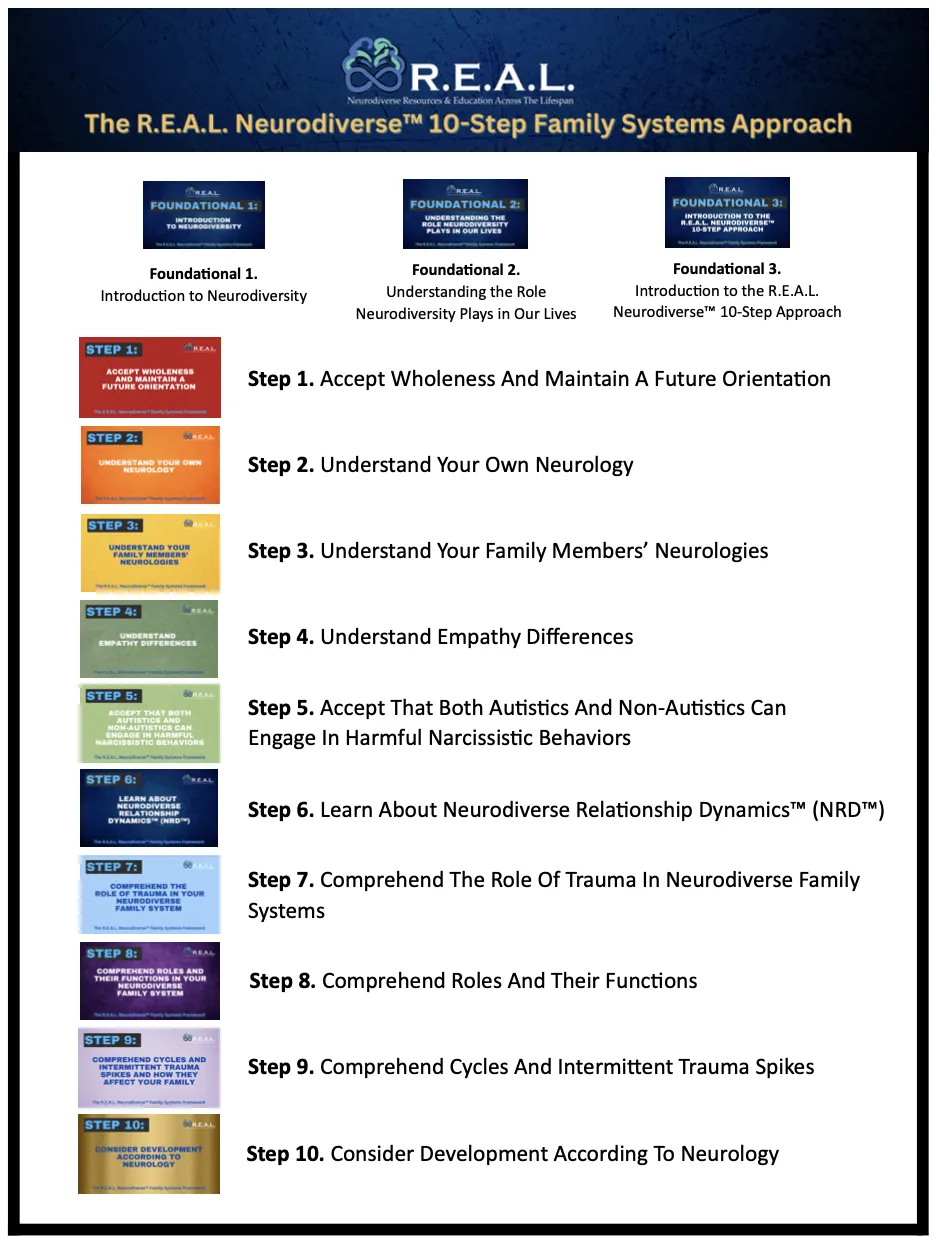
Taken together, the ten steps don't just teach. They transform the way you understand yourself, each other, and the relationships you are navigating, one carefully sequenced stage at a time.
Structure With Flexibility
A program this structured could easily feel rigid. The R.E.A.L. model is deliberately designed not to be.
Your Sessions Are Still Yours
The ten steps provide a recommended sequence, and that sequence exists for good reason. Each step builds on the one before it. The pacing supports emotional safety. The structure creates the conditions for insight to accumulate rather than fragment.

But within that structure, you and your provider have real flexibility in how the work unfolds. You might watch a video together in session and talk through it in real time. You might engage with material between sessions and bring what came up into the next conversation. You might follow your own lead entirely, letting what you discover in your own portal exploration shape where you go next.
Through your client portal, you have direct access to your own materials at every step: the educational videos, the integration tools, the reflection exercises. That access is intentional. It makes it possible to engage at the right moment, in the right way, at the pace that fits your nervous system.
There is no single right way to move through this framework. There is only the right way for you, in your relationship with your provider, at this point in your work.
What stays constant is the structure itself: the ten steps, the three-stage integration cycle, the client portal, the progressive developmental arc. That structure is always there, holding the work steady, no matter how you adapts it to meet your own needs.
“This is what it means to offer something that genuinely fits neurodiverse realities. Not a rigid protocol. Not an open-ended exploration without direction. Something in between: structured enough to provide clarity and continuity, flexible enough to honor every nervous system it serves." — Anne MacMillan, Founder of the R.E.A.L.™ Approach
Ten Steps. One Repeating Arc. Every Nervous System Honored.
The R.E.A.L. 10-Step Model gives you a clear developmental arc, a repeating three-stage process, and the flexibility to honor your own needs. The structure is already built. The work can begin as soon as you're ready.
Step in. The structure and the support are already here.
Contact Your Home Provider To Get Started


